Talking Science Podcast
Living in Space – What Zero-G Does to the Body
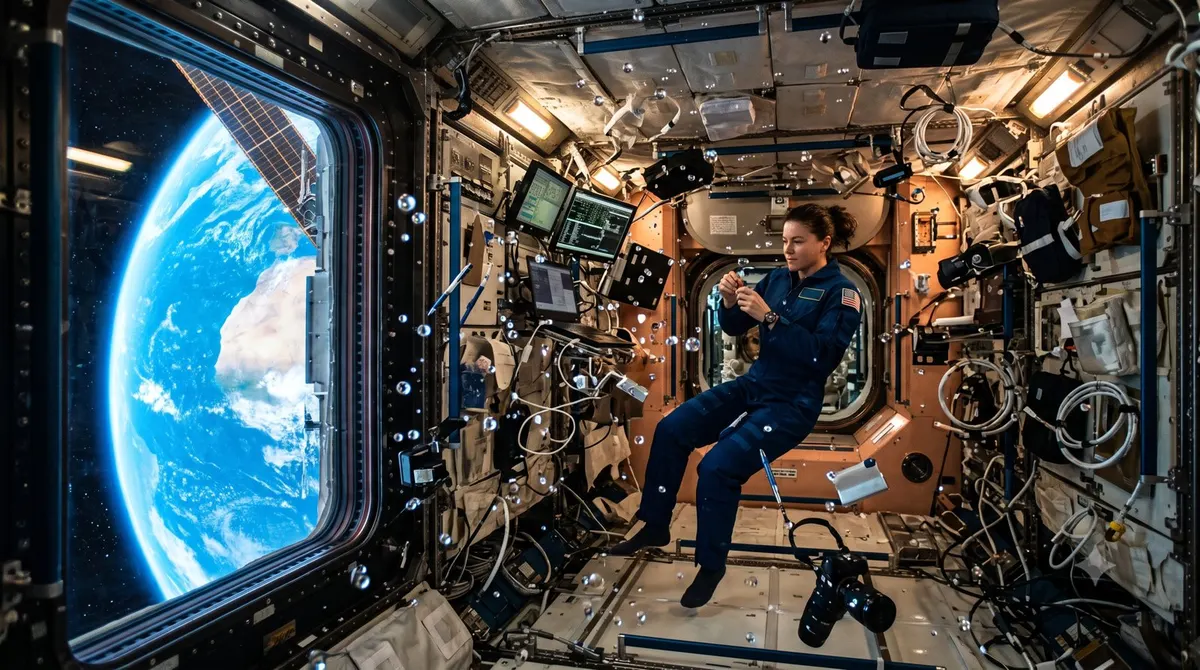
Imagine never feeling your own weight again. In orbit, astronauts float through their spacecraft, pushing off walls with a fingertip and sleeping strapped loosely to avoid drifting into equipment. It looks joyful, and it is. But beneath the playful weightlessness, something profound is happening to the human body. Evolution shaped us over millions of years to stand, walk, and work against Earth’s gravity. Take that pull away, and the body starts to quietly rewire itself in ways that are fascinating, and sometimes alarming.
Why We Say Zero-G, and What It Really Means
People often call the environment aboard a spacecraft zero gravity, but that is not quite accurate. Gravity is very much present in low orbit; it is what keeps the station circling the planet instead of flying off into space. What astronauts actually experience is continuous free fall. The station and everyone in it are falling toward Earth together, while also moving sideways fast enough to keep missing it. Because everything falls at the same rate, nothing feels any weight. Scientists call this microgravity, and it is the true cause of everything that follows.
Bones That Grow Thin
On Earth, your skeleton is under constant, gentle stress. Every step and every time you stand, your bones bear your weight, and they respond by staying strong and dense. In microgravity that load vanishes. The body, ever efficient, decides it no longer needs to maintain so much bone and begins breaking it down.
Astronauts can lose bone density in the weight-bearing parts of the skeleton, such as the hips and spine, at a rate far faster than the gradual loss seen with ageing on the ground. This is one of the most serious long-term concerns for space travel. The lost calcium also enters the bloodstream, which can raise the risk of kidney stones. To fight back, crews follow demanding exercise routines using specialised equipment that mimics resistance, essentially tricking the skeleton into thinking it is still working.
Muscles on Holiday
Muscles face a similar problem. The large muscles of the legs, back, and core spend all day on Earth holding us upright and moving us around. In space they barely have to work, and unused muscle wastes away with surprising speed. An astronaut who did nothing to counter this could return home too weak to walk comfortably.
This is why exercise is not optional on a space station; it is a core part of the daily schedule. Crews typically spend a couple of hours a day running on a treadmill with bungee cords holding them down, cycling, or pulling against resistance machines. Even with all that effort, some loss is hard to avoid, and rebuilding strength after a long mission takes weeks of rehabilitation back on the ground.
A Flood of Fluid
One of the strangest effects appears within hours of reaching orbit. On Earth, gravity pulls your blood and other fluids down toward your feet, and your body works constantly to push them back up. Remove gravity and that downward pull disappears, so fluids shift upward toward the chest and head.
The result is a puffy, flushed face and skinnier legs, sometimes described by astronauts as feeling like a permanent head cold. This fluid shift does more than change appearance. The pressure it creates around the head is now thought to contribute to changes in the eyes and vision that some astronauts experience on longer missions, a condition researchers are studying closely because it could be a real obstacle to very long journeys, such as a trip to Mars.
A Confused Sense of Balance
Deep inside your inner ear sits a delicate system of tiny structures that sense gravity and motion, telling your brain which way is up. In microgravity this system sends confusing signals. For the first few days many astronauts feel a form of motion sickness, sometimes called space adaptation syndrome, with queasiness and disorientation as the brain struggles to reconcile what the eyes see with what the balance organs report.
Most people adjust within a few days as the brain learns to rely more on vision. The catch is that returning to Earth reverses the process. Fresh from orbit, astronauts often feel dizzy and unsteady, and the simple act of standing up can be a challenge until the body relearns how to cope with weight.
There is even a curious effect on height. Freed from gravity’s constant compression, the soft discs between the bones of the spine expand slightly, and astronauts can grow a couple of centimetres taller during a mission. It is a temporary change that reverses once they are back on the ground, but it is a vivid illustration of just how much gravity shapes the body in ways we never normally notice.
The Invisible Threats
Not every hazard of space is about weightlessness. Beyond the protective bubble of Earth’s atmosphere and magnetic field, astronauts are exposed to more radiation from the Sun and from deep space. Over a long mission this raises health risks and is a major concern for future travel far from home. The isolation and confinement of living in a small crew far from everyone else also take a mental toll, which is why psychological support and careful crew selection matter as much as physical training.
Why Study This at All?
Understanding how the body copes without gravity is essential if humans are ever to live on the Moon, journey to Mars, or spend years in orbit. But the benefits reach back to Earth too. The bone loss astronauts endure resembles osteoporosis, and the muscle wasting mirrors what happens to people confined to bed. Research done for space has sharpened our understanding of both, guiding better treatments here on the ground.
The human body turns out to be remarkably adaptable, remoulding itself within days to a world without weight, then remoulding itself again on the way home. That flexibility is a marvel, but it also reveals how deeply gravity is written into who we are. Every bone, muscle, and sense of balance was tuned by a lifetime of being gently pulled toward the ground. Learning to live without that pull is one of the great challenges standing between us and the wider cosmos, and one we are steadily, ingeniously, learning to meet.