Talking Science Podcast
Mars – Why We Keep Going Back
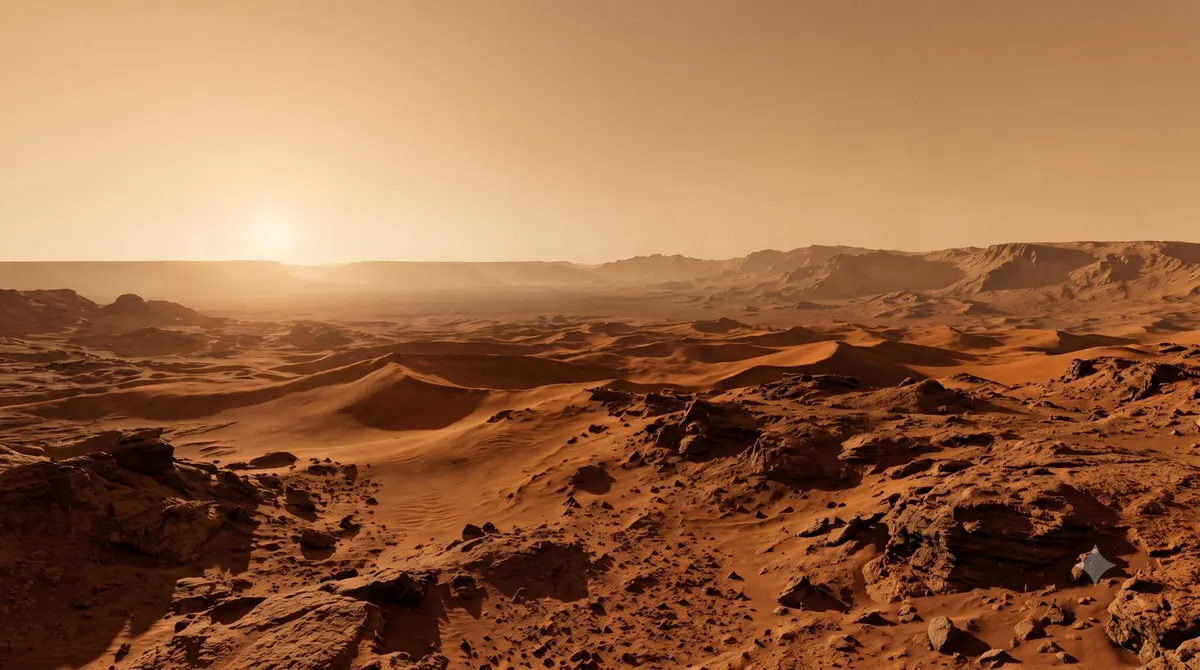
Of all the places beyond Earth, one keeps drawing us back like no other. Mars has been visited by orbiters, landers, and rovers again and again, decade after decade, by several nations. No other world in the Solar System has received anything close to this much attention. There is something about the red planet that will not let us leave it alone – and the reason is not just that it is relatively close. It is that Mars looks like a place where the story of life might have had a chance to begin.
A world that feels almost familiar
Part of the pull is how much Mars resembles a rougher, colder version of home. A day there is only slightly longer than ours, about twenty-four and a half hours. It has seasons, because like Earth it is tilted on its axis. It has polar ice caps that grow and shrink through the year, towering volcanoes, deep canyons, and vast dune fields shaped by wind. Stand on its surface and, apart from the pinkish sky and the rusty ground, the landscape can look eerily like a desert on Earth.
But the resemblance is skin deep. Mars today is brutally hostile. The air is thin – far too thin to breathe and less than one percent as dense as ours – and it is almost entirely carbon dioxide. Temperatures can climb above freezing at midday near the equator but plunge far below at night. With so little atmosphere and no protective magnetic shield like Earth’s, the surface is bathed in radiation. It is not a welcoming place. And yet the evidence says it was once very different.
The case for a wetter past
The single most important discovery about Mars is that liquid water once flowed across its surface. This is not a hunch; it is written into the landscape and the rocks. Orbiting cameras have mapped dried-up river valleys, branching channels, and the fan-shaped deltas where rivers once spilled into standing lakes. Rovers exploring the ground have found minerals that only form in the presence of water, and rounded pebbles of the kind that get smoothed by tumbling along a streambed.
Piece it together and a picture emerges of an ancient Mars, billions of years ago, that was warmer and wetter – a world with rivers, lakes, and possibly seas, under a thicker atmosphere. That matters enormously, because everywhere we find liquid water on Earth, we find life. If Mars had standing water for long stretches of time, then it once had one of the essential conditions that life, as we understand it, requires.
The question that drives everything
This leads to the question underneath nearly every Mars mission: did life ever arise there? It is worth being clear about the stakes. If we were to find even the fossil traces of ancient microbes on Mars – nothing more than the remains of simple, single-celled organisms – it would tell us that life began independently on two neighbouring worlds. And if it happened twice in one solar system, it becomes very hard to believe it is rare in the universe.
No one has found such evidence, and it is important not to overstate what we know. What the rovers have found are the ingredients and the right conditions: water, the chemical building blocks, energy sources, environments that could once have been habitable. Habitable is not the same as inhabited. Whether anything ever actually lived there remains genuinely unknown, which is precisely why the search continues.
How we explore it
Studying Mars is done in layers. Orbiters circle the planet, mapping its surface, tracking weather and dust storms, and scouting for interesting sites. Landers touch down in one spot and study it in detail. Rovers are the real workhorses – mobile laboratories that trundle across the terrain, drilling into rocks, analysing their chemistry, and photographing everything along the way. Each generation has been more capable than the last.
One of the most ambitious ideas now underway is to collect promising samples of Martian rock and soil and eventually return them to Earth. The reasoning is simple: the instruments in our laboratories are far larger and more sensitive than anything we can send to Mars, and some tests can only be done here. A rock examined under the full weight of Earth’s scientific tools could settle questions a rover never could. Getting those samples home is a formidable challenge, but the potential payoff is a definitive answer about the planet’s past.
The dream of going ourselves
Behind the robots lies a bolder ambition: sending humans. This is enormously difficult. The journey takes months in each direction. Travellers would face radiation, isolation, and the challenge of surviving on a world with no breathable air and few resources. Everything from water to fuel would have to be carried, made on site, or done without. These are not small problems, and honest timelines for a crewed landing remain uncertain.
It is worth appreciating just how much a human explorer could do that a rover cannot. A rover moves slowly and deliberately, taking days to do what a trained geologist on foot could accomplish in minutes – walking over a ridge, picking up a promising rock, recognising in an instant that a particular outcrop is worth a closer look. Human curiosity is flexible in a way that even the cleverest machine is not. The dream of boots on Martian soil is partly about adventure, but it is also about the sheer scientific power of putting a thinking explorer directly in the landscape. The trade-off is risk and enormous cost, which is why robots have gone first and will keep going for some time.
There is also the question of what living on Mars would demand of us. Any long-term presence would mean learning to extract water from the soil, to pull breathable oxygen and rocket fuel from the thin air, and to grow food far from home. In a sense, Mars is a testing ground not just for exploration but for whether humans can learn to live anywhere beyond the Earth at all.
Still, Mars endures as a goal because it sits at the intersection of so many human motives – curiosity, the urge to explore, and the question of whether Earth is the only place life has ever taken hold. We keep going back because every visit answers a few questions and raises new ones, and because the red planet may hold a clue to the deepest question we can ask: whether we are alone. Until we know, Mars will keep pulling us across the dark.