Talking Science Podcast
Metals and Alloys – The Materials That Built Civilisation
Take a metal spoon in one hand and a ceramic mug in the other, and imagine pushing hard on each. The mug cracks and shatters into sharp pieces. The spoon bends, changes shape and stays in one piece. That humble kitchen-table difference, between a material that breaks and one that gives, is one of the quiet reasons civilisation looks the way it does, and the story of how people learned to win metal from rock is one of the most inventive in human history.
A Sea of Shared Electrons
The secret sits at the scale of atoms. In a metal, each atom holds its outermost electrons only loosely. Pack billions of metal atoms together and those outer electrons stop belonging to any one atom. They drift freely through the whole structure, shared by everyone, in what scientists call a sea of electrons. The metal atoms, now positively charged, sit in orderly rows like stacked cannonballs, held together by their attraction to that surrounding negative sea.
That shared arrangement explains why metals carry electricity and heat so well, a story told in Why Metals Conduct and Plastics Do Not. It also explains the spoon. In ceramic or glass, atoms are locked by rigid bonds to particular neighbours, so a crack races straight through. In a metal, the bonding does not care which atom sits beside which, so whole layers can slide past each other, a process called slip, and the metal bends instead of breaking.
What the Blacksmith Knew
A real piece of metal is not one perfect crystal. It is a patchwork of countless tiny crystals called grains, each pointing a slightly different way, like a wall of small, irregular bricks. Inside those grains are tiny flaws called dislocations, and these are what actually let layers of atoms slip.
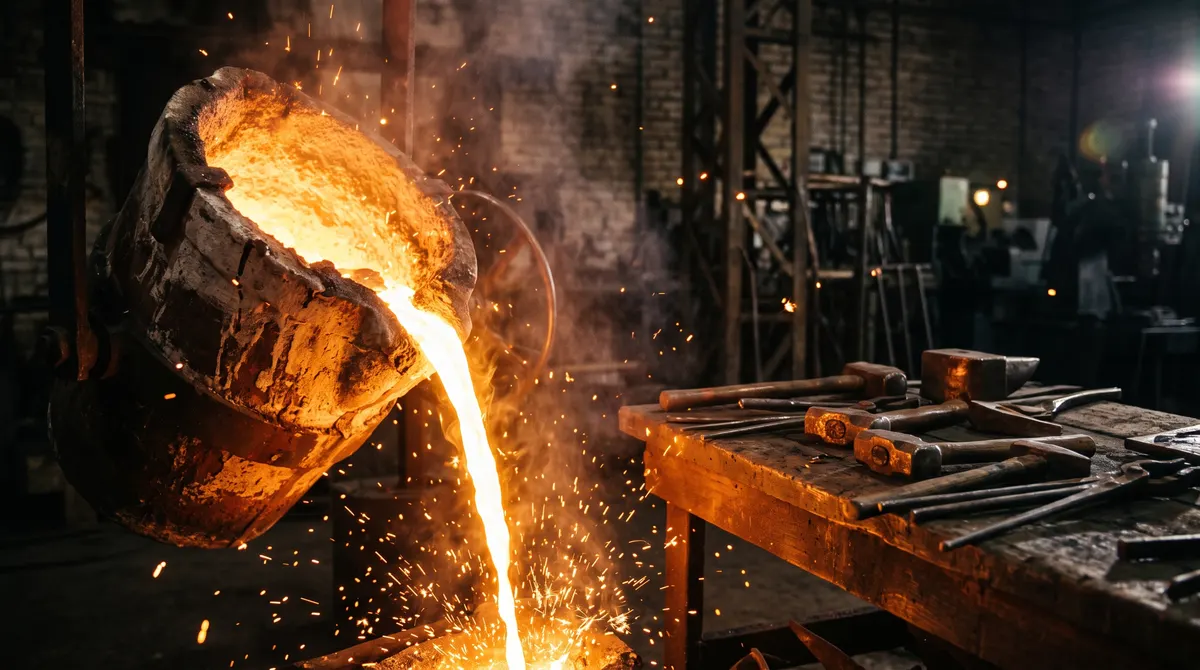
Hammer or roll a metal cold and you create more dislocations, which tangle and jam, so the metal gets harder and less bendable: work hardening. Heat it again and the atoms rearrange and smooth out the tangles, softening it once more: annealing. That is why a blacksmith keeps returning iron to the fire between rounds of hammering, knowledge used for thousands of years without anyone knowing about atoms.
Winning Metal from Rock
Most metals do not lie around in pure form. They are locked inside minerals called ores, chemically bound to oxygen, sulfur or other elements. Getting them out takes smelting: heating the ore, usually with a carbon source such as charcoal, until a chemical reaction strips away the unwanted elements and leaves purer metal behind.
For ancient peoples this was a serious feat, needing furnaces that held intense heat and hard-won knowledge of which ores and fuels worked. The earliest metals people used, gold and copper, sometimes occur in pure form and could simply be hammered into shape. Smelting opened the door to far more.
The Bronze Age Breakthrough
The real leap came when people discovered that combining two metals could produce something better than either. Bronze, mostly copper with a smaller share of tin, is much harder than pure copper and holds a sharper edge. Bronze-making spread through parts of the ancient world roughly five thousand years ago, and it mattered so much that we still name the whole era after it.
Bronze tools and weapons were a genuine step up from soft copper and stone, and an early, purely practical demonstration that mixing metals can create properties neither has alone. Why that works at the atomic level is explored in Alloys – Why Mixing Metals Makes Them Stronger.
Iron, Steel and the Industrial Leap
Iron eventually pushed bronze aside across much of the ancient world, but not because pure iron was simply better. It is actually somewhat softer than bronze. Its real advantage was availability. Iron ore is far more common and widespread than the tin needed for bronze, so communities without access to tin could make tools locally instead of depending on long-distance trade.
Early iron came from simple furnaces called bloomeries, which usually could not fully melt iron. They produced a spongy lump, the bloom, that was heated and hammered again and again to drive out impurities, giving fairly soft wrought iron. Hotter blast furnaces, forcing air into the fuel, came later.
The prize was steel: iron with a small, controlled amount of carbon, typically well under two per cent, far harder and stronger than iron or bronze yet still tough rather than brittle. For centuries it was slow and expensive to make. Then, in the mid-nineteenth century, methods such as the Bessemer process blasted air through molten iron to burn off excess carbon, and cheap steel soon reshaped railways, bridges, ships and buildings.
Designing Metals Like Recipes
Deliberately adding small amounts of other elements to a base metal to tune its behaviour is called alloying, and it runs from ancient forges to modern laboratories. A few examples show how precise the recipes have become:
- Stainless steel: steel with at least around 11 per cent chromium, which forms a thin, tough, invisible layer of chromium oxide that clings to the surface and repairs itself if scratched.
- Brass: copper with zinc, harder than copper and golden in colour, long favoured for fittings and musical instruments.
- Shape-memory alloys: carefully engineered metals that can be bent out of shape and then spring back to a set form when warmed, used in things like flexible eyeglass frames and medical stents.
Alloying also fights corrosion. Ordinary rust is iron oxide, but unlike the film on stainless steel it is porous and flaky, falling away to expose fresh iron so the damage creeps deeper. Paint keeps air and moisture out, while galvanising coats steel in zinc, which corrodes first and sacrifices itself to protect the steel.
The Metal Once Worth More Than Gold
Aluminium has the strangest story of all. It is the most abundant metal in Earth's crust, more common than iron, yet well into the nineteenth century it was rare and prized, at one point valued more highly than gold and reportedly used for fine tableware at state banquets. The problem was never a shortage of ore. Aluminium binds to oxygen so tightly that the chemical methods of the day could free it only with enormous effort.
The breakthrough came in 1886, when the American chemist Charles Martin Hall and the French engineer Paul Héroult, working independently, found essentially the same answer: dissolve aluminium oxide in a molten mineral bath and pass a strong electric current through it. Arriving just as large-scale electricity became available, it sent the price collapsing within years. The same basic method still runs aluminium smelters worldwide, including those supplied by Australia, one of the world's largest producers of bauxite, the ore aluminium comes from.
The lesson is a striking one. How hard a material is to produce, not simply how much of it exists in the ground, often decides whether it becomes part of everyday life.
A Willingness to Share
Bend a paperclip, stir a pot or rinse a stainless steel sink, and you are relying on that invisible sea of electrons. Thousands of years of furnaces, hammering and, eventually, real understanding turned malleable rocks into bronze blades, steel bridges and aluminium wings. All of it rests on one simple fact about metal atoms: they are willing to share.