Talking Science Podcast
Crystals – Order Inside Solids
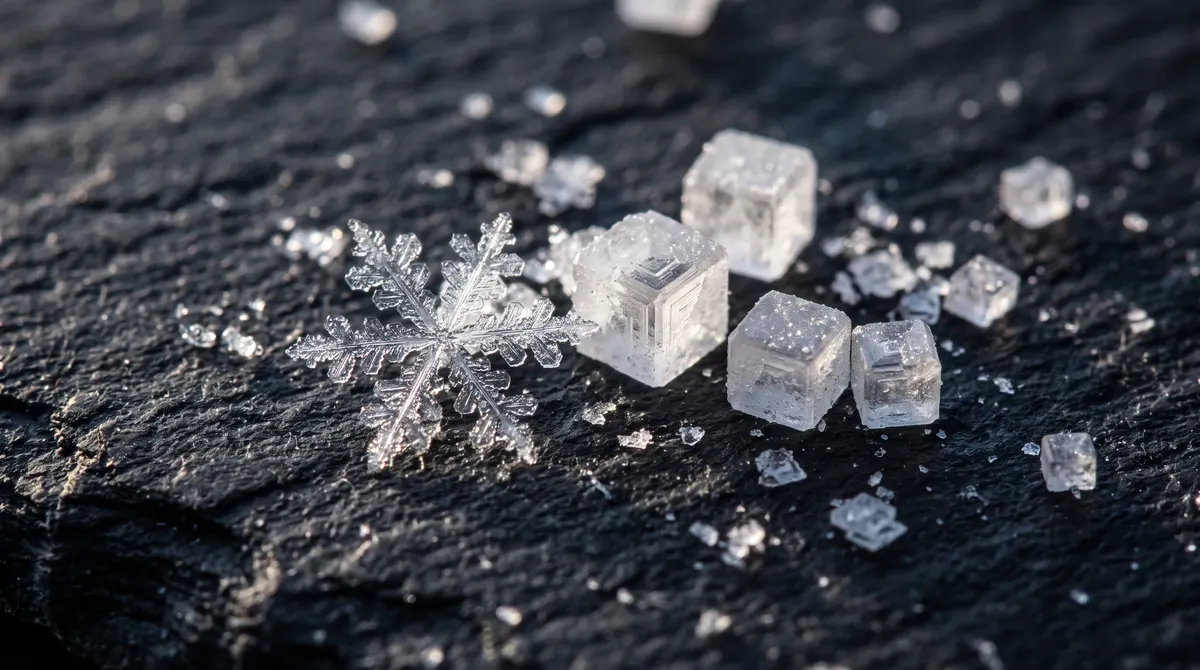
Tip a little table salt onto a dark plate and look closely, ideally with a magnifying glass. Almost every grain is a tiny cube, with flat faces meeting at crisp right angles, as if someone had carved each one by hand. Nobody did. Every one of those cubes built itself, simply because of how sodium and chlorine, the two ingredients of salt, prefer to arrange themselves when they get the chance.
That hidden preference for repeating order is what a crystal is. It explains salt grains and snowflakes, keeps quartz watches on time, revealed the shape of DNA and makes computer chips possible.
What Makes a Crystal a Crystal
In science, "crystal" means something specific: a solid whose atoms, ions or molecules are arranged in an orderly, repeating three-dimensional pattern called a crystal lattice. One small basic arrangement, the unit cell, is stacked identically in every direction millions or billions of times to build even a tiny visible grain.
Ordinary glass, by contrast, is an amorphous solid: its atoms are jumbled, like a heap of building blocks rather than a neatly laid wall. Both hold their shape, but only a crystal has deep internal order.
Why Crystals Have Flat Faces
That order produces the flat faces and sharp angles of a salt grain. As a crystal grows, arriving atoms settle into the spots that fit most snugly into the existing lattice, as oranges in a crate settle into tidy rows. The outside shape becomes a magnified echo of the atomic arrangement inside.
Salt packs into a cubic lattice, so it grows cubes. Quartz, made of silicon and oxygen, packs into a hexagonal pattern and grows six-sided prisms. The faces are not decoration. They are geometry made visible, decided at the scale of individual atoms.
Growing Crystals: From Jars and from Fire
Crystals form in two main ways. The first is growth from solution. Dissolve as much sugar as you can in hot water, then let it cool or evaporate. The water can no longer hold it all, and the excess deposits itself, molecule by molecule, onto a seed crystal or a piece of string, building rock candy over days. Mineral-rich water seeping through rock builds natural crystals the same way over thousands of years.
The second is growth from a melt. Magma cooling slowly deep underground gives its minerals time to grow large, which is why polished granite shows big interlocking crystals. Lava cooling fast at the surface leaves atoms little time to find their places, producing tiny crystals or even obsidian, a volcanic glass with no crystal structure at all.
Some crystals last almost unimaginably long. Tiny zircon crystals from the Jack Hills in Western Australia are around 4.4 billion years old, the oldest known pieces of Earth's crust.
Seeing Atoms with X-rays
For a long time nobody could see inside a lattice. Then came X-ray crystallography. X-rays have a wavelength close to the spacing between atoms, so a beam passing through a crystal scatters off the regularly spaced atoms and interferes with itself, producing a pattern of spots that is a decodable fingerprint of the atomic arrangement.
Australia has a special place in this story. Working out how to read those patterns was pioneered by William Henry Bragg and his son William Lawrence Bragg, who grew up in Adelaide. They shared the 1915 Nobel Prize in Physics, and Lawrence remains one of the youngest Nobel laureates in science.
Its most famous moment came in the early 1950s at King's College London, where Rosalind Franklin, working in the same laboratory as Maurice Wilkins, produced a remarkably clear X-ray image of DNA known as Photo 51, pointing strongly to a helix. That image and other unpublished King's data were shown to James Watson and Francis Crick and proved decisive in their 1953 model of the DNA double helix. Watson, Crick and Wilkins shared the 1962 Nobel Prize. Franklin had died in 1958, and the prize is not awarded posthumously, but her central role is now widely recognised.
The technique is still a workhorse, used to map proteins atom by atom. Since many medicines fit a pocket on a protein like a key in a lock, seeing the lock makes designing the key far easier.
Colour from Atoms Out of Place
If lattices are so orderly, why are gemstones so colourful? Usually the answer is a few atoms that do not belong. Pure aluminium oxide, called corundum, is colourless. But as it grows in nature, other atoms sometimes slip into the lattice in place of aluminium:
- A little chromium turns corundum deep red: ruby.
- Iron and titanium turn it blue: sapphire.
- In quartz, trace iron combined with natural background radiation produces purple amethyst.
Ruby and sapphire are, underneath their colour, the same mineral. The lattice is unchanged. A rare atom out of place simply alters how the crystal handles light.
Quartz Watches and Perfect Silicon
Some crystals do real work because of their lattice. Quartz's atomic arrangement is slightly lopsided, so squeezing a quartz crystal distorts it enough to produce a small voltage, an effect called piezoelectricity. It works in reverse too: apply a voltage and the crystal flexes very slightly.
Cut quartz precisely, give it a small voltage, and it vibrates at an extremely steady frequency, tens of thousands of times per second. A quartz watch counts those vibrations, keeping time more accurately and cheaply than springs and gears. The same effect sparks push-button lighters and drives medical ultrasound.
Computer chips need crystal perfection of another kind: silicon grown as a single continuous crystal, because boundaries between differently oriented regions disrupt the flow of electrons. In the Czochralski process, a seed crystal is dipped into molten silicon and slowly drawn up while rotating, so new silicon freezes on in perfect continuation of its lattice. The ingot is sliced into wafers that become chips, as described in Semiconductors – The Brains of Modern Technology.
Snowflakes and Crystal Myths
Why is every snowflake six-sided, yet never quite the same? Water molecules link through hydrogen bonds into a hexagonal lattice when they freeze. A snowflake begins as a tiny hexagonal crystal in a cloud, and vapour freezes fastest onto its six exposed corners, growing branching arms. All six arms pass through the same tiny pocket of air at the same moment, so they grow alike. But no two flakes take exactly the same path, and branching is extremely sensitive to small changes in temperature and moisture. Symmetric within a flake, unique between flakes.
That leaves one popular claim: that crystals like amethyst or rose quartz can heal illness or balance energy. There is no known mechanism by which an inert mineral could store or transmit such energy, no instrument has reliably measured one, and controlled studies have not found effects beyond placebo, the real but non-specific improvement driven by expectation. That is very different from piezoelectricity, which is precisely measured and used in devices every day.
Order Without a Designer
Salt on a plate, a snowflake on a sleeve, a quartz watch on a wrist: in each case countless atoms, left to themselves, settle into the most stable repeating arrangement and build precise geometry nobody had to carve. From a grain of salt to the double helix, that quiet order is one of the most far-reaching ideas in science.