 Talking Science Podcast
Neutrinos – The Ghost Particles
Stand in the sunshine and you feel its warmth. What you don't feel, and never will, are the roughly hundred trillion tiny particles from the Sun passing straight through your body every second. They pass through you, through the ground under your feet and, for the most part, through the entire planet. Even at night they arrive, up through the Earth.
They are neutrinos, nicknamed the ghost particles, among the most abundant and least sociable things in the universe. Their story runs from a desperate idea to rescue a law of physics, through a decades-long mystery about the Sun, to a telescope built from Antarctic ice.
A Particle Invented to Save a Law
In the early twentieth century, physicists studying beta decay, a kind of radioactivity in which an unstable nucleus spits out an electron and becomes a slightly different nucleus, hit a problem. Energy is supposed to be conserved, never created or destroyed. Each electron should have emerged with the same predictable energy. Instead they came out with a whole spread of energies, as if some energy was going missing.
In 1930 the Austrian physicist Wolfgang Pauli suggested another way out, in a half-joking letter to colleagues at a meeting he couldn't attend. Perhaps the missing energy was carried off by an unseen particle with no electric charge and a tiny mass, so unwilling to interact with matter that no detector could catch it. Pauli was reportedly uneasy, worried he had proposed something that might never be observed. A few years later the Italian physicist Enrico Fermi built the idea into a proper theory of beta decay, and the particle took the Italian name neutrino, meaning little neutral one.
Why They're So Hard to Catch
Neutrinos ignore almost everything because the only force through which they meaningfully touch ordinary matter is the weak nuclear force, which really is feeble. (The full line-up of nature's forces is in The Four Fundamental Forces.) With no electric charge, they are untouched by the electromagnetic interactions that stop light in its tracks. A neutrino can cross thousands of kilometres of solid rock with only a tiny chance of hitting an atomic nucleus.
In 1956, Clyde Cowan and Frederick Reines found a way. They placed a large tank of water, laced with a chemical chosen to give a distinctive double flash of light when a neutrino struck a proton, right beside a nuclear reactor. Reactors produce neutrinos in colossal numbers, so even though almost every one sailed through, a handful were bound to hit. They did, confirming Pauli's idea about twenty-five years after he made it. Reines shared the Nobel Prize in Physics in 1995; Cowan had died before it was awarded.
That strategy, build something huge, shield it and let overwhelming numbers work for you, still defines neutrino physics. Detectors are buried deep underground or in ice to block the constant drizzle of cosmic-ray particles that would drown out the rare real signal. Japan's Super-Kamiokande, beneath a mountain, holds around 50,000 tonnes of ultrapure water watched by thousands of light sensors waiting in darkness for faint flashes.
The Case of the Missing Solar Neutrinos
The fusion reactions that turn hydrogen into helium in the Sun's core also release neutrinos, which fly straight out and reach Earth about eight minutes later. The energy that becomes sunlight, by contrast, takes many thousands of years to jostle its way to the surface. Solar neutrinos are a live report from inside a star, whose engine is explored in Nuclear Fusion – The Star in a Bottle.
From the 1960s, Raymond Davis Jr ran a detector deep in the Homestake gold mine in South Dakota, using a huge tank of dry-cleaning fluid. He found only about a third of the neutrinos solar theory predicted. Later experiments based on a different element, gallium, also found a shortfall. With independent methods agreeing, this solar neutrino problem couldn't be written off as one experiment's quirk. Either our understanding of the Sun was wrong, or our understanding of neutrinos was.
Shape-Shifting Particles
The answer lay with the neutrino. There are three types, or flavours: electron, muon and tau neutrinos. The Sun makes only electron neutrinos, and Davis's detector could only see that type. The missing two-thirds had changed flavour on the way to Earth. This is neutrino oscillation, a quantum effect in which a neutrino's type shifts back and forth as it travels.
The decisive evidence came in the early 2000s from the Sudbury Neutrino Observatory in Canada, built deep in a working nickel mine and filled with heavy water. It could count electron neutrinos alone and all three flavours together, and the total matched solar theory almost perfectly. The Sun's physics had been right all along.
There was a bonus. A particle can only oscillate like this if it has mass, so neutrinos, long assumed massless, must weigh something. The 2015 Nobel Prize in Physics went to Takaaki Kajita and Arthur McDonald for showing it. Exactly how much each flavour weighs, and even which is heaviest, is still an open question several experiments are now chasing.
Supernova 1987A: Beating Light to the Punch
On 23 February 1987, detectors in several countries, including Kamiokande-II in Japan, the forerunner of Super-Kamiokande, recorded a brief burst of neutrinos within seconds. Hours later, astronomers spotted a new point of light in the Large Magellanic Cloud, a neighbouring galaxy in the southern sky. Supernova 1987A was visible to the naked eye from the Southern Hemisphere, including Australia.
The neutrinos arrived first because they escaped the collapsing core straight away, while the light had to fight through the star's outer layers. Detectors had caught a star's death before anyone could see it, launching a new field: neutrino astronomy.
A Telescope Made of Antarctic Ice
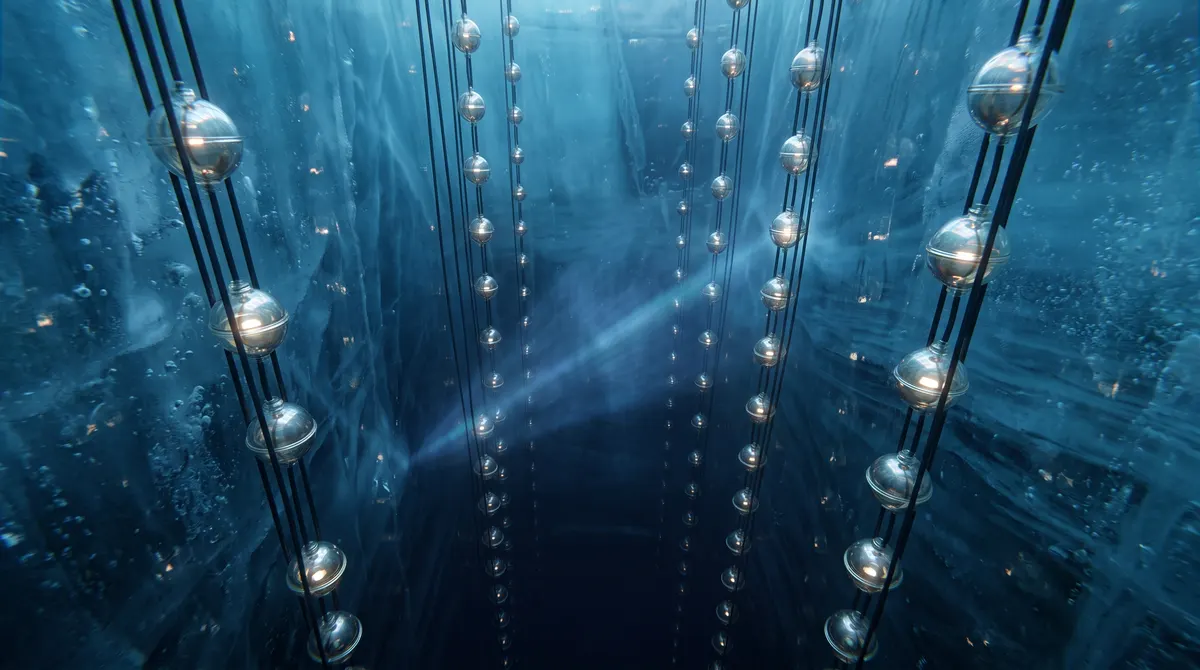
At the South Pole, IceCube was built by drilling more than 80 holes into the ice sheet and lowering strings of light sensors to depths of roughly one and a half to two and a half kilometres, turning a cubic kilometre of ice into a detector. When a high-energy neutrino hits a nucleus there, the charged particles produced can outpace light's speed in ice, giving off a faint blue glow called Cherenkov radiation, a kind of optical sonic boom. The sensors map that glow to trace where the neutrino came from.
Since reaching full operation in 2010, IceCube has detected neutrinos from far beyond our galaxy. In 2017 it caught one high-energy neutrino traced back to a flaring blazar, a giant black hole in a distant galaxy firing a jet almost straight at us, while telescopes saw the same source brightening at the same time. Combining neutrinos with light, called multi-messenger astronomy, opens a window on violent events ordinary telescopes can't fully see.
Closer to home, geoneutrinos from decaying uranium and thorium inside the Earth help geophysicists estimate how much of the planet's internal heat comes from radioactivity.
Not Bad for a Ghost
Even sitting perfectly still, you are being crossed by around a hundred trillion of these particles every second, particles their own inventor feared would never be found. It took about twenty-five years to catch the first, decades more to learn they come in three flavours and carry mass, and less than a century in all to turn Pauli's uneasy guess into a cubic kilometre of Antarctic ice that traces violent events in faraway galaxies. Not bad for a particle nobody was ever supposed to see.