Talking Science Podcast
Neutron Stars – Matter at the Edge of Impossible
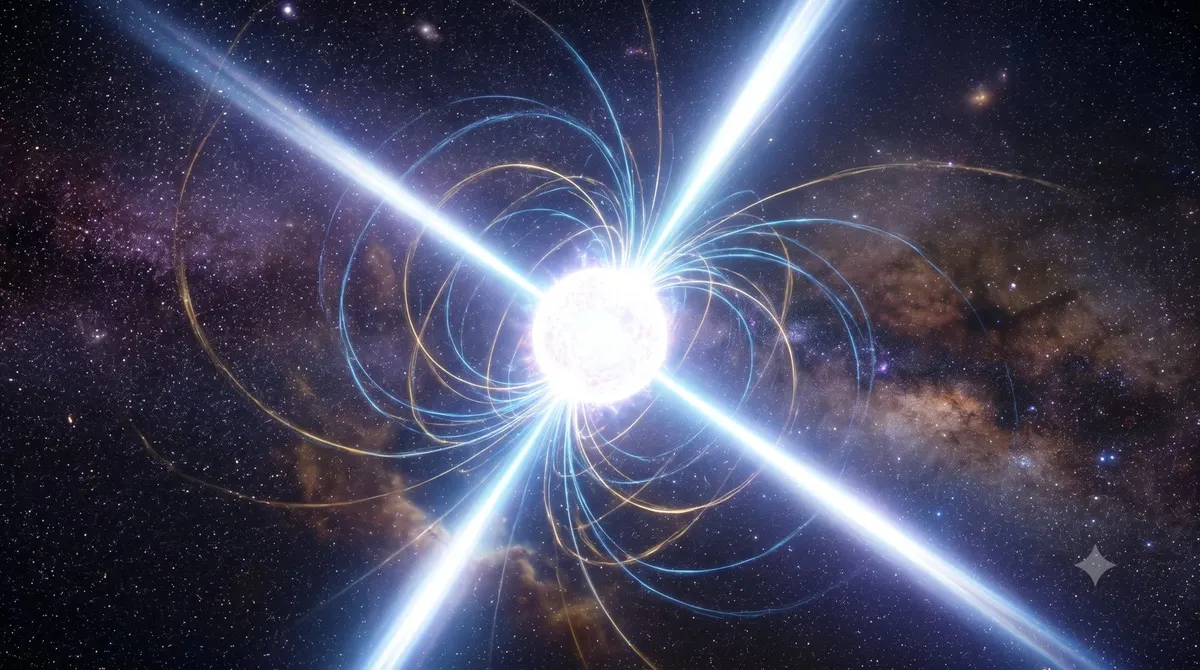
Picture squeezing the entire mass of the Sun into a ball small enough to fit inside a city. Picture that ball spinning hundreds of times every second, gripped by gravity billions of times stronger than Earth’s, wrapped in a magnetic field so intense it would scramble the atoms in your body from thousands of miles away. This is not imagination running wild. This is a neutron star, one of the most extreme objects that exists, sitting at the very edge of what matter can endure.
Born From Catastrophe
Neutron stars are what remains after a massive star dies. When a star far heavier than our Sun runs out of fuel, its core collapses in an instant and the outer layers blast away in a supernova explosion. If the surviving core lands in a certain range of mass, gravity crushes it beyond anything in ordinary experience, but not quite enough to form a black hole. What is left is a neutron star.
The crushing is almost beyond belief. Under such pressure, the ordinary structure of atoms cannot survive. Electrons are forced into protons, and together they become neutrons. The entire object turns into a densely packed sphere of these particles, which is where the name comes from. A typical neutron star is only about a dozen miles across, yet it can weigh more than the Sun.
Density Beyond Comprehension
The numbers involved are hard for the human mind to grasp. On a neutron star, a single teaspoon of material would weigh billions of tons, comparable to a mountain compressed into your kitchen spoon. The matter is packed so tightly that it approaches the density found inside the nucleus of an atom, effectively turning the whole star into one gigantic atomic nucleus.
This makes neutron stars natural laboratories for physics we can never recreate on Earth. No experiment in any lab can reach such densities, so studying these stars gives physicists a rare window into how matter behaves when pushed to the absolute limit. What exactly happens deep in a neutron star’s core remains one of the intriguing open questions in modern science.
The surface of a neutron star is strange too. Its gravity is so fierce that any mountain rising from the crust could be no more than a fraction of an inch tall, since the pull flattens everything into an almost perfect sphere. Yet that same crust is thought to be fantastically strong, far tougher than steel. When the crust occasionally cracks and shifts, the tiny rearrangement can send out detectable bursts of energy, giving astronomers a rare glimpse of the physics playing out on a surface we can never visit.
Lighthouses of the Cosmos
Many neutron stars spin, and they spin astonishingly fast. Just as a spinning ice skater speeds up when pulling in their arms, a collapsing stellar core whirls faster as it shrinks. Some neutron stars complete hundreds of full rotations every single second, their surfaces moving at a significant fraction of the speed of light.
Some of these spinning stars beam out streams of radiation from their magnetic poles. If that beam happens to sweep across Earth, we detect a pulse of energy with each rotation, as regular as a ticking clock. These are called pulsars, and when the first one was discovered, its signal was so precise and rhythmic that astronomers briefly wondered, half in jest, whether it might be a message from another civilization. In fact it was a natural lighthouse, its beam sweeping the galaxy.
Magnetic Monsters
Neutron stars carry some of the strongest magnetic fields known to exist. The most extreme examples, called magnetars, have fields so powerful they are almost impossible to describe in everyday terms. Such a field could erase the data on a credit card from the distance of the Moon, and up close it would distort the very shape of atoms.
These magnetic titans occasionally unleash sudden, violent bursts of energy as their fields shift and snap. A single flare from a magnetar can release more energy in a fraction of a second than our Sun produces in a very long time. When one such burst swept through the solar system in the past, it briefly disturbed the upper atmosphere of Earth, even though the source lay far across the galaxy.
When Neutron Stars Collide
Sometimes two neutron stars orbit each other, locked in a slow, inward spiral that can last for ages. As they draw closer they whirl faster and faster, until finally they crash together in a cataclysm that ranks among the most energetic events in the universe. Scientists have actually detected such a collision, observing it in two completely different ways at once.
First came ripples in spacetime itself, gravitational waves radiating outward from the merging pair. Then came a flash of light across many wavelengths. This double detection was a landmark moment, and it revealed something profound: neutron star collisions are cosmic forges that create heavy elements, including gold and platinum. The precious metals we treasure on Earth were, at least in part, born in these violent unions.
Why They Matter
Neutron stars are far more than exotic curiosities. They help us understand the fundamental behavior of matter, they serve as extraordinarily precise natural clocks, and they play a key role in seeding the universe with heavy elements. Consider what these small stars teach us:
- How matter behaves at the highest densities in nature
- How the heaviest elements are forged in the cosmos
- How to test the laws of gravity in extreme conditions
They occupy a remarkable place in the cosmic order, right at the boundary between an ordinary dead star and a black hole. Push a neutron star a little heavier, and gravity would win completely, collapsing it into a point from which nothing escapes. That neutron stars exist at all, balanced on this knife’s edge, is a testament to the delicate interplay of forces that shapes our universe. They are matter at the edge of impossible, and the fact that we can study them from a quiet planet like Earth is one of the quiet triumphs of human curiosity.