Talking Science Podcast
Our Moon – How It Formed and Why It Matters
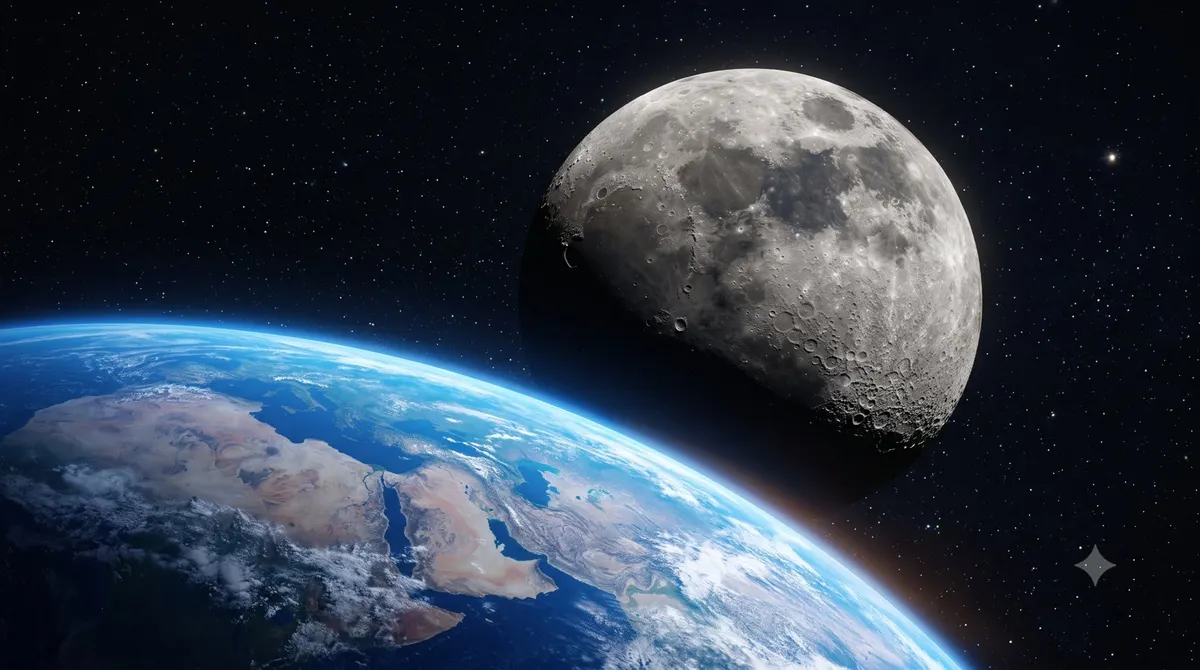
Step outside on a clear night and there it is, the most familiar object in the sky. We rarely give the Moon a second thought, yet it is one of the strangest and most consequential bodies in the solar system. It is unusually large compared to the planet it circles, it keeps one face permanently turned toward us, and it may be part of the reason life on Earth got the stable, gentle conditions it needed to flourish. The story of how it came to be is one of the great detective tales of modern science.
A Violent Birth
For a long time nobody could agree on where the Moon came from. Some thought Earth had captured a passing body. Others imagined the two had formed side by side from the same swirling cloud of dust. A third idea suggested a fast-spinning young Earth had flung off a chunk of itself. Each explanation ran into trouble when scientists looked closely at the numbers and the rocks.
The leading answer today is the giant-impact hypothesis. Roughly four and a half billion years ago, when the solar system was young and crowded, a Mars-sized body is thought to have slammed into the early Earth. The collision was so enormous that it melted much of our planet and threw a vast plume of vaporized rock into orbit. Over a surprisingly short time, perhaps only centuries, that debris gathered itself together and cooled into the Moon we know.
What makes this idea so persuasive is the evidence brought back by the Apollo astronauts. The rocks they collected are remarkably similar in composition to Earth’s own mantle, which fits the notion that the Moon is largely made of material blasted off our planet. The Moon is also strikingly poor in iron, exactly what you would expect if it formed from Earth’s outer layers rather than its dense metal core.
A World Frozen in Time
Earth is a restless planet. Wind, rain, and shifting continents constantly erase its past. The Moon is the opposite. With almost no atmosphere and no flowing water, its surface has changed little over billions of years. Every crater is a preserved record of an ancient impact, and the dark plains we see with the naked eye, called maria, are vast sheets of hardened lava from a time when the Moon’s interior was still warm.
Because it is so well preserved, the Moon serves as a kind of history book for the whole inner solar system. By counting craters and dating lunar rocks, scientists have pieced together the timeline of the bombardment that battered all the young planets, including our own. Earth surely took the same beating, but its scars have long since healed. The Moon still wears them plainly.
Master of the Tides
The Moon’s most obvious effect on daily life is the tides. Its gravity tugs on Earth’s oceans, pulling the water into a bulge that follows it around. As our planet rotates, coastlines pass in and out of these bulges, giving most shores two high tides and two low tides each day. The Sun adds its own gentler pull, and when Sun and Moon line up, we get the especially large spring tides.
Tides are more than a curiosity for beachgoers. Many coastal ecosystems depend on the rhythmic rise and fall of the water, and some researchers suspect that tidal pools, repeatedly wetted and dried, may have played a role in the chemistry that led to life. The Moon’s steady pull has been shaping shorelines and living things for a very long time.
The Anchor of Our Seasons
There is a subtler gift the Moon gives us. As Earth spins, it wobbles slightly, and its axis is tilted, which is what gives us seasons. Without a large moon, that tilt could swing wildly over long stretches of time, driving dramatic and chaotic shifts in climate. Our massive companion acts like a stabilizer, keeping the tilt within a fairly narrow range. Many scientists think this steadiness has helped Earth maintain the relatively mild, predictable climate that complex life needs, though the exact importance is still debated.
Look closely and you will notice something else. The Moon always shows us the same face. This is not a coincidence but the result of tidal forces that long ago slowed its spin until its rotation matched its orbit, a condition called tidal locking. The far side, often wrongly called the dark side, receives just as much sunlight as the near side. We simply never see it from the ground.
Why We Keep Going Back
Half a century after the first footprints, the Moon is once again a destination. Space agencies and private companies are planning new missions, drawn by scientific questions and practical possibilities alike. Frozen water hides in permanently shadowed craters near the poles, and that ice could one day supply drinking water, breathable oxygen, and even rocket fuel for journeys deeper into space.
The Moon also offers a quiet, stable platform for astronomy and a natural stepping stone toward Mars. Learning to live and work on another world, just three days away, is a sensible rehearsal before we venture farther. In that sense the Moon is both an ancient relic and a doorway to the future.
There is a poetry to this renewed interest. The same worn face that guided ancient sailors and inspired countless myths is now a laboratory and a launchpad. Robotic landers are mapping its poles, testing its dusty soil, and scouting sites where future crews might stay for weeks rather than hours. The goal is no longer simply to visit but to learn how to remain, turning the Moon from a place we once touched into a place we might genuinely use.
Its scientific value keeps growing as well. Rocks still waiting to be collected could sharpen our timeline of the early solar system and settle lingering questions about exactly how the giant impact unfolded. Because the Moon has no muffling atmosphere and its far side is shielded from the constant radio chatter of Earth, it offers an unusually quiet perch from which to listen to the faint signals of the distant universe. Few places are better suited to certain kinds of astronomy.
So the next time you glance up at that pale, cratered disc, remember what you are really seeing: the frozen aftermath of a cosmic collision, the engine of the tides, a stabilizer for our climate, and a preserved record of our own beginnings. The Moon is not just a companion to Earth. In many ways it helped make Earth the world we know.