 Talking Science Podcast
Plate Tectonics – The Moving Skin of the Earth
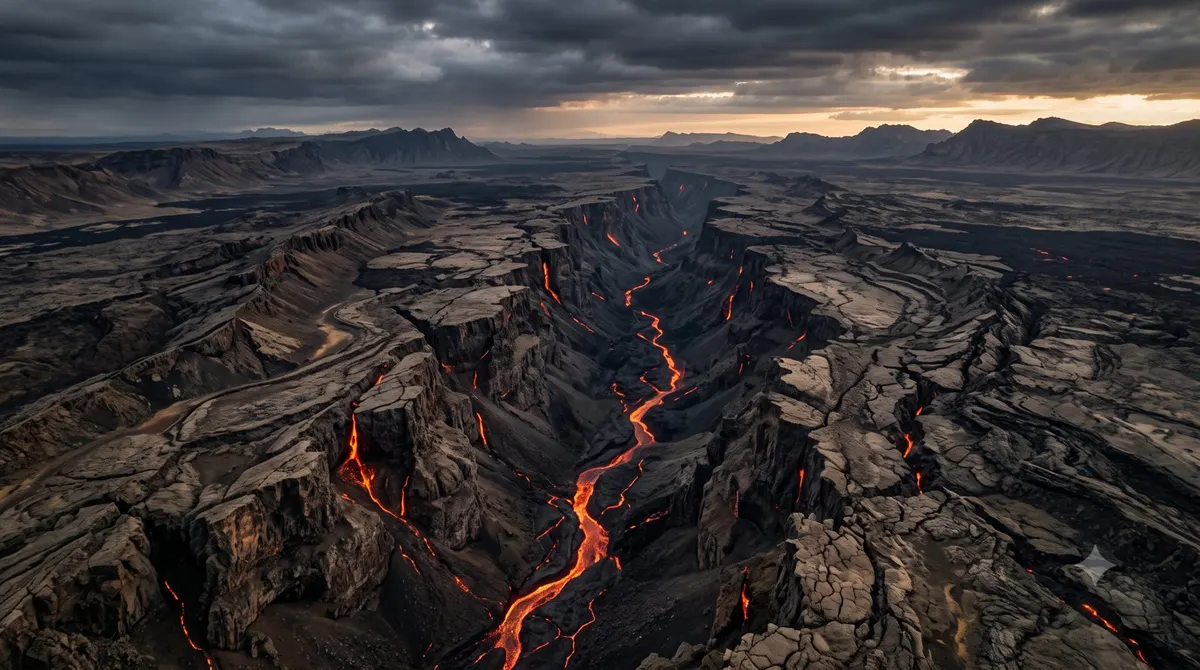
Look at a world map and let your eye wander along the coastlines. The bulge of Brazil seems to fit snugly into the hollow of West Africa, like two pieces of a puzzle drifted apart. This is not a trick of the imagination. Those continents really were joined once, and they have since travelled thousands of kilometres to reach where they sit today. The ground beneath our feet, which feels so solid and permanent, is in fact slowly and endlessly on the move.
A Cracked Shell Riding on Warm Rock
The Earth is not solid all the way down. Its outer layer, the part we live on, is a relatively thin, rigid shell of rock. Beneath it lies the mantle, a vast region of hot rock that, over long stretches of time, can flow slowly like extremely stiff putty. The rigid shell above is not a single unbroken piece. It is fractured into a set of enormous slabs called tectonic plates, fitting together like the cracked shell of a boiled egg.
There are around a dozen major plates and many smaller ones. Some carry whole continents on their backs; others lie mostly beneath the oceans. Each plate creeps along at roughly the speed your fingernails grow, a few centimetres a year. That sounds impossibly slow, and it is, for a human lifetime. But given millions of years, those tiny yearly steps add up to journeys across the entire globe.
What Keeps the Plates Moving
Why do the plates move at all? The engine lies in the heat within our planet. The deep interior is extremely hot, warmed partly by heat left over from Earth’s fiery birth and partly by natural radioactivity in the rocks. This heat drives slow churning motions in the mantle, where hotter material tends to rise and cooler material sinks, much like the lazy circulation you might see in a pot of thick soup on a low flame.
These slow motions tug and drag on the plates above. Where hot rock rises and spreads, plates are pushed apart. Where a cold, dense plate sinks back into the mantle, it pulls the rest of the plate along behind it, rather like a tablecloth sliding off a table under its own weight. Together these forces keep the great slabs drifting, colliding and grinding for hundreds of millions of years.
Three Kinds of Boundary
The real drama of plate tectonics happens at the edges where plates meet. Geologists recognise three main kinds of boundary, and each shapes the landscape in its own way.
- Where plates pull apart, hot rock rises to fill the gap and forms new crust. This happens along great ridges hidden beneath the oceans, where the seafloor is quite literally being created.
- Where plates push together, something has to give. One plate may dive beneath the other and sink into the mantle, or two continents may crumple against each other and throw up mountains.
- Where plates slide past one another sideways, they grind and stick and jolt, releasing their tension as earthquakes.
Almost every great feature of the Earth’s surface can be traced back to one of these boundaries.
Mountains, Oceans and Fiery Rings
Consider the Himalayas, the highest mountains on Earth. They exist because the plate carrying India has been ploughing into the plate carrying Asia for tens of millions of years. Neither continent will sink, so the rock between them buckles upward, and it is still rising today. The mighty Andes, running down the western edge of South America, tell a different version of the same tale, built where an ocean plate dives beneath the continent.
The oceans themselves are products of plate motion. The Atlantic Ocean grows a little wider each year as the seafloor spreads down its middle, slowly carrying the Americas away from Europe and Africa. Around the rim of the Pacific lies a horseshoe of volcanoes and earthquakes so active it is nicknamed the Ring of Fire, marking the boundaries where the Pacific plates plunge beneath their neighbours.
A Story Written in Deep Time
Plate tectonics unfolds over spans of time that dwarf human history. The continents we know are only the latest arrangement in a long dance. Hundreds of millions of years ago, the land was gathered into a single supercontinent, which then broke apart into the pieces we recognise today. Long before that, other supercontinents formed and split. Given enough time, the continents will gather again into new shapes we can only guess at.
Scientists pieced this story together from many clues: matching rock formations and fossils on continents now separated by oceans, the pattern of magnetism frozen into seafloor rocks, and precise measurements from satellites that can now track the plates inching along in real time. What once seemed a wild idea is today one of the great unifying theories of science.
A Discovery That Took Time to Accept
It is worth remembering that this now-familiar picture was once fiercely resisted. Early on, a few thinkers noticed the jigsaw fit of the continents and the matching fossils and proposed that the landmasses had drifted apart. For a long time the idea was dismissed, largely because no one could explain what force could possibly shove whole continents around. Without a convincing engine, the notion seemed fanciful, and it languished at the edges of respectable science.
The turning point came from the ocean floor. When ships and instruments began mapping the seabed in detail, they found the great mid-ocean ridges and, remarkably, discovered that the rocks recorded stripes of alternating magnetism, laid down as the Earth’s magnetic field flipped over the ages. These stripes lay in matching patterns on either side of the ridges, proving that new seafloor was being created and spreading outward. Here at last was the mechanism, and the old idea of drifting continents was reborn as the powerful theory of plate tectonics.
The Living Surface
It is humbling to realise that the continents are not fixed stage sets but slow-moving travellers, and that the ground is a living, restless thing. Plate tectonics ties together earthquakes and volcanoes, mountains and ocean basins, into a single grand system powered by the heat of our planet’s interior. The next time you feel the solid earth beneath you, remember that it is quietly on a journey, carrying you along on a voyage measured not in years but in millions of them.


