Talking Science Podcast
Proteins – The Molecular Machines of Life
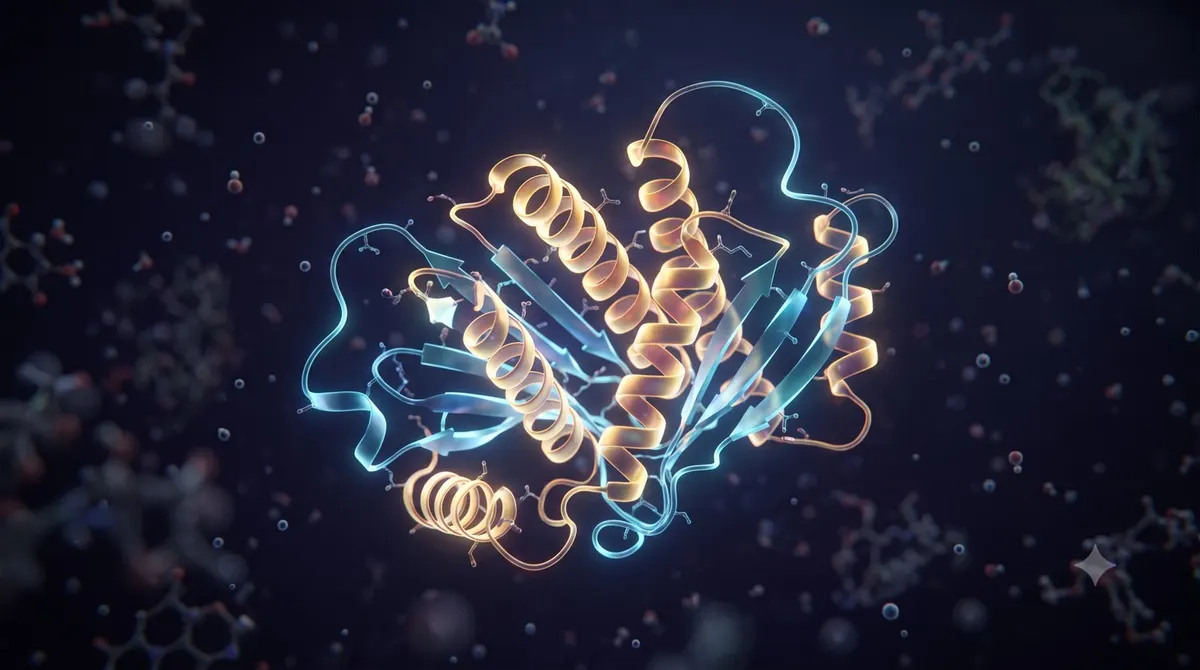
If DNA is the instruction manual of life, proteins are the workers who actually get things done. They digest your breakfast, carry oxygen through your blood, fight off invading germs, build your hair and fingernails, and let your muscles contract so you can turn this page. Almost everything happening inside a living body, at the level of chemistry, is being carried out by proteins. They are the molecular machines of life, and once you understand a little about how they work, the living world starts to look like an impossibly sophisticated factory running on its own.
Beads on a String
For all their variety, proteins are built from a surprisingly small set of parts. There are twenty basic building blocks called amino acids, and every protein is simply a long chain of these amino acids strung together in a particular order. Picture a necklace made from beads that come in twenty colours. The order of the beads is what makes one protein different from another. A short chain might have a few dozen amino acids; a large one can have many thousands.
The instructions for that order come straight from your genes. A stretch of DNA spells out the exact sequence of amino acids for a given protein, letter by letter. The cell reads this code and assembles the chain accordingly. So when we say a gene “codes for” something, what it usually codes for is a protein. Your genes are, in large part, a catalogue of protein recipes.
The Magic Is in the Folding
Here is where proteins become genuinely wondrous. A freshly made chain of amino acids does not stay stretched out like a piece of string. Almost instantly, it folds up on itself into a precise three-dimensional shape. Some parts coil into spirals, others fold into sheets, and the whole thing tucks and twists into a compact, intricate structure. This shape is not random. The same sequence of amino acids will fold into the same shape nearly every time, and that shape is everything.
Why does shape matter so much? Because a protein’s job depends entirely on its form. A protein that ferries oxygen has pockets shaped to grip oxygen molecules. A protein that speeds up a chemical reaction has a surface contoured to hold its target just so. Change the shape and you change, or destroy, the function. It is a bit like a key: the specific bumps and grooves are what let it turn a particular lock. When you cook an egg, the heat unravels the proteins in the white, wrecking their shapes permanently, which is why the runny liquid turns solid and can never go back.
A Job for Every Shape
The range of tasks proteins perform is breathtaking. Consider just a few of the roles they fill:
- Enzymes act as catalysts, speeding up chemical reactions that would otherwise take far too long. Your digestion depends on them breaking food into pieces small enough to absorb.
- Structural proteins provide strength and shape. Collagen holds your skin and bones together, and keratin builds hair, nails, and the outer layer of your skin.
- Transport proteins carry cargo. Haemoglobin, packed inside your red blood cells, grabs oxygen in your lungs and releases it throughout your body.
- Antibodies patrol your bloodstream, recognising and latching onto invaders so your immune system can destroy them.
And this only scratches the surface. Proteins also send signals between cells, act as tiny motors that move things around inside the cell, and form channels in cell membranes that let specific molecules pass. Whatever a living thing needs done, there is almost certainly a protein doing it.
Enzymes, the Tireless Catalysts
Of all proteins, enzymes deserve a special mention, because life would grind to a halt without them. Chemical reactions that keep you alive, breaking down sugar for energy, copying DNA, building new molecules, would happen far too slowly on their own to sustain a living body. Enzymes solve this by holding the reacting molecules in exactly the right position and lowering the energy needed to get the reaction going. A single enzyme can carry out its reaction thousands of times per second and emerge unchanged, ready to do it again.
What makes enzymes especially elegant is their specificity. Each one recognises only its particular partner, thanks to that precisely folded shape. This means your cells can run thousands of different reactions at once without them interfering, each managed by its own dedicated enzyme. It is chemistry with the precision of a locksmith.
When Folding Goes Wrong
Because shape is so critical, proteins that fold incorrectly can cause serious trouble. Cells have quality-control systems that catch and recycle many misfolded proteins, but the systems are not perfect. Some diseases are linked to proteins that clump together in the wrong shape and accumulate where they should not. Scientists study protein folding intensely, not only to understand these conditions but because predicting how a chain will fold is one of biology’s great puzzles. In recent years, powerful computer methods have made striking progress at forecasting protein shapes from their sequences, a breakthrough that is already reshaping medicine and biological research.
It is easy to think of life as being about big things, hearts beating, plants growing, creatures moving. But peer closely enough and you find that all of it rests on proteins, quietly folding into shape and doing their appointed work. Twenty simple building blocks, arranged and folded in countless ways, give rise to the entire machinery of living things. The next time you breathe, digest, or simply exist, spare a thought for the trillions of tiny protein machines making it all possible, each one a small marvel of natural engineering.