Talking Science Podcast
Pulsars – Cosmic Lighthouses
In 1967 a young researcher noticed something baffling in her data: a faint, perfectly regular pulse of radio waves arriving from deep space, ticking away with the precision of a clock. It was so precise that for a moment scientists half-joked it might be a signal from another civilization. It was not. It turned out to be something almost as strange, a new kind of dead star that would reshape our understanding of matter, gravity, and the extremes the universe is capable of. We call these objects pulsars.
The Corpse of a Giant Star
To understand a pulsar, you have to understand how massive stars die. A large star spends its life burning fuel in its core, and the outward push of that furnace balances the inward crush of its own gravity. When the fuel finally runs out, the balance breaks. The core collapses in an instant and the outer layers rebound in a titanic explosion called a supernova, briefly outshining an entire galaxy.
What remains at the center is extraordinary. If the collapsing core is in the right range of mass, gravity crushes it until its protons and electrons merge into neutrons, packing an object more massive than our Sun into a ball only about the size of a city. This is a neutron star, and it is almost unimaginably dense. A single teaspoon of its material would weigh as much as a mountain. A pulsar is simply a neutron star that we happen to observe pulsing.
Nature’s Perfect Timekeeper
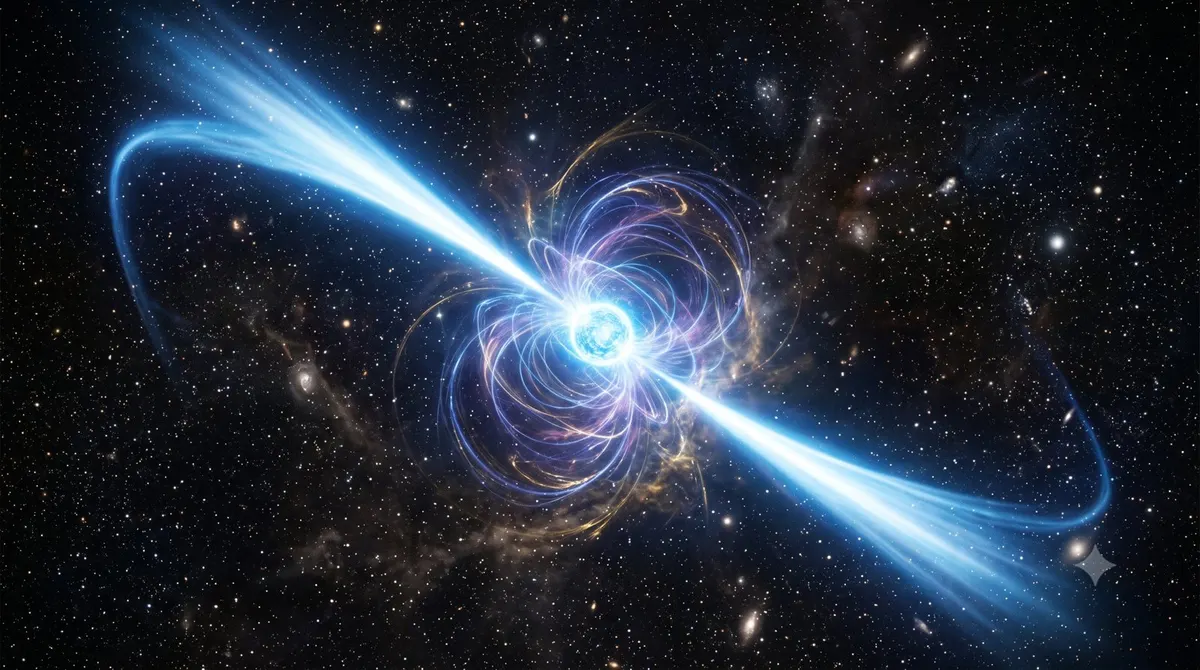
Why do these stars pulse? Two properties combine to produce the effect. First, as the giant core collapses, it spins faster and faster, in the same way a figure skater speeds up by pulling in her arms. A neutron star can end up rotating many times every second. Second, it has an intensely strong magnetic field, which funnels beams of radiation out from its magnetic poles.
If those poles do not line up with the spin axis, the beams sweep around the sky as the star rotates, exactly like the rotating lamp of a lighthouse. Each time a beam sweeps across the Earth, our telescopes catch a brief flash. We do not see a steady glow but a rapid series of pulses, one for every rotation. The star is not actually blinking; it is spinning, and we are only in the beam for an instant each turn.
The regularity of these pulses is astonishing. Some pulsars keep time so faithfully that they rival the best atomic clocks built by humans. This reliability is not just a curiosity. It has made pulsars into precision instruments for testing some of the deepest ideas in physics.
Testing Einstein With Dead Stars
Because pulsars are so massive, so compact, and so precise, they are ideal natural laboratories for studying gravity. When two neutron stars orbit each other, and at least one is a pulsar, astronomers can time the pulses with exquisite accuracy and watch how the orbit behaves. What they find matches the predictions of Einstein’s theory of gravity, general relativity, with remarkable precision.
One landmark discovery came from watching such a pair slowly spiral closer together. The orbit was shrinking at exactly the rate expected if the system were losing energy by radiating ripples in the fabric of space itself, known as gravitational waves. This was among the first strong evidence that these waves, predicted long before, were real, decades before instruments on Earth detected them directly.
Mapping the Galaxy and Beyond
Pulsars have practical uses too. Because their pulses arrive with such reliable timing, they can serve as cosmic beacons for navigation. In principle, a spacecraft could use the distinctive rhythm of several pulsars to work out its position in the solar system, a natural positioning system written into the sky.
Astronomers also use arrays of pulsars scattered across the galaxy as an enormous detector. By monitoring many of these clocks at once and watching for tiny, coordinated hiccups in their timing, scientists hope to sense the passage of very long, slow gravitational waves rippling through the galaxy, perhaps produced by pairs of giant black holes at the centers of distant galaxies. In effect, the pulsars become buoys, and the gentle rising and falling of their signals reveals waves washing through space.
Extremes Beyond Imagination
Perhaps the most humbling thing about pulsars is what they reveal about the range of conditions the universe contains. Their density defies everyday intuition, their magnetic fields are among the strongest known anywhere, and the most rapidly spinning ones whirl hundreds of times a second, their surfaces moving at a sizable fraction of the speed of light. These are conditions we can never reproduce in any laboratory on Earth.
Studying them lets physicists probe how matter behaves when it is squeezed far beyond anything we can create ourselves. In that sense, each pulsar is a free experiment, running continuously, sending its results to us in the form of steady radio ticks.
Pulsars also age in revealing ways. As a young pulsar spins, it gradually radiates energy and slows down, so over long stretches of time its flashes come a little further apart. Astronomers can use this steady slowing to estimate how old a pulsar is and how strong its magnetic field must be. Some old, quiet neutron stars can even be given a second life. If one draws in material from a companion star, that infalling matter can spin it back up to dizzying speeds, producing what astronomers call a recycled pulsar that whirls hundreds of times each second.
Occasionally these clocks misbehave in interesting ways. Now and then a pulsar will suddenly speed up by a tiny amount in an event known as a glitch, thought to be caused by shifts deep inside the star. These hiccups offer a rare glimpse into the hidden interior of a neutron star, a place we can never visit or see, and they remind us that even nature’s most reliable timekeepers have a churning, dynamic core beneath their steady beat.
From a puzzling blip in a young astronomer’s data to a cornerstone of modern physics, the pulsar’s story is a reminder of how discovery works. Something unexpected appears, refuses easy explanation, and slowly opens a window onto a hidden corner of nature. These spinning stellar corpses, flashing across the darkness like lighthouses on an unseen coast, guide us toward truths about gravity and matter that we could learn no other way.