 Talking Science Podcast
Quantum Computing and the Race to Save Encryption
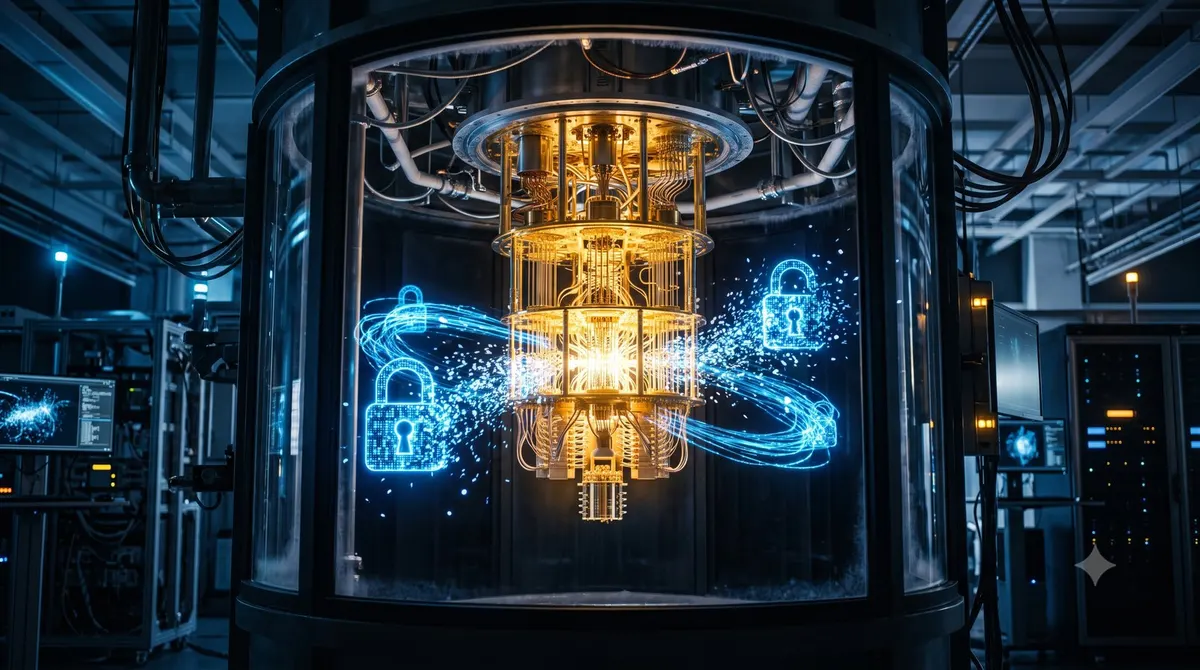
Almost every private thing you do online is protected by a piece of mathematics. When you bank, message or shop, your data is scrambled using codes that would take an ordinary computer longer than the age of the universe to crack. That security rests on a quiet assumption: that certain sums are practically impossible to reverse. Quantum computing threatens to break that assumption, and the race to respond is already under way.
The maths that keeps secrets
Much of today’s encryption relies on a lovely asymmetry. It is easy to multiply two enormous prime numbers together, but fiendishly hard to take the result and work backwards to find the original primes. Multiply two 300-digit primes and you get a 600-digit number that no classical computer can factor in any reasonable time. That one-way difficulty is the lock on which online trust is built.
How a quantum computer picks the lock
A quantum computer does not simply run faster. It works in a fundamentally different way, using quantum bits that can represent many possibilities at once and interfere with one another like waves. In the 1990s a mathematician named Peter Shor showed that a sufficiently large quantum computer could use these properties to factor huge numbers efficiently — turning that impossible backwards sum into a manageable one. The encryption that guards the internet today would, in principle, fall.
The reassuring caveat is “sufficiently large”. Today’s quantum machines are noisy and modest, nowhere near powerful enough to break real encryption. But the direction of travel is clear, and secrets have a long shelf life.
Harvest now, decrypt later
That long shelf life is the heart of the problem. An adversary does not need a code-breaking quantum computer today to benefit from one tomorrow. They can simply record encrypted traffic now — financial records, health data, state secrets — and store it, confident that in a decade or two the means to unscramble it may exist. Anything that must stay confidential well into the future is, in a sense, already at risk. This “harvest now, decrypt later” threat is why organisations that take data protection seriously are being urged to review their cybersecurity posture long before large quantum computers actually arrive.
The quiet fix already being built
The good news is that mathematicians saw this coming. A new generation of “post-quantum” encryption schemes has been developed, built on mathematical problems that appear hard even for quantum computers. After years of public scrutiny, the first of these have been standardised and are beginning to roll out across the software the world relies on. The transition is enormous and largely invisible — every browser, bank and messaging app must eventually switch — but it is the reason a future quantum computer will not simply hand its owner the keys to everything.
A problem of timing, not panic
Quantum computing is not a doomsday device for privacy; it is a deadline. The physics that makes these machines possible is the same physics being used to defend against them, and the defenders have a head start. The challenge is less about genius than about diligence: identifying what needs protecting, and upgrading the locks before the new lock-picks are built. In cybersecurity, as in science, the unglamorous work of preparing early is what averts the crisis later.


