Talking Science Podcast
Renewable Energy – Sun, Wind and Water
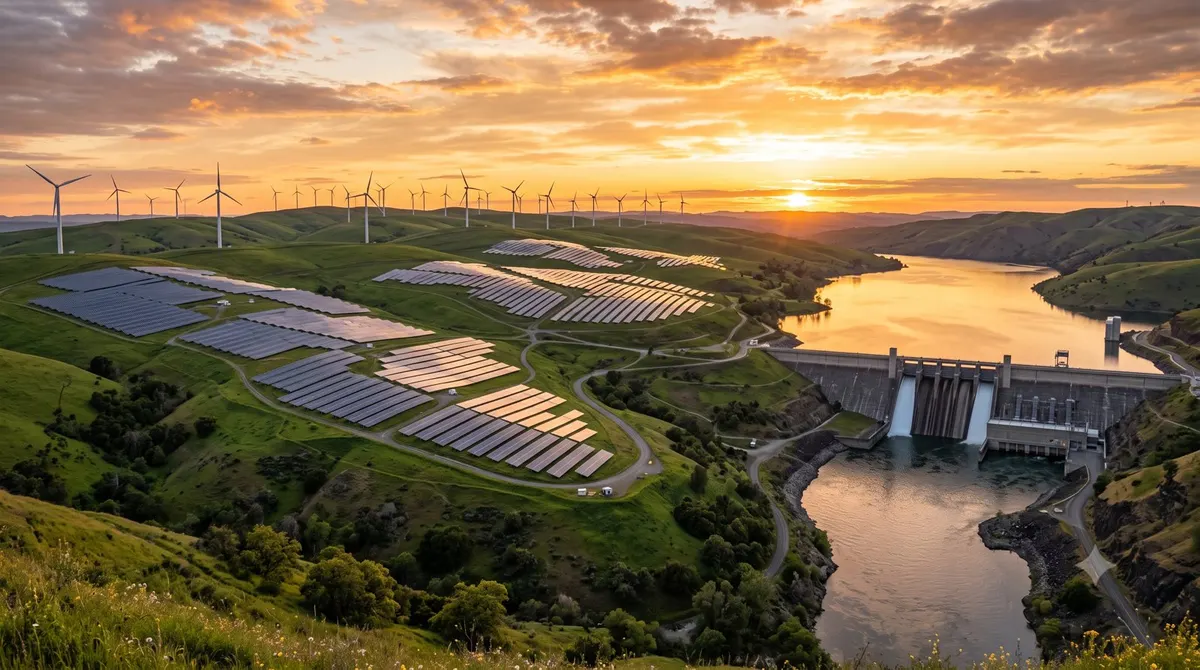
Every second, the Sun pours more energy onto the Earth than all of humanity uses in a whole day. The wind that ruffles your hair and the river that tumbles past a town carry energy too, endlessly renewed by the natural churning of the planet. For most of history we could only watch this energy come and go. Now we have learned to catch it, convert it, and pipe it into our homes as electricity. Renewable energy – power from sources that never run out and give off no smoke as they work – is quietly transforming how the world keeps its lights on.
What Makes Energy Renewable
The fuels that powered the industrial world – coal, oil, and gas – share two problems. They exist in limited amounts, formed over millions of years and burned in a couple of centuries, so eventually they run low. And burning them releases carbon dioxide, the gas warming our planet. Renewable energy sidesteps both problems at once.
Renewable sources are called renewable because they are constantly replenished. The Sun will keep shining for billions of years. The wind will keep blowing as long as the Sun heats the air unevenly. Rivers will keep flowing as long as rain keeps falling. We are not draining a finite tank; we are tapping a stream that refills itself. And because we are capturing energy that is already moving through nature rather than burning something, these sources produce electricity without the smoke and carbon of a fire.
Catching the Sun
Solar power comes in two main flavours. The most familiar is the solar panel, the dark bluish rectangle now seen on so many rooftops. These panels are made of special materials that perform a small miracle: when sunlight strikes them, it knocks electrons loose and sets them moving, and moving electrons are exactly what electricity is. There are no moving parts, no fuel, and no noise – just sunlight going in one side and electricity coming out the other.
The other approach uses mirrors to concentrate sunlight onto a single spot, focusing the Sun’s warmth to produce intense heat. That heat boils water into steam, and the steam drives a turbine to make electricity, much as in a traditional power plant. Both methods draw on the same limitless source. The great catch with solar power is obvious: it only works when the Sun is out. At night, or under heavy cloud, a solar panel goes quiet.
Harvesting the Wind
Wind turbines are among the most graceful machines humans have built – tall white towers with three long blades turning slowly against the sky. The idea behind them is ancient. Windmills ground grain and pumped water for centuries. A modern wind turbine simply does the reverse of a fan. A fan uses electricity to push air; a turbine lets moving air push its blades, and that spinning is used to generate electricity.
As the wind pushes the blades around, they turn a shaft connected to a generator, and the generator produces power. Turbines are often gathered into large groups called wind farms, sometimes on open land and increasingly out at sea, where the wind blows stronger and steadier. Like the Sun, though, the wind is not always obliging. On a still day the blades hang motionless, and no amount of engineering can make a turbine spin without wind.
The Power of Moving Water
The oldest large-scale renewable is water power. For over a century, we have built dams across rivers to harness the energy of flowing water. Behind the dam, water piles up in a reservoir. When it is released, it rushes downward through channels and spins turbines on its way, generating electricity as it goes. Because a large reservoir stores a great deal of water, this kind of power can be switched on reliably whenever it is needed, which gives it a big advantage over the sometimes-fickle Sun and wind.
Water power is powerful and dependable, but it is not free of downsides. Building a large dam floods a valley behind it, displacing people and wildlife and changing the river forever. There are only so many good sites for big dams, too. Engineers are also learning to draw energy from the movement of ocean tides and waves, though these newer methods are still finding their feet.
The Puzzle of Keeping the Lights On
Renewables have one shared weakness that shapes the whole challenge of using them: many of them are not constant. The Sun sets, the wind stills, but people still want electricity at all hours. A power grid must match supply to demand from moment to moment, which is tricky when your supply depends on the weather. Solving this puzzle is the central task of the renewable age, and there are several promising approaches:
- Large batteries that store surplus electricity when the Sun shines or the wind blows, then release it when they do not.
- Connecting wide regions together, so that wind somewhere can cover calm elsewhere.
- Combining different sources, since the wind often blows when the Sun is weak, and vice versa.
None of this is fully solved, but progress has been rapid. Storage is improving, costs have tumbled, and renewables now supply a growing share of the world’s electricity year after year.
There is also a quieter revolution in how we use energy, not just how we make it. A home with solar panels on the roof can generate its own power by day and draw on the grid or a battery by night, turning ordinary buildings into tiny power stations. Electric cars can charge when clean energy is plentiful and cheap. Smarter systems can nudge demand toward the moments when the Sun shines and the wind blows. The renewable future is not only about giant wind farms and solar fields; it is also about millions of small, clever adjustments that together make a flexible, resilient grid.
The shift to renewable energy is one of the great engineering stories of our time. We are learning to run our civilisation on sunlight, moving air, and falling water – forces that have played across the Earth since long before we arrived and will play on long after. There are real hurdles still, above all the challenge of storing energy for when nature pauses. But the direction is set. Slowly and surely, humanity is learning to power itself not by burning the past, but by catching the endless energy the planet offers freely, every single day.