Talking Science Podcast
Saturn’s Rings – A Structure That Shouldn’t Last
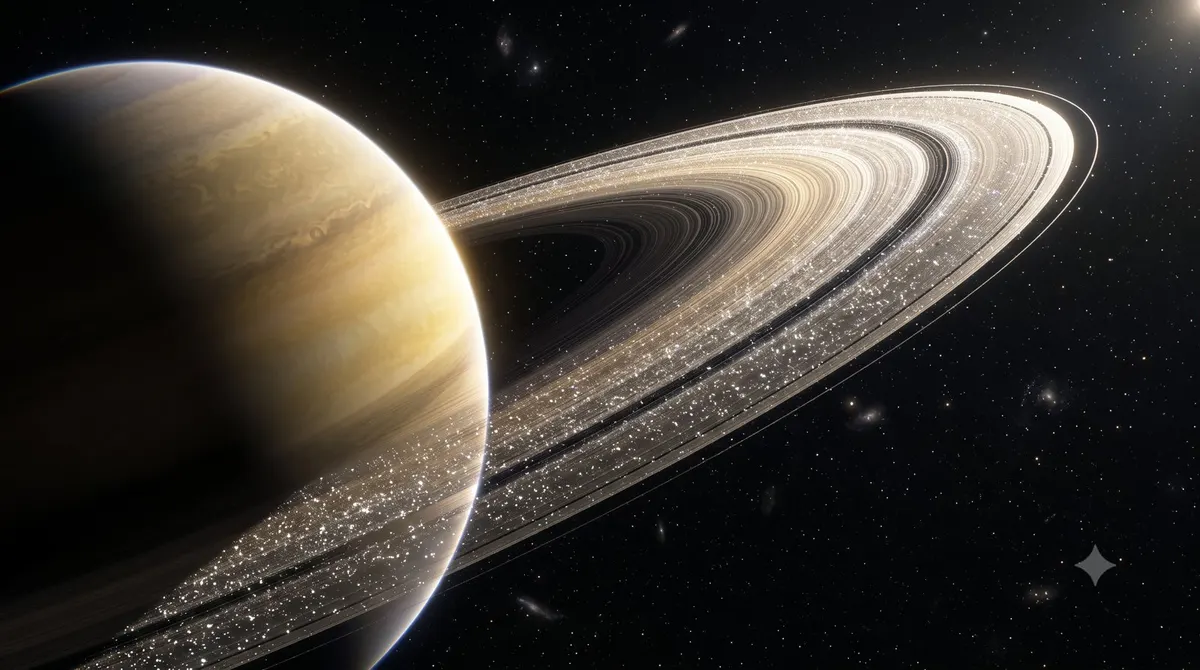
There is no more instantly recognisable sight in the Solar System than Saturn wearing its rings. Point even a modest telescope at that pale golden dot and the rings snap into view, and almost everyone who sees them for the first time gasps. They look permanent, eternal, the kind of thing that has always been there and always will be. But the more closely astronomers study them, the more it looks as if the opposite may be true. Saturn’s rings could be both surprisingly young and slowly disappearing – a fleeting decoration we are lucky enough to be around to see.
What the rings actually are
From a distance the rings look like solid, smooth discs, as though Saturn were threaded through a set of flat hoops. They are nothing of the kind. The rings are made of countless separate pieces of ice and rock, each one orbiting the planet on its own, like an enormous swarm of tiny moons all circling in the same flat plane. These pieces range from grains the size of dust and specks of frost up to chunks as large as houses and mountains. There is no solid material holding them together; the rings only look continuous because there are so many pieces packed so closely.
The rings are also astonishingly wide and astonishingly thin. They stretch outward from the planet across a span so vast it dwarfs the distance between Earth and the Moon, and yet in the other direction they are only a fraction of that – in most places just tens of metres from top to bottom. Scaled down, they would be far thinner, relative to their width, than a sheet of paper. It is this combination of enormous breadth and razor thinness that makes them so strikingly flat and delicate when we see them lit by the Sun.
Mostly ice, and that is a clue
When astronomers analysed what the rings are made of, they found the answer was overwhelmingly water ice – clean, bright, and reflective. That is a significant clue, and here is why. The space around Saturn is not perfectly empty. Over time, a steady drizzle of dark micrometeoroid dust rains down and coats everything it touches, dimming and dirtying surfaces the way grime settles on anything left outdoors. Yet Saturn’s rings remain remarkably bright and clean.
If the rings were extremely old – as old as the planet itself, billions of years – you would expect them to have been thoroughly darkened by all that accumulated dust by now. The fact that they are still so bright suggests they may not have had time to get dirty. In other words, the rings might be far younger than Saturn, a relatively recent addition rather than an original feature. This is not settled beyond all doubt, and scientists continue to debate the exact age. But the cleanliness of the ice is hard to explain if the rings have been there since the dawn of the Solar System.
Where did they come from?
If the rings are indeed young, then something must have created them long after Saturn itself formed. The leading ideas all involve destruction. Perhaps an icy moon wandered too close to the planet and was torn apart by its gravity. Perhaps a passing comet strayed too near and was shredded. Whatever the object was, the picture is one of a body that came apart, its debris spreading out and settling into the flat, spinning disc we see today.
This is why the rings lie in such a perfectly flat plane around Saturn’s equator. When a great many fragments orbit a planet and gently collide with one another over time, their motions average out, and the whole swarm flattens into a thin sheet. The same physics shapes many discs in space, from the rings of a planet to the vast spirals of galaxies. Order emerges out of countless small collisions.
Why they won’t last
Here is the part that gives the story its poignancy. The rings appear to be slowly vanishing. The tiny ice particles are gradually being pulled inward and drawn down onto Saturn itself, drizzling into the planet’s atmosphere in a slow, steady rain of ice. Interactions with Saturn’s magnetic field and the constant nudge of sunlight and dust all conspire to erode the rings over time.
This process is gradual by human standards – the rings are not going to disappear next year, or in anyone’s lifetime, or for a very long time to come. But on the grand timescale of the Solar System, it appears the rings are a temporary feature. They were not here for much of Saturn’s history, and they will not be here for the rest of it. We happen to be living during the relatively brief window when they exist.
It is worth pausing on how the rings hold their intricate shape while all this is going on. Look closely and they are not a single smooth sheet but a series of distinct bands separated by gaps, like the grooves on an old record. Much of this structure is sculpted by Saturn’s many moons. Some small moons orbit within the gaps themselves, their gravity sweeping the region clear of ring particles and acting almost like shepherds keeping a flock in line. Other moons, orbiting further out, tug rhythmically on the ring material and carve it into sharp edges and waves. The rings are not a static ornament but a living, restless system, constantly being nudged and shaped by the family of moons around it.
A structure worth savouring
There is something quietly moving about all this. We tend to think of the great sights of nature as permanent fixtures. But Saturn’s rings may be an ornament the planet put on comparatively recently and will eventually take off again. If that is true, then their beauty is not just spectacular but rare in time as well as space. We are here to admire them, and future observers in the distant future may look at a ringless Saturn and know them only from old images. That thought turns a familiar postcard image into something more precious: a fleeting masterpiece we were fortunate enough to catch.