Talking Science Podcast
Space Junk and the Kessler Problem
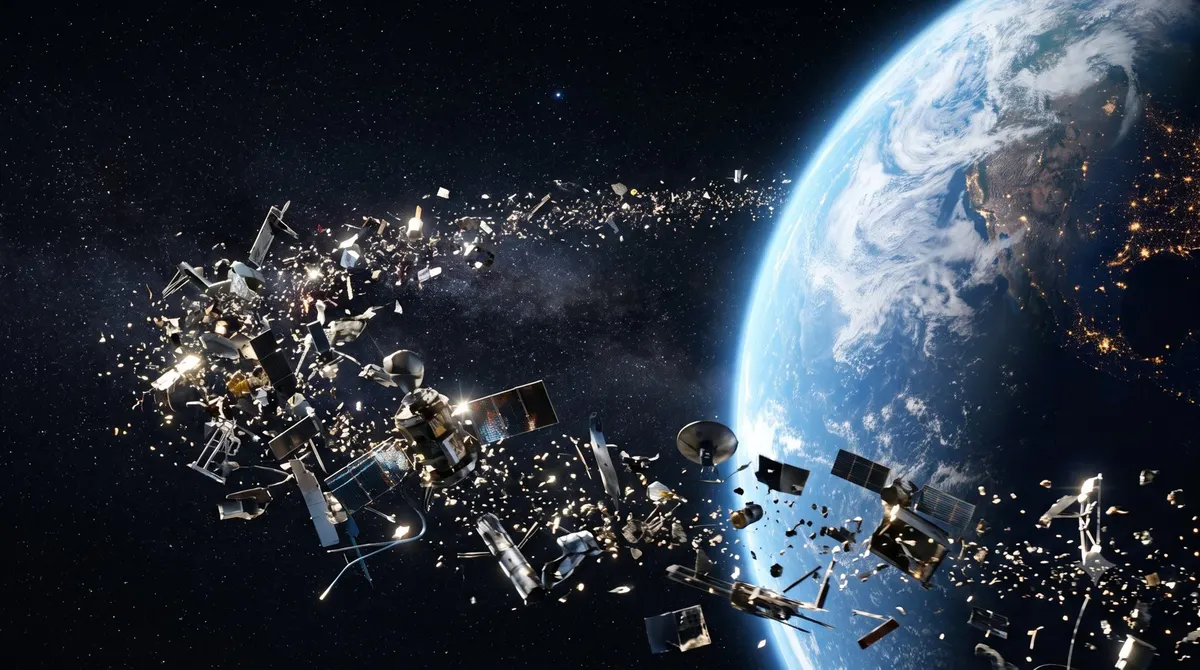
Look up on a clear night and space seems calm, endless, and empty. But the region just above our atmosphere has become surprisingly crowded. Circling the planet right now are thousands of working satellites, dead ones, spent rocket stages, and countless fragments of shattered hardware, all racing along at speeds that would make a rifle bullet look sluggish. This orbiting scrapyard is what we call space junk, and it poses a quiet but serious threat to the technology woven into everyday life.
What Counts as Space Junk?
Space junk, or orbital debris, is any human-made object in orbit that no longer serves a purpose. It comes in a huge range of sizes. At the large end are entire defunct satellites, some as big as a bus, and the discarded upper stages of rockets that carried payloads to space. In the middle are pieces broken off from explosions and collisions. At the small end are flecks of paint, frozen droplets of coolant, and metal shards no bigger than a grain of sand.
You might think tiny fragments hardly matter, but in orbit size is deceptive. What makes debris dangerous is not its mass so much as its speed. Objects in low orbit travel at roughly 28,000 kilometres per hour. At those velocities, even a chip of paint carries enough energy to gouge a spacecraft window, and a fragment the size of a marble hits with the force of a small bomb.
How Did It Get There?
Every launch since the dawn of the space age has left something behind. Rockets shed stages. Satellites reach the end of their working lives and simply keep orbiting, unpowered and uncontrolled. Occasionally an old fuel tank or battery ruptures, spraying debris in all directions.
Two events stand out for how much clutter they created. In 2007 a country deliberately destroyed one of its own weather satellites in a missile test, producing thousands of trackable fragments. Two years later, a working communications satellite and a dead one slammed into each other by accident, generating thousands more. Between them, these two events dramatically increased the amount of debris in the most heavily used orbits.
The Kessler Problem
In the late 1970s, a NASA scientist named Donald Kessler proposed a troubling idea. He suggested that once the density of objects in orbit passed a certain point, collisions would become self-sustaining. One crash would scatter fragments, those fragments would strike other objects, and each new collision would produce still more debris. The process could snowball, filling key orbits with a cloud of shrapnel.
This runaway chain reaction became known as the Kessler syndrome, or simply the Kessler problem. The nightmare scenario is not a single catastrophe but a slow cascade playing out over years or decades, where certain orbital altitudes gradually become too hazardous to use. Importantly, the cascade could continue even if we stopped launching anything new, because the existing junk would keep colliding on its own.
Why It Matters Down Here
It is tempting to shrug off a problem happening hundreds of kilometres overhead, but our daily lives lean heavily on the machines up there. Satellites handle weather forecasting, television and phone signals, internet links to remote areas, and the navigation systems that guide everything from delivery trucks to aeroplanes. The precise timing signals from navigation satellites even keep financial networks and power grids in sync.
If cascading debris rendered valuable orbits unusable, we would lose more than convenience. Rebuilding those services would be slow and expensive, and some might not be replaceable at all while the debris persists. The International Space Station already performs occasional manoeuvres to dodge tracked objects, and crews have sometimes sheltered in their capsules as a precaution when debris passed close by.
Cleaning Up and Slowing Down
The good news is that the problem is understood and being actively managed. Networks of ground-based radars and telescopes track tens of thousands of larger objects, cataloguing their orbits so operators can be warned of close approaches. When a warning comes, a satellite with fuel to spare can nudge itself out of harm’s way.
Preventing new junk is the cheapest fix. Modern guidelines ask satellite operators to plan for disposal at the end of a mission. Some spacecraft in low orbit are steered downward to burn up harmlessly in the atmosphere. Those in higher orbits are boosted into so-called graveyard orbits, well away from busy regions. Rocket stages are increasingly designed to vent leftover fuel so they cannot explode later.
Engineers are also testing ways to actively remove debris. Experimental missions have trialled nets, harpoons, and robotic arms to capture and drag dead objects down to burn up. These techniques are still young, but they hint at a future where we might tidy the worst of the mess rather than simply avoid it.
Nature offers a small helping hand as well. In the lowest orbits, the thin wisps of the upper atmosphere create a faint drag that gradually slows debris until it eventually falls back and burns up. This natural cleaning is why the region closest to Earth tends to clear itself over years or decades. Higher up, though, the air is so thin that debris can linger for centuries, which is exactly why the busiest high orbits are watched so closely.
A Shared Responsibility
Space near Earth is a shared resource, a bit like a fishery or a common pasture. If everyone launches freely and cleans up nothing, the region degrades for all. Because debris drifts across national boundaries and orbital paths, no single country can solve the problem alone. Cooperation, agreed standards, and a willingness to design missions responsibly are all part of keeping orbit usable.
The Kessler problem is a reminder that even the vastness of space has limits when we crowd into the same thin shell around our planet. It is not a doomsday certainty but a warning, and warnings are useful precisely because they give us time to act. With careful tracking, smarter satellite design, and the first steps toward active cleanup, we have a real chance to keep the sky above us open for the generations of explorers and engineers still to come.