Talking Science Podcast
Stem Cells – The Body’s Master Cells
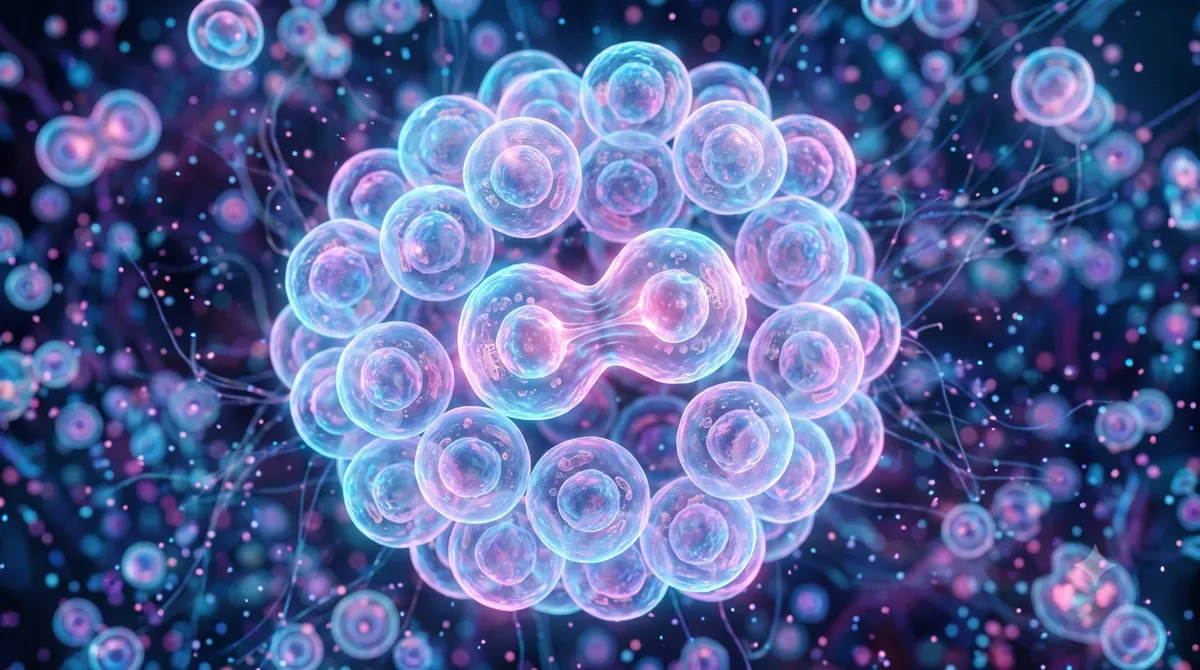
You began life as a single cell. From that one starting point came the roughly thirty-seven trillion cells that make up your body today—the neurons firing as you read this, the muscle fibers holding you upright, the cells lining your gut and pumping in your heart. How does one cell become so many wildly different things? The answer lies in a remarkable kind of cell that biologists call the stem cell, nature’s master material, still holding the possibility of becoming almost anything.
What makes a cell a stem cell
Most cells in your body are specialists. A skin cell does skin things; a liver cell does liver things. They are committed, locked into a single job. Stem cells are different because they hold on to two rare abilities at once. First, they can divide to make more stem cells, renewing their own supply indefinitely. Second, they can transform into specialized cell types when the body calls for them, a process biologists call differentiation.
Think of a stem cell as a blank apprentice that has not yet chosen a trade. Given the right signals from its surroundings, it can train up to become a blood cell, a bone cell, a nerve cell, and so on. That combination of self-renewal and flexibility is what sets stem cells apart from every other cell in the body, and it is exactly what makes them so valuable.
Not all stem cells are equal
Stem cells come in different degrees of potential. The most versatile are the embryonic stem cells found in the earliest days of development. These are what scientists call pluripotent, meaning they can become essentially any tissue in the body. In a growing embryo, they are the raw clay from which every organ is eventually shaped.
Adults keep stem cells too, but these are usually more restricted, tuned to maintain and repair particular tissues. The stem cells in your bone marrow, for example, spend your whole life churning out fresh blood and immune cells to replace the ones that wear out. Others sit quietly in your skin, gut lining, and elsewhere, ready to patch damage. They are more like specialized repair crews than all-purpose builders, but they are the reason your body can heal at all.
This quiet, ongoing repair is easy to take for granted, yet it is happening constantly. The lining of your gut is renewed every few days. Your skin sheds and rebuilds itself continuously. Cuts close, and broken bones knit back together. All of this depends on reserves of tissue-specific stem cells waiting in the wings. When those reserves falter with age or disease, healing slows and tissues break down—one reason scientists are so eager to understand and, one day, replenish them.
The breakthrough that changed everything
For years, the most flexible stem cells came only from embryos, which raised difficult ethical questions and limited what researchers could do. Then came one of the most important discoveries in modern biology. Scientists found that an ordinary adult cell—say, a skin cell—could be coaxed backward in time. By switching on a small set of key genes, they could reset a mature, committed cell into a pluripotent state resembling an embryonic stem cell.
These reprogrammed cells are known as induced pluripotent stem cells. The achievement was so significant that it earned a Nobel Prize, and for good reason: it meant researchers could, in principle, generate versatile stem cells from a patient’s own body, sidestepping both the ethical debate and the problem of the immune system rejecting foreign tissue. A pinch of your own skin might one day become a repair kit tailored precisely to you.
Healing with master cells
The medical promise here is enormous, and some of it is already real. The oldest and most established use is the bone marrow transplant, which is fundamentally a stem cell therapy: replacing a patient’s damaged blood-forming system with healthy stem cells that rebuild it from scratch. This approach has saved many lives, particularly for people with certain blood cancers.
Beyond that, researchers are chasing a much broader vision. If stem cells can become any tissue, then in theory they could repair almost any damage:
- Growing fresh insulin-producing cells for people with diabetes.
- Replacing nerve cells lost to spinal injury or degenerative disease.
- Repairing heart muscle scarred by a heart attack.
Much of this remains experimental, tested in labs and early trials rather than proven in clinics. But the direction is unmistakable, and steady progress is being made on several fronts.
Even where stem cells cannot yet be used to treat patients directly, they have quietly transformed research. Scientists can now take a patient’s cells, reprogram them, and coax them into growing into the very tissue affected by a disease—a patch of nerve cells or heart muscle carrying that person’s exact genetic makeup. Studied in a dish, these living models let researchers watch a disease unfold and test drugs against it, without risk to the patient. Some labs are even growing tiny, simplified versions of organs, called organoids, to explore how tissues form and fail.
Promise, hype, and caution
With so much excitement comes a real risk of overselling. Stem cells are powerful precisely because they can grow and change—but that same power can turn dangerous. Cells that divide freely and refuse to settle into a fixed role are, in some ways, uncomfortably close to what a tumor is. Guiding stem cells to become the right tissue, in the right place, and then stop, is a genuine scientific challenge, and getting it wrong can do harm.
This is why it is worth being wary of clinics that advertise unproven stem cell cures for a long list of ailments. Legitimate stem cell medicine advances slowly, through careful testing, because the stakes are high and the biology is unforgiving. The gap between what is promised in a glossy advertisement and what is actually supported by evidence can be wide.
Still, it is hard not to feel a sense of wonder. Inside every one of us are cells that remember, in a sense, how to build a body—and we are only beginning to learn how to speak their language. Stem cells sit at the meeting point of the deepest questions in biology and the most practical hopes of medicine. Understanding them better may not just repair injuries and treat disease; it may finally reveal how a single cell, following an ancient set of instructions, becomes a whole living person.