 Talking Science Podcast
The Atmosphere – Layers of Air
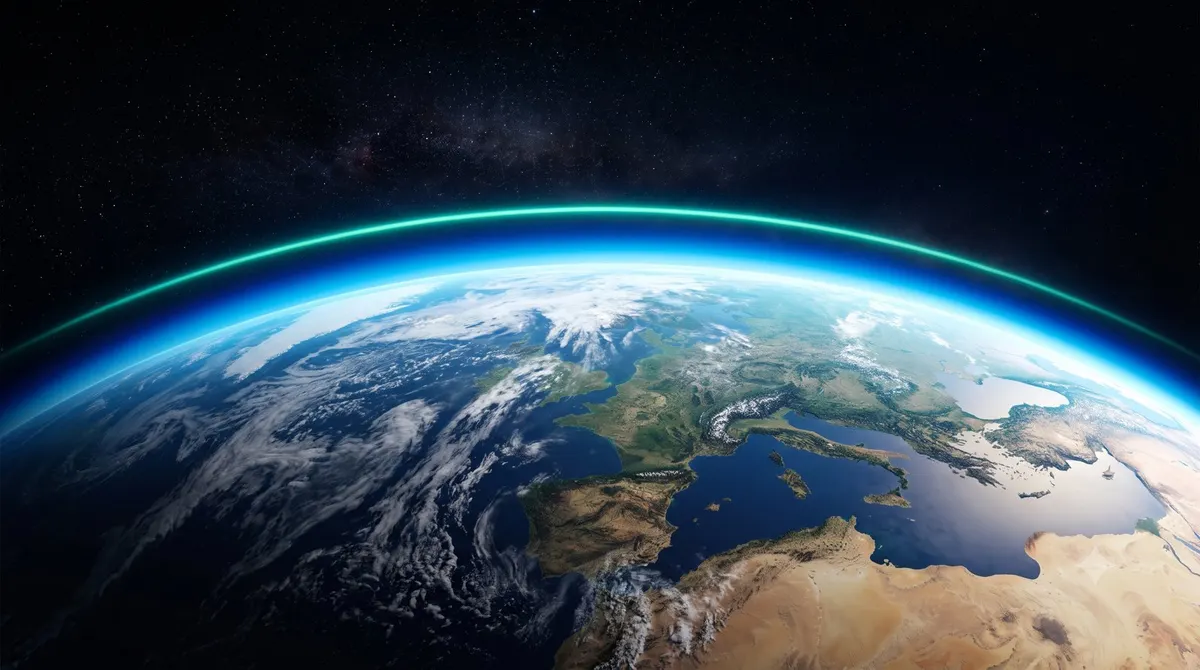
Take a deep breath. The air that just filled your lungs is part of something vast: a thin skin of gas wrapped around the whole planet, reaching hundreds of kilometres up before fading into space. We call it the atmosphere, and we tend to treat it as a single, uniform thing, simply “the air.” But it is not uniform at all. It is built in layers, each with its own temperature, its own character, and its own job to do. Understanding those layers is like learning the floors of a strange and wonderful building we all live inside.
An ocean of air
It helps to think of the atmosphere as an ocean of air, with us living at the very bottom of it. Like water, air has weight, and the whole column pressing down on us creates what we call air pressure. Down here at the surface, the air is thick and dense because everything above is squeezing it. Climb a high mountain and you feel the difference: the air thins, and each breath holds less oxygen.
The atmosphere does not have a hard edge. It simply gets thinner and thinner with height until there is so little air that we call it space. Almost all of the air, and all of our weather, is packed into the lowest stretch, close to the ground. Above that, the layers grow ever more rarefied, but each still plays an important role in making our planet livable.
The troposphere: where weather lives
The layer we actually live in is called the troposphere. It reaches up roughly ten kilometres or so, higher over the tropics and lower over the poles, and it holds most of the atmosphere’s air and nearly all of its water. This is the realm of weather. Every cloud you have ever seen, every rainstorm, every gust of wind, happens here.
A key feature of the troposphere is that it gets colder as you go up. This is why tall mountains wear caps of snow even in warm countries, and why the tops of towering storm clouds are freezing cold. The warmth at the bottom, heated by the sunlit ground, and the chill at the top keep the air churning and mixing, and that restless stirring is the engine of our daily weather.
The stratosphere: calm and protective
Above the troposphere lies the stratosphere, reaching up to around fifty kilometres. Here something curious happens: instead of getting colder with height, the air gets warmer. The reason is the ozone layer, a band of gas within the stratosphere that absorbs harmful ultraviolet radiation from the Sun and warms the surrounding air as it does so.
This upside-down temperature pattern makes the stratosphere very stable and calm, with little of the churning that stirs the layer below. That stillness is why airliners like to cruise in its lower reaches, gliding above most of the weather. It is a quieter, clearer region, and its ozone acts as a shield for all the life crowded below.
Higher still: the outer layers
Keep climbing and the layers grow stranger and thinner. Above the stratosphere is the mesosphere, where temperatures plunge to the coldest found anywhere in the atmosphere. This is the layer where most meteors burn up, the shooting stars we see streaking across a dark sky as small pieces of space rock heat up and disintegrate against the air.
Higher again is the thermosphere, where the thin air is heated by the Sun to astonishingly high temperatures, though it would not feel hot to us because the air is so sparse. This is the realm of the shimmering auroras, the northern and southern lights, and the region where many satellites orbit. Beyond it, the atmosphere simply thins away into the near-emptiness of space in a final layer sometimes called the exosphere. Broadly, the layers stack up like this:
- Troposphere, where weather happens
- Stratosphere, home of the protective ozone layer
- Mesosphere, where meteors burn up
- Thermosphere, home of auroras and many satellites
The blanket that makes life possible
Beyond dividing into layers, the atmosphere as a whole does something essential: it keeps the planet at a temperature that suits life. Certain gases in the air, notably carbon dioxide and water vapour, trap some of the heat that the Earth radiates, much as a blanket holds in your body warmth. This natural greenhouse effect keeps the surface tens of degrees warmer than it would otherwise be. Without it, our world would be a frozen ball.
The trouble today is that human activity is thickening that blanket by adding extra heat-trapping gases, tipping a naturally balanced system toward warming. The very same property that makes the atmosphere a life-giver also makes it sensitive to change, which is why what we put into the air matters so much.
What the air is made of
It is worth pausing on what this ocean of air actually contains, because the mix is surprising. The overwhelming majority of the atmosphere is nitrogen, a gas that is largely unreactive and simply along for the ride. Only about a fifth is the oxygen our bodies depend on. The remaining sliver is a jumble of other gases, including the carbon dioxide and water vapour that do so much of the heat-trapping, along with tiny traces of many others.
What is striking is how much work that thin trace of gases does. Carbon dioxide makes up only a small fraction of a percent of the air, yet it is a major reason our planet is warm enough to live on, and small changes in its amount can shift the whole climate. It is a vivid lesson that in the atmosphere, quantity and importance are not the same thing. The rarest ingredients can have outsized effects, which is exactly why scientists watch them so closely.
So the next breath you take connects you to something extraordinary: a layered, invisible ocean of air that makes weather, shields us from radiation, burns up incoming debris, and holds the planet at a temperature fit for life. We rarely look up and think about it, yet every layer overhead is quietly doing its part. The atmosphere is not just empty sky. It is a finely built structure, thin as a coat of varnish on a globe, and it is the reason Earth is alive.


