Talking Science Podcast
The Big Bang – The First Three Minutes
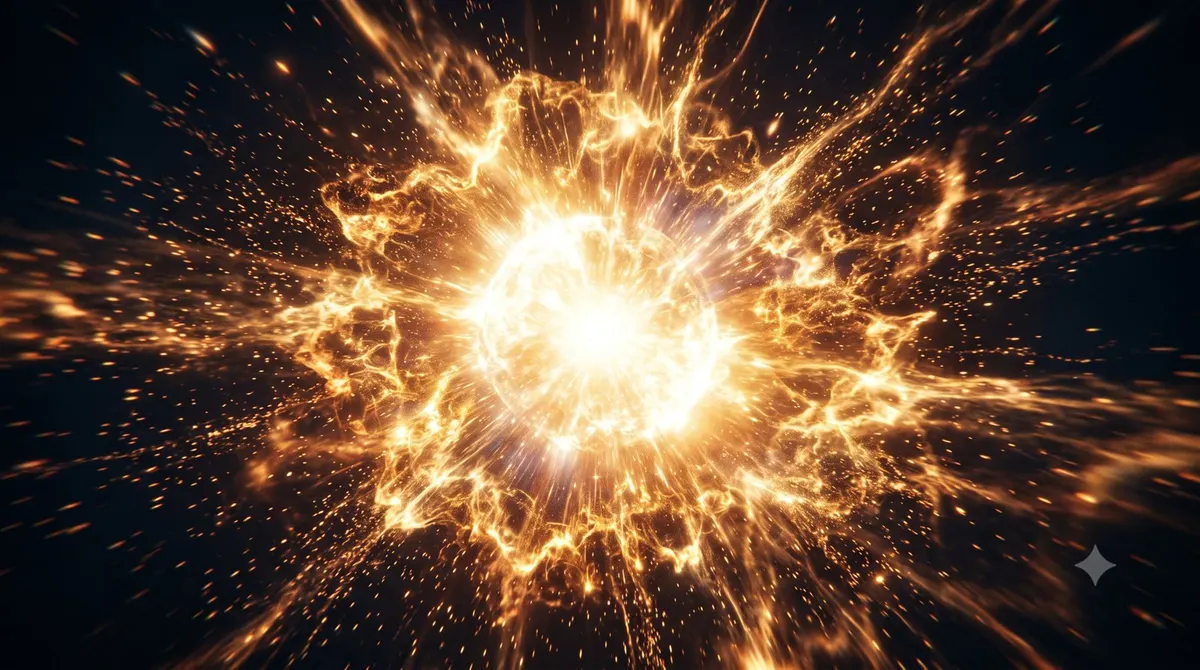
Everything you have ever seen, every star, every planet, every atom in your body, traces its origin to a single beginning nearly fourteen billion years ago. In that moment the entire universe was smaller, hotter, and denser than anything we can truly imagine. From that fiery start, in just the first few minutes, the fundamental building blocks of the cosmos were forged. The story of those first three minutes is one of the most remarkable tales science has ever told, and the astonishing thing is that we can reconstruct it at all.
What the Big Bang Really Means
First, let us clear up a common misconception. The Big Bang was not an explosion that scattered matter into empty space, like a bomb going off in a room. It was something far stranger. It was the expansion of space itself, beginning everywhere at once. There was no center, no edge, no outside. The universe did not expand into anything. Space and time themselves came into being and began to stretch.
The evidence tells us that the early universe was extraordinarily hot and dense, and that it has been expanding and cooling ever since. Run the cosmic clock backward, and everything grows closer together, hotter and more compressed, until we reach that first extraordinary moment. The Big Bang is the name we give to this beginning, and to the hot, dense state from which everything grew.
The First Fraction of a Second
The earliest instants of the universe were governed by conditions so extreme that our ordinary physics struggles to describe them. Temperatures were unimaginably high, far hotter than the center of any star. In this searing environment, the familiar particles of matter could not yet exist in their usual forms. The universe was a roiling soup of energy and fundamental particles, constantly transforming into one another.
As the universe expanded, it cooled, and this cooling drove everything that followed. Cooling allowed particles to settle into more stable forms. In an incredibly brief span, the basic ingredients of matter began to take shape. Tiny particles called quarks bound together to form protons and neutrons, the building blocks of atomic nuclei. All of this happened in a small fraction of a single second.
Forging the First Elements
Now we arrive at the famous first few minutes, when the universe became a cosmic kitchen. By this point it had cooled enough for protons and neutrons to begin sticking together, but it was still hot enough for nuclear reactions to occur, much like the reactions that power the Sun today. In this brief window, the lightest elements were born.
Protons and neutrons fused to create the nuclei of the simplest elements. Most of the matter ended up as hydrogen, the lightest and most common element, along with a good amount of helium and a trace of a few others. This process is called primordial nucleosynthesis, a grand name for the cosmic cooking that took place before the universe was even a few minutes old.
Then the window closed. As the universe kept expanding and cooling, it soon became too cold and too thin for these nuclear reactions to continue. Whatever elements had formed in those first few minutes were essentially locked in. The heavier elements would have to wait for stars, which would not exist for a very long time yet.
This is one of the quiet triumphs of modern science. The recipe is delicate: change the conditions of those early minutes even slightly, and the amounts of hydrogen and helium would come out different from what we actually measure in the oldest, most pristine gas clouds. The close agreement between prediction and observation is a powerful sign that we genuinely understand what the universe was doing when it was only minutes old. Few ideas in science reach back so far and match reality so well.
How We Know Any of This
It might seem impossible to know what happened in the universe’s opening minutes, so long ago and so far beyond direct experience. Yet we have remarkably solid evidence, and it comes from several independent directions that all agree:
- The measured amounts of hydrogen and helium in the universe match what the theory predicts should have been cooked up in those first minutes
- A faint glow of radiation fills all of space, the leftover heat of the early hot universe, now cooled by expansion
- The expansion of the universe, visible today, points back to a hot, dense beginning
That leftover glow, called the cosmic microwave background, is especially convincing. It is light that has been traveling since the young universe first became transparent, and it carries a detailed imprint of conditions long ago. When scientists discovered it, somewhat by accident, it transformed the Big Bang from an interesting idea into the well-supported foundation of modern cosmology.
From First Light to Galaxies
The story did not stop after three minutes, of course. For a long time afterward, the universe remained a hot, glowing fog, too energetic for complete atoms to hold together. Only after many thousands of years did it cool enough for electrons to join with nuclei and form the first neutral atoms. At that moment, light could finally travel freely, and the universe became transparent. That released light is the very glow we still detect today.
From there, gravity took over the long work of building structure. Slight variations in density, present from the earliest moments, gradually drew matter together. Over millions and billions of years, these seeds grew into the first stars, then galaxies, then the grand cosmic web of structure we observe across the sky. Everything that came later, including our own Sun and Earth, grew from that foundation.
A Beginning Worth Wondering About
The Big Bang theory is one of the towering achievements of human thought. Using observations of the sky and the laws of physics worked out in laboratories, scientists have reconstructed the history of the universe back to its first seconds. That we can speak with confidence about what happened in the first three minutes of everything is genuinely astonishing.
And yet mysteries remain. We do not fully understand the very first instant, and questions linger about what set the whole process in motion. But the broad story is clear and beautifully supported by evidence. From an unimaginably hot and dense beginning, through a few minutes of cosmic cooking, the universe forged the ingredients from which stars, planets, and eventually people would arise. The next time you look at the night sky, remember that you are made of the elements first assembled in those opening minutes of time.