 Talking Science Podcast
The Deep Ocean – Earth’s Last Frontier
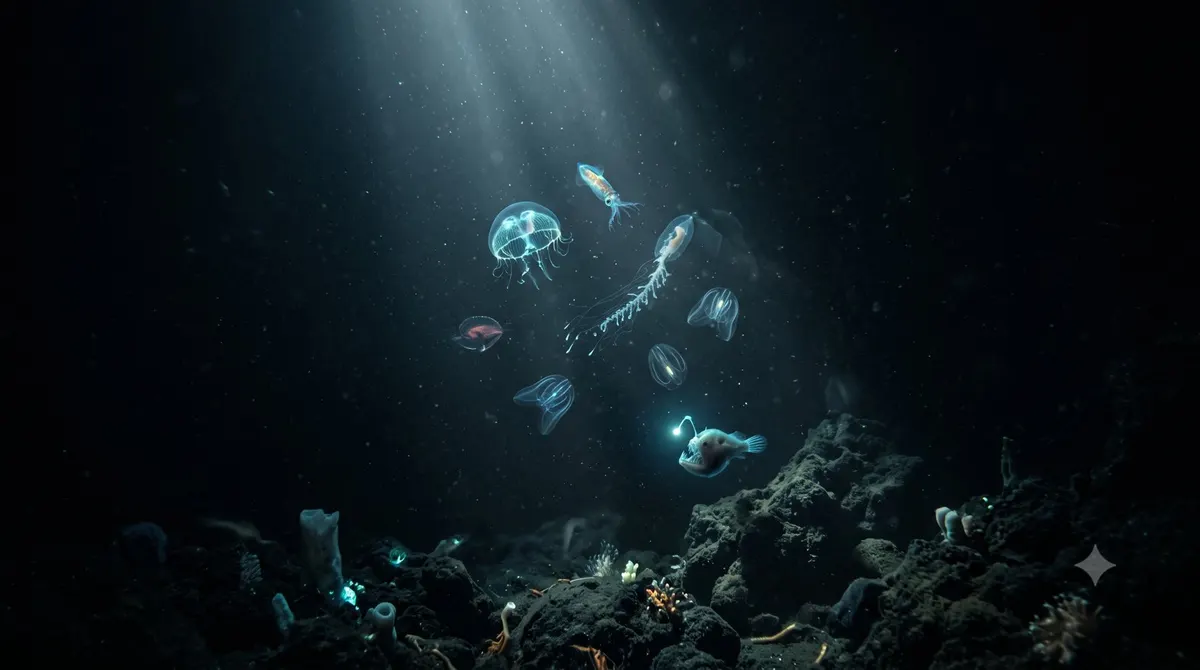
Look out at the sea and you see a shining surface, waves catching the light, maybe a boat or a seabird. But that surface is a lid. Beneath it lies the largest living space on Earth, a world so deep, dark, and cold that we have explored less of it than we have the face of the Moon. The deep ocean is not empty. It is crowded with life, laced with mountain ranges taller than any on land, and quietly running machinery that keeps our whole planet livable. It is, in every real sense, our last great frontier.
How deep is deep?
The ocean averages around four kilometres in depth, but its deepest trenches plunge to nearly eleven kilometres. To picture that, imagine dropping Mount Everest into the Mariana Trench in the western Pacific. Its peak would still be more than a kilometre underwater. Scientists usually call everything below about 200 metres the “deep sea,” because that is roughly where sunlight fades out. Below that line, the familiar rules of the surface no longer apply.
What makes the deep so extreme is pressure. Water is heavy, and every ten metres you descend adds roughly the weight of one atmosphere on top of you. At the bottom of the deepest trenches, the pressure is more than a thousand times what we feel at sea level, enough to crush an unprotected submarine like a tin can. This is why so little of the deep has been visited in person, and why we lean on robots and remote instruments to do our exploring for us.
A world without sunlight
Sunlight is the engine of life on the surface, powering the tiny plant-like plankton that feed almost everything else. But sunlight cannot reach the deep. Descend a few hundred metres and the world turns a deep twilight blue, then, a little further down, pure and total black. It is also cold. Away from the tropics the deep ocean hovers just above freezing, a near-uniform chill that blankets most of the planet’s water.
You might expect a lifeless desert. Instead, the deep teems with strange and beautiful creatures adapted to the dark. Many make their own light through a chemical trick called bioluminescence, glowing to lure prey, find mates, or confuse predators. Fish carry glowing lures dangling in front of their jaws. Some squid squirt clouds of living light instead of ink. In the deep, a flash in the dark can mean dinner, danger, or romance.
Life that needs no sun at all
In the 1970s, explorers found something that rewrote biology textbooks. Along cracks in the seafloor, where the planet’s internal heat leaks out, hot mineral-rich water gushes from chimney-like vents. Around these hydrothermal vents lives a thriving community: giant tube worms, ghostly crabs, mats of bacteria. What astonished scientists was that this life does not depend on the Sun at all.
Instead of photosynthesis, these ecosystems run on chemosynthesis. Special microbes harvest energy from chemicals in the vent water, such as hydrogen sulphide, and use it to build the base of a food web. It was proof that life can flourish on chemistry rather than light, a discovery that reshaped how we think about where life might exist, including on other worlds with hidden oceans, such as some of the icy moons of Jupiter and Saturn.
The deep ocean and the climate
The deep is not just a curiosity. It is a vital part of the machinery that keeps Earth’s climate steady. Ocean currents do not only swirl at the surface. Cold, salty water in the polar regions sinks and flows along the seafloor, spreading slowly around the globe over centuries before rising again. This great overturning acts like a planetary conveyor belt, carrying heat from the tropics toward the poles and redistributing it.
The deep ocean is also an enormous storehouse. It holds vast amounts of heat and carbon dioxide, absorbing much of the extra heat trapped by human-made greenhouse gases. In effect, the deep sea has been softening the blow of climate change, soaking up energy that would otherwise warm the air even faster. But this service comes at a cost: as the deep warms and its chemistry shifts, it can affect currents, sea levels, and the creatures that live there in ways we are only beginning to understand.
The frontier we have barely mapped
Given how important the deep ocean is, it is startling how little we know it. We have detailed maps of the surface of Mars, yet only a fraction of our own seafloor has been surveyed in fine detail. Much of what we do know comes from a handful of crewed dives, along with tethered and free-swimming robots that beam back images and samples. Every serious expedition tends to find species never seen before.
Exploring the deep is slow and expensive, but the reasons to keep going are piling up. The deep holds clues to how life began and how it endures in extreme conditions. It contains mineral deposits that some companies would like to mine, raising urgent questions about protecting fragile ecosystems we barely understand. And it plays a quiet but central role in the climate future of every person on the surface.
The tools we use to explore keep improving, too. Modern research ships trail long strings of sensors, satellites measure the height and temperature of the sea surface from orbit, and fleets of small robotic floats now drift through the ocean for years at a time, diving and surfacing to record conditions at depth. Together these instruments are slowly turning the deep from a total blank into a place we can begin to watch. Yet for all this progress, the honest truth is that a single dive can still reveal creatures and features nobody has ever recorded, a reminder of just how much remains genuinely unknown down there.
The next time you stand at the shore, try to picture what lies beneath that bright, restless surface: kilometres of cold black water, glowing creatures, sunken mountains, and slow deep currents steering the planet’s heat. The deep ocean is the closest thing we have to another world, and it is right here, wrapped around our own. It is Earth’s last frontier, and we are only just beginning to learn how to listen to it.


