 Talking Science Podcast
The Ice Ages – When the World Froze Over
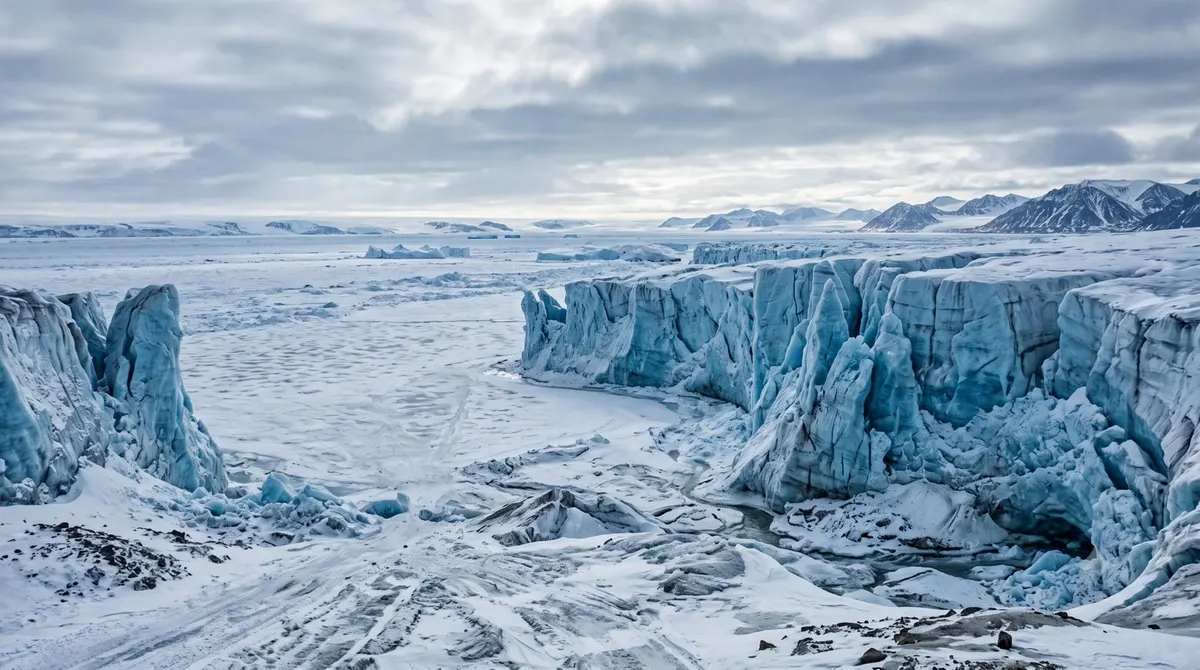
Imagine standing where a great city stands today and seeing, instead of streets and towers, a wall of ice a kilometre thick stretching to the horizon. Not so long ago in the life of our planet, this was reality across much of the northern world. Ice buried Canada, Scandinavia, and northern Britain. Sea levels dropped so far you could have walked between lands now separated by open water. The ice ages are among the most dramatic chapters in Earth’s story, and understanding them tells us a great deal about the climate we live in today.
What an ice age really means
The phrase “ice age” is used loosely, so it helps to be precise. In the strict sense, an ice age is a long period when Earth has permanent ice sheets somewhere on its surface. By that definition we are technically in an ice age right now, because Greenland and Antarctica are still capped with ice. What most people picture, though, are the colder pulses within such a period, when ice spreads far and wide.
Scientists call these colder pulses “glacial periods,” and the warmer gaps between them “interglacials.” Over roughly the last couple of million years, Earth has cycled repeatedly between the two. We currently live in an interglacial, a relatively mild window that has lasted long enough for farming, cities, and civilisation to arise. The great ice sheets that once covered so much land are the leftovers of the last glacial period, which ended around eleven or twelve thousand years ago.
The rhythm of the ice
The most remarkable thing about the ice ages is that they come and go in a rhythm. The ice did not simply arrive once and melt. It advanced and retreated again and again, in cycles lasting tens of thousands of years. For a long time this pattern was a mystery. Why should the planet swing so regularly between frozen and mild?
The leading explanation points to the sky. Earth’s journey around the Sun is not perfectly steady. Over long timescales, the shape of our orbit stretches and relaxes, the tilt of our axis nods up and down, and that axis slowly wobbles like a spinning top. These slow changes, often named after the scientist Milutin Milankovitch who worked them out, alter how much sunlight reaches different parts of the world in different seasons. They do not change the total heat by much, but they change its timing and location, and that turns out to be enough to nudge the planet toward ice or away from it.
How small nudges become big freezes
Here is the puzzle: the changes in sunlight from these orbital wobbles are quite small. How can they build kilometre-thick ice sheets? The answer lies in feedbacks, the ways the climate amplifies a small push into a large response.
Consider what happens when a cool summer lets a little winter snow survive instead of melting. Fresh snow and ice are bright white and reflect sunlight back to space. So more surviving ice means more reflected sunlight, which means more cooling, which means still more ice survives the following year. This self-reinforcing loop is called the ice-albedo feedback, and it can turn a modest cooling into a runaway chill.
Another key player is carbon dioxide. During glacial periods, the oceans and other processes pulled more of this heat-trapping gas out of the air, which cooled the planet further. When conditions shifted the other way, carbon dioxide rose again and helped melt the ice. Orbit sets the beat, but feedbacks involving ice and greenhouse gases turn that beat into full-blown ice ages.
Reading the frozen record
How can we possibly know about climates from tens of thousands of years ago? The Earth keeps records, if you know where to look. Ice sheets themselves are living archives. As snow falls year after year and compresses into ice, it traps tiny bubbles of ancient air. By drilling long cylinders of ice, called ice cores, from Greenland and Antarctica, scientists can sample the atmosphere of the distant past and measure how temperatures and greenhouse gases changed.
The land and sea keep records too. Mud on the ocean floor, laid down layer by layer, holds the shells of tiny creatures whose chemistry reflects the temperature of the water they lived in. Glaciers leave scratches on bedrock and dump piles of rubble that mark how far they once reached. Piece these clues together and a detailed history emerges, one that matches the rhythm of Earth’s orbital wobbles remarkably well.
Why it matters now
The ice ages are more than ancient history. They are a natural experiment that shows how sensitive our climate is, and how tightly temperature and carbon dioxide are linked. Small nudges, amplified by feedbacks, can reshape whole continents. That lesson is directly relevant today, because humans are now changing the amount of carbon dioxide in the air far faster than any natural ice-age cycle ever did.
Understanding past climates also helps us read the future. The ice cores and ocean muds give scientists a baseline for what is normal, letting them see clearly how unusual the recent warming is. And they remind us that the comfortable, stable climate in which civilisation grew up is not guaranteed forever. It is one setting on a machine that has known both frozen worlds and warmer ones.
There is a striking human dimension to all of this as well. The end of the last glacial period, as the great ice sheets melted back, opened up land, changed coastlines, and reshaped where plants and animals could live. It was during this warming, into the mild interglacial we still enjoy, that people first settled into villages, began to farm, and built the earliest cities. In a very real way, the retreat of the ice set the stage for everything we call history. The ice ages are not just a chapter about frozen landscapes; they are part of the story of how we came to live the way we do.
The ice ages tell a story of a restless planet, one that has repeatedly buried and freed its own surface in response to the faint rhythm of its orbit. It is a humbling tale of how connected everything is: the tilt of a distant axis, the brightness of snow, an invisible gas in the air, all working together to decide whether ice or grassland covers the ground beneath our feet.


