Talking Science Podcast
The James Webb Space Telescope – Seeing the First Light
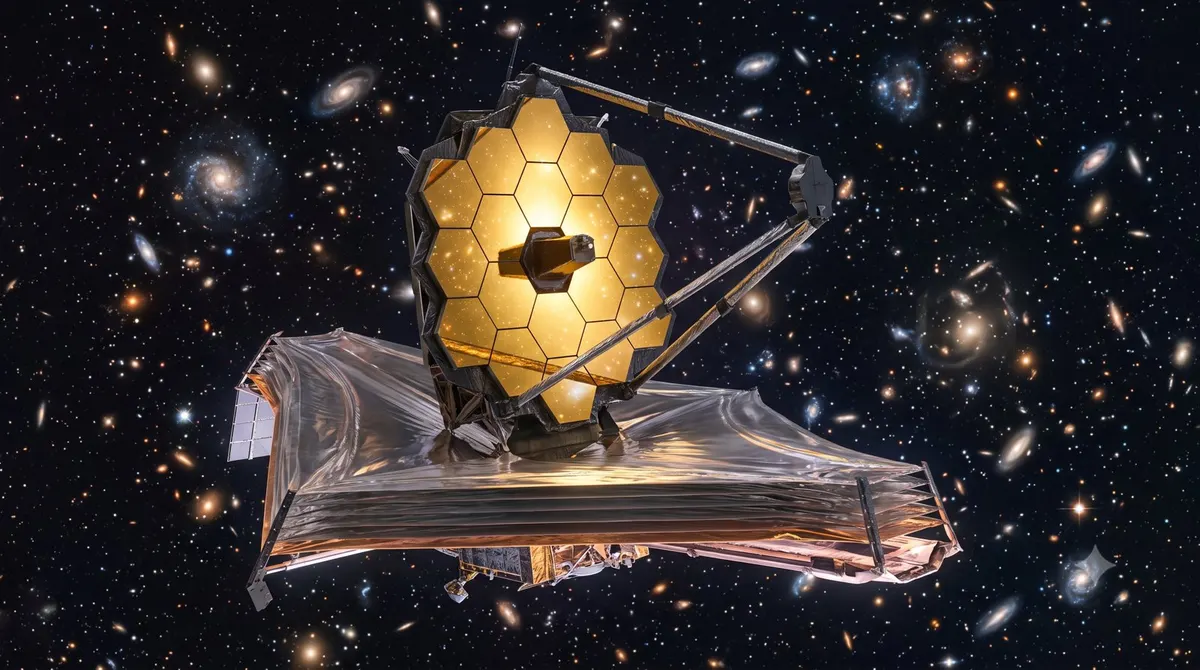
Every so often, humanity builds an instrument that changes what we are able to see. The James Webb Space Telescope is one of those instruments. It is the largest and most powerful telescope ever sent into space, the product of decades of work by thousands of people, and it was built with an audacious goal: to catch the faint light of the very first galaxies, born in the early universe, and to peer at distant planets in a way no telescope before it could. To understand why it is such a leap, it helps to start with the strange kind of light it was designed to see.
Seeing in infrared
Our eyes detect only a thin slice of all the light that exists – the colours of the rainbow, from red to violet. But light comes in many other varieties beyond what we can perceive. Just past red, at wavelengths too long for our eyes, lies infrared light. We cannot see it, but we can feel some of it as heat. The James Webb telescope is designed above all to see this infrared light, and that choice is the key to everything it does.
Why infrared? There are two big reasons. First, infrared light passes more easily through the clouds of dust that fill space, so an infrared telescope can peer into the dusty cradles where stars and planets are being born, seeing through veils that block ordinary light. Second, and more profoundly, the light from the most distant objects in the universe reaches us stretched into the infrared – and that stretching is a direct consequence of how the universe behaves.
Light from the deep past
Here is one of the most beautiful ideas in astronomy. When you look at something far away in space, you are also looking back in time. Light travels fast but not infinitely fast, so the light entering a telescope tonight left its source long ago. Look far enough, and you are seeing objects as they were billions of years in the past, when the universe was young.
The universe is also expanding, with distant galaxies moving away from us, and as that space stretches it stretches the light travelling through it toward longer, redder wavelengths. Light that began as ordinary visible or ultraviolet light, emitted by some of the earliest stars and galaxies, has been stretched so far by its long journey across the expanding cosmos that it arrives as infrared. To see the first light in the universe, then, you must build a telescope that sees in the infrared. That is exactly what was done.
An engineering marvel
Building such a telescope pushed engineering to its limits. To gather as much faint light as possible, the telescope needed an enormous mirror, far larger than any rocket could carry in one piece. The solution was to build the mirror in segments that folded up for launch, packed away like origami, and then unfolded once in space to form a single great golden mirror several metres across.
There was a second, equally demanding problem. Because the telescope hunts for faint heat-light, its own warmth would blind it – like trying to see a candle while standing next to a bonfire. So the telescope has to be kept extraordinarily cold. It carries a vast sunshield, roughly the size of a tennis court, made of thin layers that block the Sun’s heat and let the instruments chill to hundreds of degrees below freezing. And rather than orbiting close to Earth, the telescope was sent far out into space, well beyond the Moon, to a special point where it can stay cold and stable, always shielded from the Sun, the Earth, and the Moon at once.
What it is showing us
Since it began its work, the telescope has been sending back images and measurements of remarkable depth. It has captured galaxies so distant, and therefore so ancient, that we are seeing them as they were when the universe was only a small fraction of its present age. It has photographed clouds of gas and dust where new stars are forming, revealing structure and detail that were previously hidden. Its pictures manage to be both scientifically valuable and genuinely, unexpectedly beautiful.
Its work broadly falls into a few great themes:
- Looking back toward the earliest galaxies to learn how the first structures in the universe took shape.
- Watching stars and planetary systems being born inside their dusty clouds.
- Studying the atmospheres of planets around other stars.
Sampling distant atmospheres
That last theme is especially exciting. When a planet passes in front of its star, a little starlight filters through the planet’s atmosphere on its way to us, and different gases leave their fingerprints on that light. This telescope’s power and its infrared vision make it able to detect those fingerprints for worlds many light-years away, teasing out what their atmospheres are made of. It is a way of studying the air of planets we can never visit – and, in time, of asking whether any of them might be suited to life.
It is worth remembering, too, how much patience and nerve this project required. The telescope was many years in the making, far longer and far more expensive than first planned, and its success depended on hundreds of separate steps unfolding flawlessly after launch. Because it sits so far from Earth, no repair mission could ever reach it; every folding mirror segment and every layer of the sunshield had to deploy perfectly, in sequence, with no chance to fix a mistake. That it all worked was a triumph not just of clever design but of careful, meticulous engineering carried out by an enormous international team over the better part of a generation.
A new window, just opening
What makes all this so thrilling is that the telescope is still near the beginning of its mission. Every deep observation reaches a little further, and each one has the potential to surprise us. Great instruments have a way of revealing things their builders never imagined, answering old questions while raising new ones no one thought to ask. The James Webb Space Telescope has given us a fresh window onto the cosmos, tuned to catch the ancient, stretched-out light of the universe’s first morning – and through it, we are only just beginning to look.