Talking Science Podcast
The Life and Death of Stars
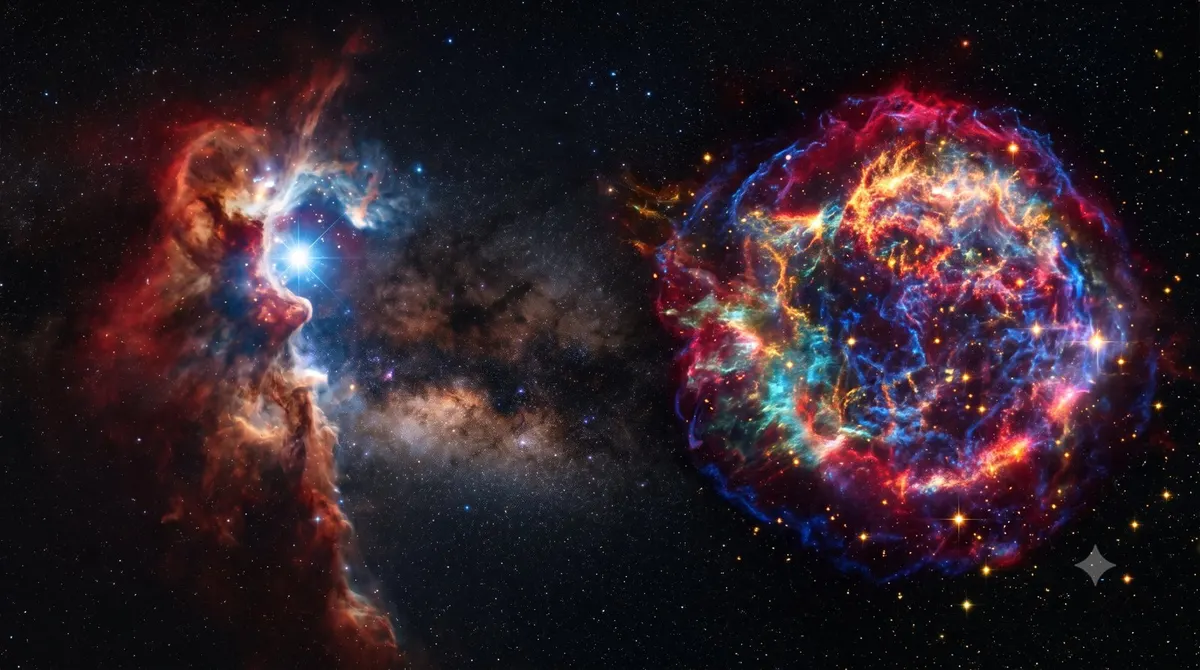
Look up on a clear night and the stars seem eternal, fixed points that have watched over the world since the beginning of time. But stars are not eternal. They are born, they live, and they die, following life stories that can stretch across billions of years. And here is the wonderful part: nearly every atom in your body was forged inside a star that died long before the Sun was born. To understand stars is, in a very real sense, to understand ourselves.
Cradles of Gas and Dust
Stars begin their lives in enormous clouds of cold gas and dust that drift between the stars. These clouds, sometimes light-years across, are mostly hydrogen, the simplest and most abundant element in the universe. Left alone, a cloud might sit quietly for ages. But give it a nudge, perhaps a shockwave from a nearby exploding star, and pockets of gas begin to clump together under their own gravity.
As a clump collapses, it heats up. Gravity pulls the material tighter and tighter, and the center grows denser and hotter. When the core finally reaches millions of degrees, something extraordinary happens. Hydrogen atoms begin fusing together to form helium, releasing a tremendous burst of energy. A star is born, and it begins to shine.
The Long, Steady Middle Years
For most of its life, a star exists in a delicate and beautiful balance. The energy pouring out from nuclear fusion in the core pushes outward, while the star’s own gravity pulls inward. These two forces hold each other in check, and the star settles into a long, stable phase. Our Sun is in this phase right now, and has been for billions of years, with billions more to go.
How long a star lives depends almost entirely on its mass, and in a way that surprises many people. You might expect the biggest stars to last the longest, but the opposite is true. Massive stars burn through their fuel furiously, blazing brilliantly but exhausting themselves in just a few million years. Small, cool stars sip their fuel slowly and can shine steadily for many billions, even trillions, of years.
The color of a star offers a clue to its nature. Hotter stars glow blue and white, while cooler ones burn orange and red. This is why astronomers can learn so much simply by studying starlight. By spreading a star’s light into its component colors, they can read off its temperature, its composition, and even how fast it is moving. A single beam of light, gathered by a telescope, carries a wealth of information across the vast gulf of space.
When the Fuel Runs Low
No star burns forever. Eventually the hydrogen in the core runs out, and the careful balance begins to break down. For a star like the Sun, the core contracts and heats while the outer layers swell enormously, cooling to a ruddy glow. The star becomes a red giant, bloating to many times its original size. When our Sun reaches this stage in the distant future, it may grow large enough to swallow the innermost planets.
Inside a red giant, fusion continues in new ways, building heavier elements like carbon and oxygen from helium. But a star like the Sun does not have enough mass to keep this going indefinitely. Once it can no longer sustain fusion, its fate is gentle compared to its larger cousins. There is a certain poignancy in this final chapter, a long, luminous farewell rather than a sudden end.
Two Very Different Endings
How a star dies depends, once again, on its mass. For a modest star like the Sun, the ending is quiet and even lovely. The outer layers drift away into space, forming a glowing shell of gas called a planetary nebula, a name that has nothing to do with planets and comes from how these objects looked through early telescopes. Left behind is the exposed core, a small, incredibly dense ember called a white dwarf that will slowly cool over the ages.
Massive stars go out with unimaginable violence. In their final days they fuse elements all the way up to iron, but iron cannot yield energy through fusion. With the furnace suddenly starved, the core collapses in a fraction of a second, then rebounds in a titanic explosion called a supernova. For a brief time, a single supernova can outshine an entire galaxy of billions of stars.
Stardust and Second Lives
Supernovae are not just spectacular deaths. They are engines of creation. The staggering energy of the blast forges many of the heaviest elements and scatters them across space, seeding the galaxy with the raw materials for new worlds. Consider what this means:
- The carbon in your cells was cooked inside ancient stars
- The oxygen you breathe was scattered by stellar explosions
- The iron in your blood was born in cosmic catastrophe
The clouds enriched by dying stars become the nurseries for the next generation, and so the cycle turns. Each generation of stars leaves the galaxy a little richer in the elements needed for planets, and perhaps for life.
The Densest Remnants
What the biggest stars leave behind is stranger still. If the collapsed core is heavy enough, it becomes a neutron star, an object so dense that a sugar-cube-sized piece would weigh as much as a mountain. And if the core is heavier yet, gravity overwhelms everything, and the remnant collapses into a black hole, from which not even light can escape. These exotic corpses are the final punctuation marks on the lives of the most massive stars.
So the next time you gaze at the night sky, remember that you are watching a vast, slow drama of birth and death playing out across the heavens. Stars are not eternal, but they are the great recyclers of the cosmos, turning simple hydrogen into the rich variety of elements that make up worlds and living things. Their deaths are not endings so much as beginnings, and in their scattered ashes lies the story of how we came to be here at all.