 Talking Science Podcast
The Magnetosphere – Earth’s Invisible Shield
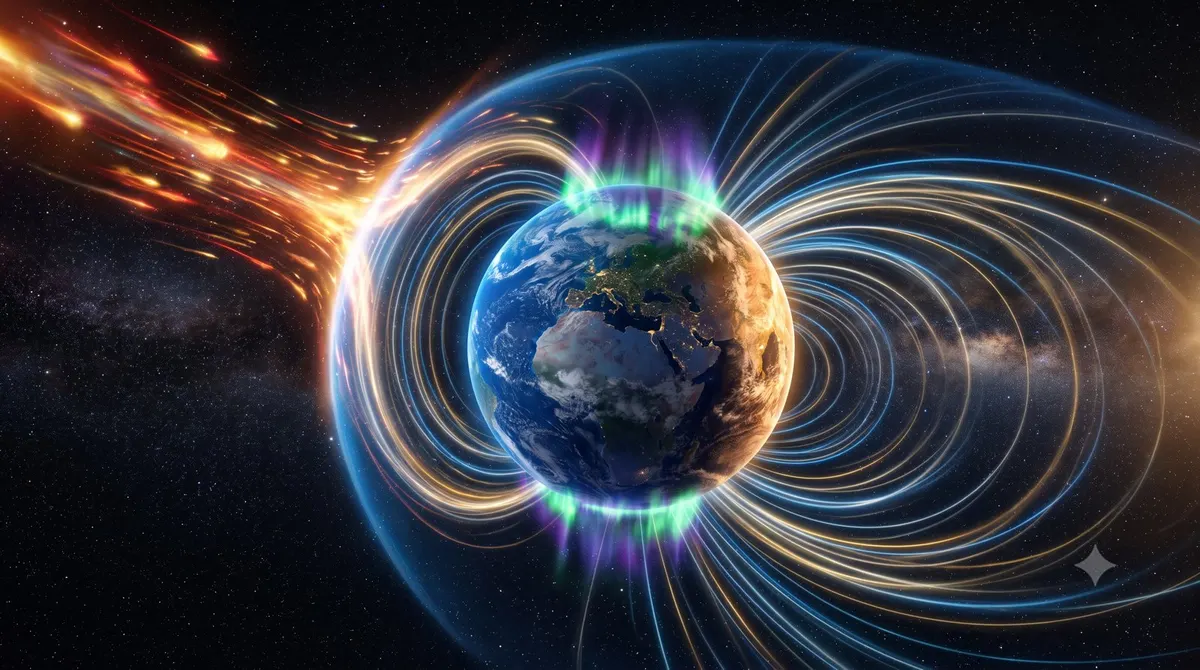
Right now, without any drama or fanfare, an invisible battle is being fought high above your head. The Sun is firing a relentless stream of charged particles across space, and something is turning them aside before they can reach the ground. That something is the magnetosphere, a vast magnetic bubble surrounding our planet. You cannot see it, feel it, or hear it, yet without it, life on Earth as we know it might never have taken hold. It is, quite literally, our planet’s invisible shield.
A Magnet at the Core
To understand the shield, we have to travel to the centre of the Earth. Far below the crust and mantle lies the core, and its outer part is a vast ocean of molten metal, mostly iron, swirling under enormous heat and pressure. As this liquid metal churns and the planet spins, it generates electric currents, and those currents produce a magnetic field. Scientists call this self-sustaining process the geodynamo.
The result is that the whole Earth behaves rather like a giant bar magnet, with a magnetic north and south. This field is what tugs the needle of a compass into line, a quiet everyday reminder that we live inside a planet-sized magnet. But the field does not stop at the surface. It stretches far out into space, and out there it does something far more important than pointing compasses.
The Wind From the Sun
Our Sun is not a calm, steady lamp. It is a seething ball of hot gas that constantly flings a stream of charged particles, mostly electrons and protons, out into the solar system. This flow is called the solar wind, and it blows past the planets day and night, year after year, sometimes gusting into violent storms when the Sun is especially active.
These particles carry energy, and a steady bombardment of them is bad news for a planet. They can strip away atmosphere over long ages and pose a hazard to living things and delicate technology. A world with no protection against the solar wind is a world at the mercy of its star. This is where the magnetosphere earns its keep.
How the Shield Works
Here is the elegant part. Charged particles cannot easily cross magnetic field lines; instead they get deflected and steered by them. So when the solar wind slams into Earth’s magnetic field, most of it is turned aside and swept around the planet, much as water parts around the bow of a boat. The magnetosphere is the region of space where Earth’s magnetic field holds sway and does this deflecting.
The constant pressure of the solar wind actually shapes the magnetosphere. On the side facing the Sun, it is squashed and compressed. On the far side, it is stretched out into a long trailing tail that reaches far beyond the Moon’s orbit, like the wake behind a boat. It is a dynamic, breathing structure, swelling and shifting as the solar wind rises and falls.
Why It Matters for Life
The protection the magnetosphere offers is easy to overlook precisely because it works so well. By deflecting much of the solar wind, it helps shield the atmosphere from being gradually stripped away into space. A stable atmosphere, in turn, is essential for liquid water and for the mild, breathable conditions that life depends on. It is one of several reasons Earth has remained hospitable over billions of years.
The shield also guards the delicate machinery of modern civilisation. Satellites, power grids, and communication systems can all be disrupted by bursts of solar particles. When the Sun unleashes a particularly strong storm, the magnetosphere absorbs much of the blow, though the strongest storms can still cause trouble, occasionally knocking out power or scrambling signals. Astronauts and high-altitude travellers rely on it too, since it reduces the radiation reaching them.
Lights in the Sky
The magnetosphere does not turn away every particle. Near the magnetic poles, the field lines dip down toward the Earth, and some charged particles are funnelled along them into the upper atmosphere. When these particles collide with gases high above the ground, they make those gases glow, painting the sky with shimmering curtains of colour. These are the auroras, the northern and southern lights.
So the same shield that protects us also gives us one of nature’s most beautiful displays. Different gases glow in different colours, greens and reds and purples rippling across the polar sky. An aurora is really a visible sign of the invisible battle overhead, the moment when the solar wind and the magnetosphere meet and, briefly, we get to watch.
A Shield That Shifts
Earth’s magnetic field is not fixed and eternal. The magnetic poles wander slowly over time, which is why navigators and mapmakers have to keep updating their charts. More dramatically, the geological record shows that the field has completely reversed many times over the planet’s history, with magnetic north and south swapping places. These reversals unfold over long stretches of time and have happened repeatedly without ending life, though the details of what a reversal is like remain an active area of study.
The idea of the shield also puts our place in the solar system in perspective. Not every world is so lucky. A planet needs a hot, churning metal interior to generate a strong magnetic field, and not all of them have one, or have kept one over time. Where the field is weak or absent, the solar wind can work away at the atmosphere over the ages with far less resistance. Earth’s vigorous internal engine, still churning after billions of years, is part of what has kept our world wrapped in air and hospitable to life.
What lingers with me about the magnetosphere is how much it does while asking nothing of us and revealing almost nothing of itself. It springs from molten metal thousands of kilometres down, reaches out beyond the Moon, turns aside a ceaseless wind from the Sun, and every so often gives us dancing lights as a kind of receipt. We go about our days beneath an invisible shield we almost never think about, and it goes about its work regardless. It is worth pausing, now and then, to be quietly grateful for the magnet at the heart of our world.


