Talking Science Podcast
The Origin of Life – From Chemistry to Biology
Somewhere in the deep past of our planet, something extraordinary happened. A world of ordinary chemistry, of rocks and water and swirling gases, gave rise to something entirely new: life. Molecules began to copy themselves, to gather energy, and to change over time. How that transition happened, how non-living matter crossed the line into living matter, is one of the greatest unsolved questions in all of science. We do not yet have the full answer, but we have learned enough to sketch a plausible outline, and the story that emerges is one of the most fascinating in nature.
A Very Different Young Earth
The Earth is about four and a half billion years old, and for its earliest stretch it was a harsh and alien place. There was no oxygen in the air to speak of, volcanoes were widespread, and the young planet was battered by impacts from space. Yet within roughly the first billion years, and quite possibly a good deal sooner, life had appeared, because we find traces of ancient microbes in some of the oldest rocks that could have preserved them.
This tells us something important. Life arose relatively quickly, in geological terms, once conditions allowed. Whatever the process was, it did not require a fantastically improbable fluke that we might expect to take almost forever. It happened on the early Earth within a span that, while vast by human standards, is a mere opening chapter in the planet’s long history.
The Building Blocks Come First
Before there could be life, there had to be the right ingredients. Living things are built from a specific set of molecules, including amino acids, which link together to form proteins, and the components of DNA and its cousin RNA. A natural question is whether such molecules could form on their own, without any life to make them.
The answer appears to be yes. In a famous experiment in the twentieth century, scientists mixed together simple gases thought to resemble the early atmosphere, added a spark to mimic lightning, and found that amino acids formed all by themselves. Since then, researchers have discovered these building-block molecules in many places, including on meteorites that fall from space. This suggests that the raw ingredients of life are not rare or special, but form readily wherever the right simple chemistry is at work.
The Puzzle of Self-Copying
Having the ingredients is not the same as having life. A crucial threshold is the ability to copy oneself, because copying is what allows for inheritance and, eventually, for evolution. This raises a chicken-and-egg problem. In life today, DNA stores information but needs proteins to copy it, while proteins are built using the information in DNA. Each depends on the other, so which came first?
A leading idea offers a way out of this loop. The molecule RNA, which is similar to DNA, can both carry information and, in some cases, act like a worker molecule that speeds up chemical reactions. This means a single type of molecule might once have done both jobs, storing information and helping to copy itself. Scientists call this proposed early stage the RNA world, and it offers a plausible bridge between plain chemistry and true biology.
Drawing a Line Around Life
Another key step was separation. A living thing needs a boundary, a way to keep its useful molecules together and hold the outside world at bay. Without some kind of container, any self-copying molecule would simply drift apart and lose its ingredients to the surrounding water.
Here nature seems to offer a helping hand. Certain fatty molecules, when placed in water, spontaneously arrange themselves into tiny hollow bubbles, because one end of each molecule is drawn to water while the other end shuns it. These bubbles resemble simple versions of the membranes that enclose every living cell. It is not hard to imagine self-copying molecules becoming trapped inside such bubbles, gaining a protected space in which to work, and taking a real step toward becoming a cell.
The Role of Energy
There is one more ingredient that any account of life’s origin must explain, and it is easy to overlook: energy. Life is not just about the right molecules sitting together; it is about keeping chemical reactions running, over and over, against the natural tendency of things to settle into stillness. A living cell is constantly working, and work requires a steady supply of energy.
On the early Earth, energy was available in several forms, such as sunlight, lightning, heat from volcanic activity, and the chemical energy locked in minerals where different substances met and reacted. Some researchers argue that the earliest life may have fed on these mineral and chemical energy sources long before anything learned to harness sunlight. Working out how the first primitive systems captured and used energy is one of the liveliest parts of the whole investigation, because without a power source, none of the rest could keep going.
Where It Might Have Happened
Scientists debate exactly where on the early Earth these steps unfolded, and several settings look promising. Among the leading candidates are:
- Warm little ponds that repeatedly dried and refilled, concentrating chemicals
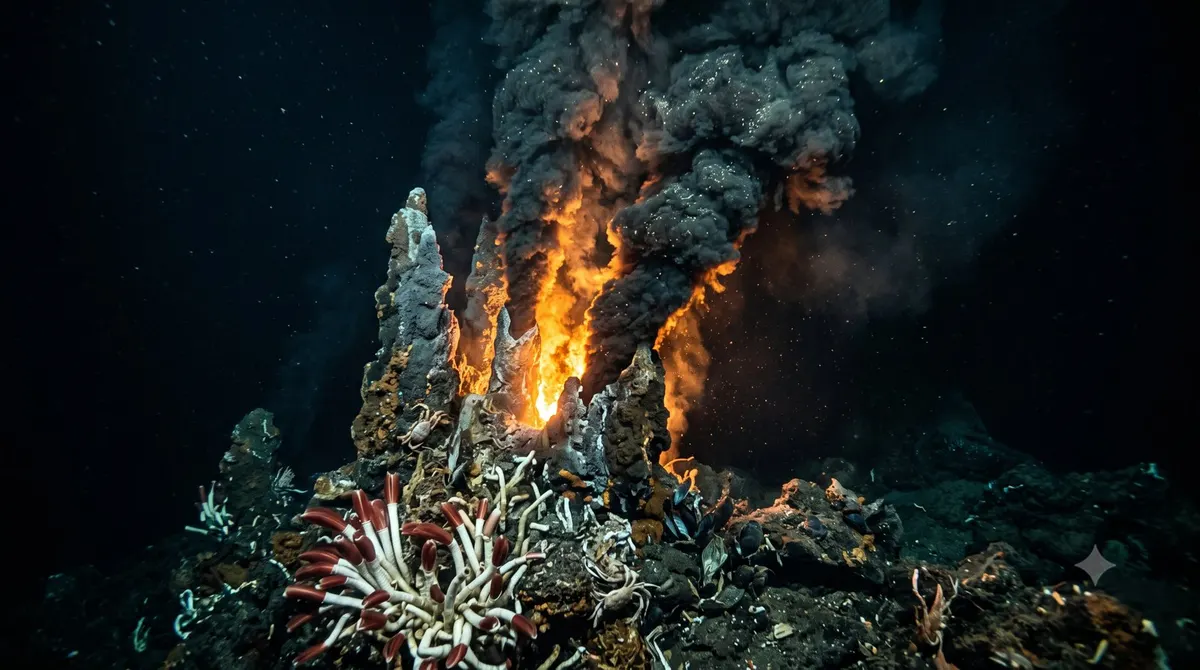
- Deep-sea vents where hot, mineral-rich water met cold ocean
- The surfaces of certain minerals, which could gather molecules together
Each of these places offers something useful, such as a source of energy, a way to concentrate scattered ingredients, or surfaces on which reactions could be encouraged. It is quite possible that the origin of life did not depend on one single setting, but drew on a combination of them. Researchers are actively testing these ideas in laboratories, trying to recreate plausible early conditions and watch what chemistry does on its own.
An Open and Honest Mystery
It is worth being clear about what we do and do not know. We do not have a complete, proven account of how life began, and we may never be able to point to the exact events that took place so long ago. But this is not a gap that science shrugs at; it is an active frontier, full of clever experiments and steadily accumulating clues. What we can say is that the ingredients of life form easily, that molecules capable of copying themselves are chemically plausible, and that simple containers arise on their own. Piece by piece, the journey from chemistry to biology is becoming less of a miracle and more of a puzzle we are slowly learning to read.