 Talking Science Podcast
The Rock Cycle – How Stone Is Recycled
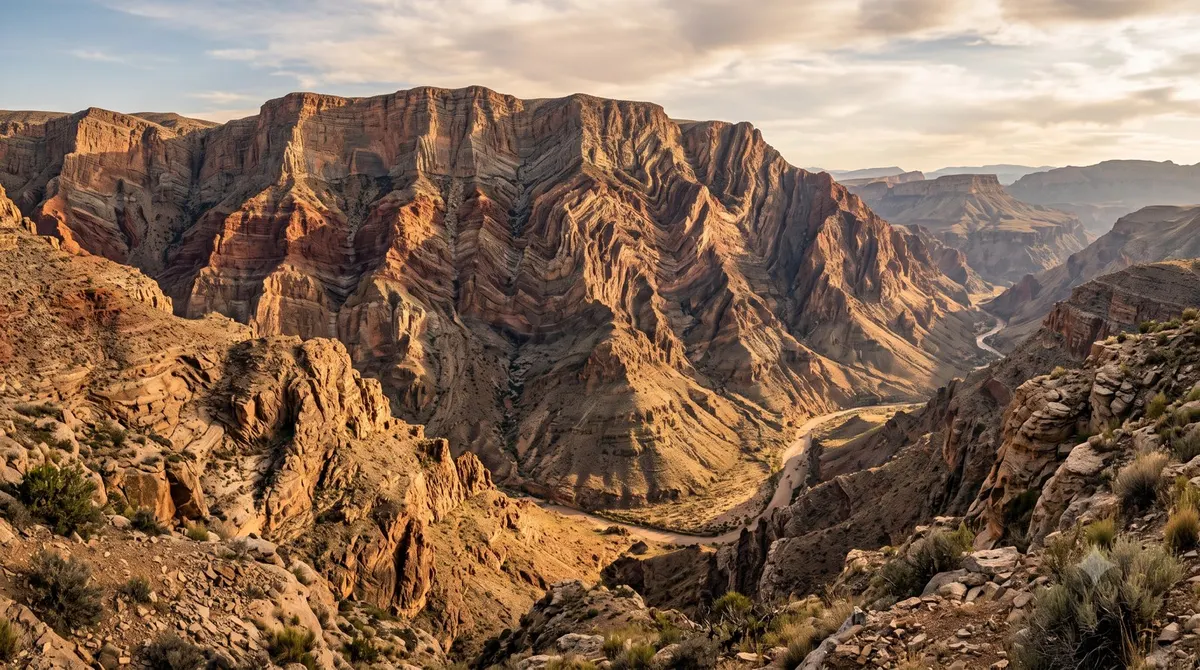
We reach for stone whenever we want to describe something that lasts. Set in stone. Solid as a rock. And on the timescale of a human life, that instinct is fair enough; the boulder in the field will outlast you and your grandchildren. But zoom out to the timescale of the planet, and rocks turn out to be some of the least permanent things around. Mountains crumble into sand, sand hardens into stone, stone melts and hardens again. This endless remaking is called the rock cycle, and it is one of the great recycling systems of the Earth.
Three Families of Rock
Almost every rock you will ever pick up belongs to one of three families, and the rock cycle is really the story of how rocks move between them. The three families are defined not by what they are made of but by how they formed.
Igneous rocks form when molten rock cools and hardens. Sedimentary rocks form when fragments and particles are pressed and cemented together over time. Metamorphic rocks form when existing rock is transformed by heat and pressure without fully melting. The magic of the rock cycle is that any of these can become any other, given the right conditions and enough time. Nothing is a dead end.
Born of Fire
Let us start with fire, because in a sense it starts everything. Deep beneath our feet, the Earth is hot, hot enough in places to melt rock into a thick, glowing liquid called magma. When magma cools and solidifies, it becomes igneous rock, from a Latin word for fire.
How the rock turns out depends on how quickly it cools. When magma erupts from a volcano as lava and cools quickly at the surface, the crystals have little time to grow, so the rock is fine-grained. When magma cools slowly deep underground, large crystals have time to form, producing coarse-grained rock like granite. Either way, molten material has become solid stone, and the cycle has a starting point, even if, in truth, the cycle has no real beginning or end.
Worn Down to Grains
No sooner does rock reach the surface than the planet sets about tearing it apart. This is weathering and erosion, the slow demolition crew of the rock cycle. Rain, frost, wind, roots, and chemical reactions all attack exposed rock. Water seeps into cracks and freezes, prying stone apart. Acids in rainwater dissolve certain minerals. Grain by grain, even the mightiest mountain is broken down.
The loosened fragments, from boulders to the finest silt, are carried away by rivers, wind, glaciers, and gravity. This is erosion, the transport of the broken pieces. Eventually much of this material comes to rest somewhere quieter, often at the bottom of a lake or sea, where it settles into layers. Given enough time, a towering peak can be reduced to a spread of sand and mud on a distant seafloor.
Pressed Into Stone
Those settled layers are the raw material of the next rock family. As sediment piles up, the weight of the material above squeezes the lower layers, driving out water and pressing the grains together. Minerals dissolved in the water can act like a natural cement, gluing the particles into solid rock. This is how sedimentary rock forms, and it is why so many sedimentary rocks show clear layers, one deposit stacked on the next like pages in a book.
Sedimentary rocks are special because they often preserve records of the past. Fossils are almost always found in them, since the gentle burial of sediment can entomb shells, bones, and footprints before they are destroyed. A cliff of layered sedimentary rock is, in effect, a history book, with the oldest chapters at the bottom and the newest near the top.
Transformed Without Melting
Now suppose a body of rock, igneous or sedimentary, gets buried very deeply, or caught up in the slow collision of the great plates that make up the Earth’s surface. Down there it is subjected to intense heat and crushing pressure, but not quite enough to melt it. Under these conditions the rock changes. Its minerals rearrange, new crystals grow, and its texture transforms. The result is metamorphic rock, from Greek words meaning to change form.
This is how soft, crumbly limestone can become hard, gleaming marble, and how ordinary mudstone can become slate that splits into flat sheets. The rock has not melted and it has not been ground up; it has been remade in place, its very structure reworked by the pressures deep inside the Earth.
A Cycle Without End
Here is where the cycle closes, or rather, where it reveals that it never really closes at all. A metamorphic rock, pushed even deeper or into hotter regions, can finally melt into magma, ready to cool once more into igneous rock. That igneous rock can be lifted up, weathered into sediment, and pressed into sedimentary rock. Sedimentary rock can be buried and transformed into metamorphic rock. Every path connects to every other, and material can loop through these forms again and again over hundreds of millions of years.
The engine behind all of it is the Earth’s own restlessness: the internal heat that keeps the interior churning and drives the slow drift of the continents, and the relentless work of water, wind, and gravity at the surface. Between them, they keep the stone moving.
One thing that often surprises people is that the cycle has no fixed sequence. A rock does not have to pass through each family in a set order. Sedimentary rock at the surface can be weathered straight back into new sediment without ever becoming metamorphic or molten. Igneous rock can be buried and transformed directly into metamorphic rock. The rock cycle is less a tidy loop and more a web of possible paths, with many shortcuts and detours, all of them playing out over spans of time that dwarf human history.
What I find quietly wonderful about the rock cycle is that it dissolves the idea of permanence altogether. The pebble on the path might once have been part of a volcano, or the floor of a vanished sea, or a mountain long since worn to nothing. It will not stay a pebble forever either. Stone is not the end of the story; it is just one frame in a film that has been running for billions of years, and is running still, far too slowly for us to see.


