Talking Science Podcast
The Search for Life Beyond Earth
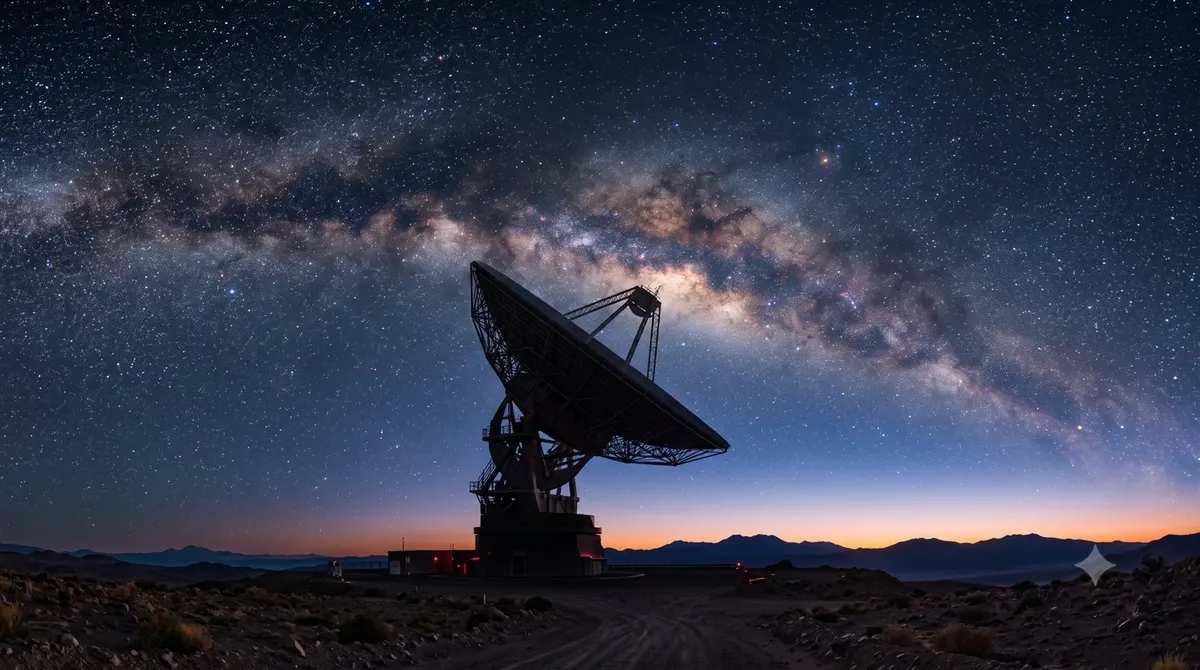
It may be the oldest question humans have ever asked while staring at the night sky: are we alone? For most of history it belonged to philosophers and poets. Today it belongs to scientists, armed with telescopes, spacecraft, and laboratories. The search for life beyond Earth has become a serious, rigorous field, and while we have not found a definite answer yet, we are learning where to look and what to look for with growing precision.
What Are We Even Looking For
Before hunting for alien life, scientists have to decide what counts as life and how to recognize it from afar. Our only example is life on Earth, so the search naturally begins with the ingredients that life here depends on. Chief among them is liquid water, which acts as the medium where the chemistry of living things takes place. Researchers also look for a source of energy and a supply of certain chemical elements, especially carbon, which forms the flexible backbone of biological molecules.
This does not mean alien life must be identical to ours. But by focusing on the conditions we know can support life, scientists can narrow an impossibly large search into something manageable. The guiding phrase is often to follow the water, since worlds with liquid water are considered the most promising places to start looking.
Life in Impossible Places
One reason optimism has grown is a series of surprises here at home. Life on Earth turns out to be far tougher and more adaptable than anyone once believed. In scalding hot springs, in the crushing dark of the deep ocean floor, in acidic pools and inside solid rock kilometers underground, scientists keep finding organisms thriving where life seemed impossible. These hardy survivors are nicknamed extremophiles.
Their existence changes the whole calculation. If living things can flourish beside boiling volcanic vents with no sunlight at all, then perhaps a frozen moon or a harsh alien world is not so hostile after all. Extremophiles have expanded our sense of where life might gain a foothold, both on Earth and elsewhere.
Promising Worlds Next Door
We do not need to leave our own solar system to find intriguing targets. Mars sits near the top of the list. It is cold and dry today, but there is strong evidence that rivers, lakes, and perhaps oceans once covered its surface billions of years ago. Rovers are actively exploring ancient riverbeds and collecting samples, searching for chemical traces that microbial life might have left behind.
Even more exciting to many scientists are certain icy moons of the giant planets. Beneath the frozen shell of Jupiter’s moon Europa, and Saturn’s moon Enceladus, lie vast oceans of liquid water, kept warm by the flexing pull of their parent planets. Enceladus even sprays plumes of water into space through cracks in its ice, and spacecraft have flown through those plumes and detected the kinds of chemistry that life could use. These hidden oceans are among the most promising places to search for life anywhere nearby.
Reading the Air of Distant Planets
Beyond our solar system, astronomers have discovered thousands of planets orbiting other stars, known as exoplanets. Some are rocky worlds sitting in the so-called habitable zone, the region around a star where temperatures could allow liquid water on the surface. The great challenge is that these planets are unimaginably far away, so we cannot visit them or even see them clearly.
Instead, scientists study the light that passes through or reflects off a planet’s atmosphere. As starlight filters through the air of a distant world, different gases absorb specific colors, leaving a chemical fingerprint. By reading these fingerprints, astronomers hope to detect gases that might hint at life, such as certain combinations that would be hard to explain without living organisms constantly producing them. This is painstaking work, and any claim would demand extraordinary evidence, but the tools are improving rapidly.
Listening for a Signal
There is also the bolder possibility of intelligent life. For decades, a field known as the search for extraterrestrial intelligence has scanned the skies for signals that technology might produce, most often radio waves. The reasoning is simple: a broadcasting civilization might, intentionally or not, send out signals that stand out from the natural static of the cosmos.
So far, the sky has been silent. This absence raises a genuine puzzle sometimes called the Fermi paradox: given the sheer number of stars and planets, why have we not heard from anyone? The possible answers range from the sobering idea that intelligent life is extraordinarily rare, to the more reassuring thought that we have simply not looked long or carefully enough. Both remain on the table.
It is worth being honest about how careful this work has to be. History is full of premature announcements of alien life that later dissolved under scrutiny, from imagined canals on Mars to hasty claims about meteorites. Because the stakes are so high, scientists hold any potential discovery to an exceptionally strict standard, demanding that ordinary, lifeless explanations be ruled out first. A whiff of an interesting gas or an unusual rock is a reason to investigate further, not a reason to celebrate. This caution is not timidity; it is what keeps the search credible.
That patience is paying off in the form of better tools. Powerful new telescopes on the ground and in space are beginning to probe the atmospheres of distant worlds in detail once thought impossible. Missions are being designed specifically to fly to the icy moons of the outer solar system and study their hidden oceans. Slowly but steadily, the question of life beyond Earth is moving from speculation toward something we can actually test.
Whatever the outcome, the search itself is worthwhile. If we find even a single microbe on another world, we will know that life is not a one-time fluke but something the universe does readily, which would transform our understanding of our place in the cosmos. And if, after all our searching, we find nothing, that too would be profound, suggesting that life, and especially minds able to wonder about it, may be rarer and more precious than we ever imagined.