Talking Science Podcast
Viruses – Alive or Not?
Somewhere on your desk right now, invisible to the eye, there may be objects that can copy themselves, evolve, and reshape the history of entire species—yet cannot eat, move, or even reproduce on their own. Viruses are among the most abundant things on Earth, and one of the oldest questions in biology refuses to go away when we look at them closely: are they actually alive? The honest answer is that scientists still disagree, and the disagreement is far more interesting than a simple yes or no.
What a virus actually is
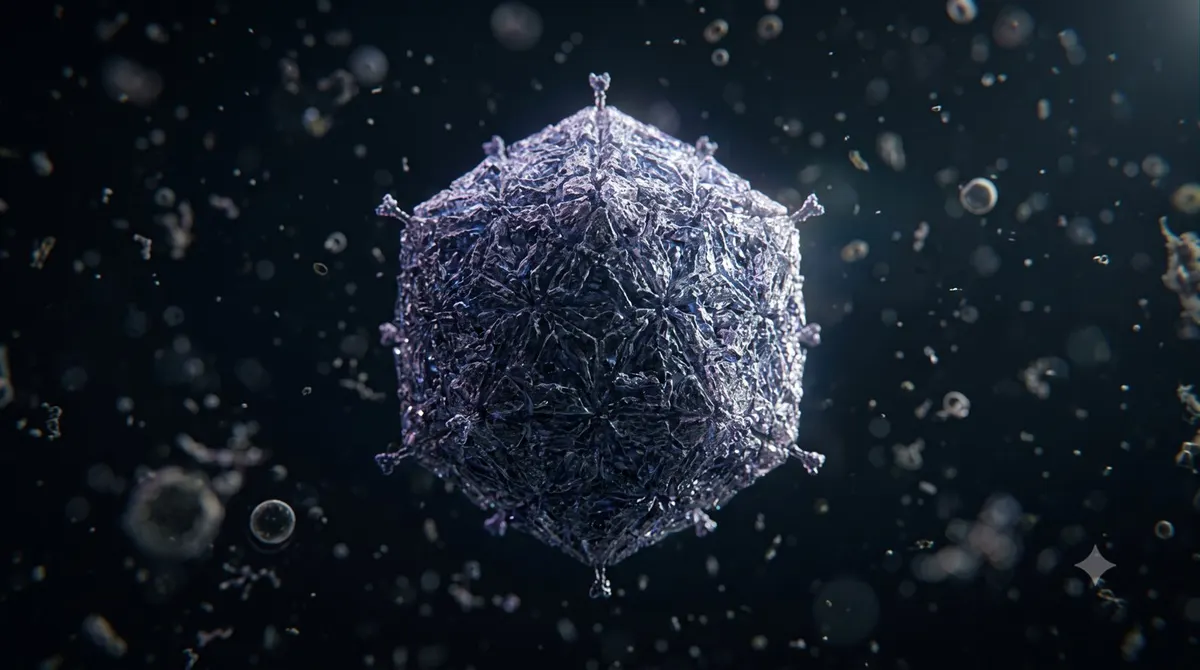
Strip a virus down to its essentials and you are left with something startlingly simple. At its core sits a set of genetic instructions, written in either DNA or its close cousin RNA. Wrapped around that genetic material is a protein coat called a capsid, and some viruses add an outer envelope stolen from the membrane of a previous host cell. That is more or less the whole machine. A virus has no way of generating energy, no machinery for building proteins, and none of the busy internal traffic that fills a living cell.
Because of this bare-bones design, viruses are also astonishingly small. A typical one is far tinier than a bacterium—small enough that millions could gather on a pinhead. For decades their existence was inferred long before anyone could see one, simply because whatever caused certain diseases could slip through filters fine enough to trap every known bacterium.
What viruses lack in complexity they make up for in sheer numbers. They are almost certainly the most numerous biological entities on the planet, outnumbering even bacteria. There are more viruses in a single spoonful of seawater than there are people on Earth, and they infect every kind of life, from animals and plants down to bacteria themselves. Whatever they are, there is a staggering amount of them.
The case that they are not alive
Here is the heart of the problem. Ask a biologist what makes something living, and you will hear a familiar checklist: it uses energy, grows, responds to its environment, and reproduces. A virus, left to itself, does almost none of these things. Outside a host it is inert. You can dry certain viruses into crystals, store them on a shelf, and revive them later, which is not something you can do with a dog or a dandelion.
Above all, a virus cannot reproduce alone. It carries the blueprint for making copies of itself, but not the factory. To multiply, it must break into a living cell and hijack that cell’s equipment, tricking it into building new viruses instead of doing its own work. By this reasoning, a virus is less a creature than a very sophisticated chemical package—closer to a seed that can only sprout by taking over someone else’s garden.
The case that they are
Yet the opposite view has real force too. Viruses carry genes. They mutate, and they evolve by natural selection, adapting to new hosts and outmaneuvering immune systems and medicines in ways that look unmistakably like the behavior of living things. Every flu season, and the emergence of new strains, is evolution unfolding in real time.
Defenders of viral life also point out that plenty of undeniably living organisms cannot survive on their own either. Many parasites and some bacteria can only reproduce inside another creature’s cells, borrowing what they lack. If we call those alive, why draw the line at viruses? From this angle, needing a host is not a disqualification from life but simply one strategy for living, taken to an extreme.
Life on a spectrum
Perhaps the deepest lesson from viruses is that our tidy boundary between living and non-living may be an illusion we impose for convenience. Nature did not promise us a clean line. The discovery of so-called giant viruses—some as large and genetically rich as small bacteria, carrying hundreds of genes—has blurred the picture further. A few even fall prey to their own smaller viruses, an odd twist for something supposedly not alive.
Many scientists now find it more useful to picture a gradient than a wall. At one end sit simple molecules; at the other, plants and animals bustling with metabolism. Viruses hover in the murky middle, more lifelike than a rock but less self-sufficient than the humblest cell. Rather than forcing them to one side, we can let them sit where they belong: at the frontier where chemistry shades into biology.
Their origins are just as murky as their status. Nobody is certain where viruses came from, and there are several competing ideas. Some researchers suspect they are runaway fragments of genetic material that escaped from living cells and learned to spread on their own. Others think they may descend from once-independent cells that shed almost everything except the ability to invade. It is even possible that viruses, or something like them, predate cells entirely, lingering from the earliest chapters of life. Each possibility carries a different answer to whether viruses are a form of life or merely an echo of it.
Why the question matters
This might sound like a philosopher’s puzzle with no practical stakes, but the way we think about viruses shapes how we fight them. Because they are not fully independent organisms, many treatments that kill bacteria simply do not work on viruses. Antibiotics target the machinery of bacterial life—machinery a virus does not carry—which is why they do nothing against a cold or the flu. Fighting viruses instead means blocking the specific steps by which they enter cells or hijack the copying process.
Understanding their in-between nature also reshapes how we see our own past. Viruses have been swapping genetic material with their hosts for billions of years, and a surprising fraction of the human genome is made of ancient viral remnants stitched permanently into our DNA. Some of those leftovers have even been put to use by our bodies, including in the development of the placenta. In other words, the boundary between us and them is not as firm as it feels.
So, alive or not? The most honest reply is that viruses expose the limits of the question itself. They are exquisitely organized, endlessly adaptive, and utterly dependent—neither fully alive nor safely dead. Instead of a failure to classify, we might treat that as a gift: a reminder that life did not arrive on Earth with clear labels attached, and that some of the most important things in nature live in the spaces between our categories.