Talking Science Podcast
Voyager – Humanity’s Farthest Messengers
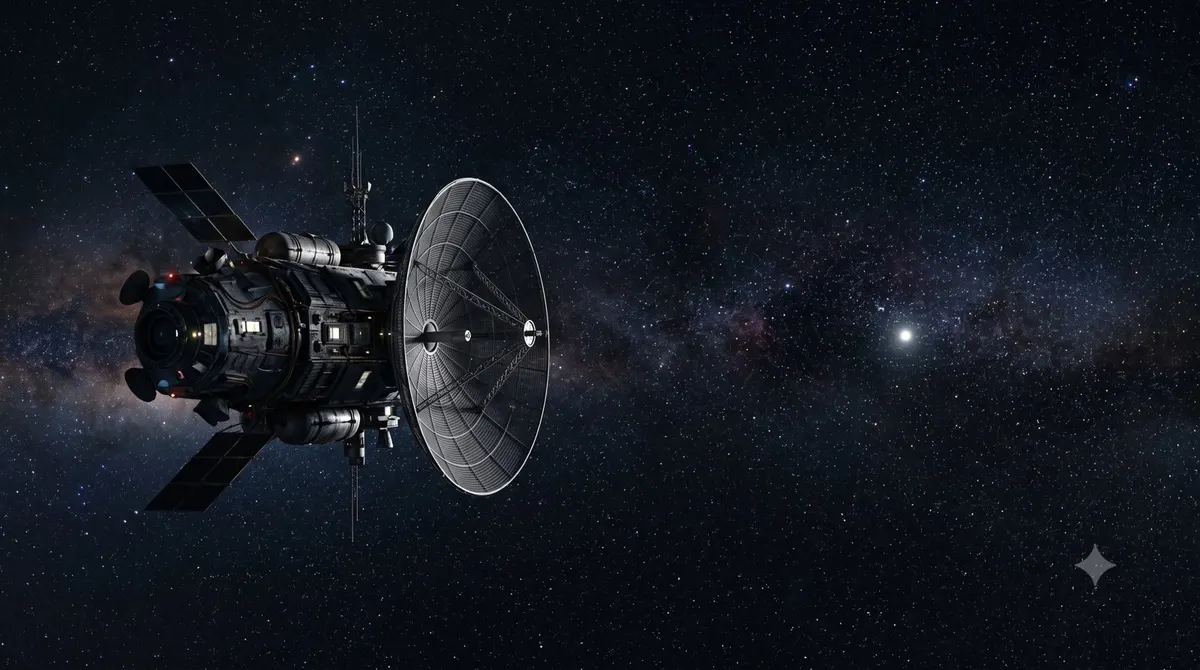
Right now, further from home than anything humanity has ever built, two small spacecraft are drifting through the dark between the stars. They were launched in the 1970s, when home computers barely existed, and they carry less computing power than a modern phone. Yet the Voyager probes have travelled billions of miles, visited worlds no one had seen up close, and slipped beyond the edge of our Sun’s domain into the vast ocean of interstellar space. Their story is one of the boldest and most moving in the history of exploration.
A Rare Alignment
The Voyager mission began with a lucky quirk of the heavens. In the late 1970s, the giant outer planets – Jupiter, Saturn, Uranus, and Neptune – happened to line up along the same side of the Sun in an arrangement that occurs only once in roughly 175 years. This alignment meant a single spacecraft could swing from one planet to the next, using the gravity of each world to fling itself onward to the following one, saving enormous amounts of fuel and time.
This gravitational trick, sometimes called a slingshot, works by borrowing a tiny bit of a planet’s motion as the spacecraft swings past, speeding up and changing direction without burning any fuel. Recognising this once-in-a-lifetime opportunity, engineers designed two probes, Voyager 1 and Voyager 2, to take a grand tour of the outer solar system. Launched in 1977, they set off on journeys that would far outlast the careers, and in some cases the lives, of the people who built them.
The Grand Tour
What the Voyagers sent back transformed our understanding of the solar system. As they swept past the giant planets, their cameras and instruments revealed worlds of astonishing variety and beauty. At Jupiter they showed the Great Red Spot as a colossal storm and discovered that one of its moons had active volcanoes, the first ever seen beyond Earth. At Saturn they revealed the famous rings in breathtaking detail, resolving them into countless fine bands.
Voyager 2 went further still, becoming the only spacecraft ever to visit the two most distant giant planets, Uranus and Neptune, sending back the first close-up views humanity had ever seen of those remote, icy worlds. Again and again the probes found surprises: strange moons, unexpected rings, and weather on a scale that dwarfs anything on Earth. Much of what fills our textbooks about the outer planets, we owe to these two travellers and their brief, precious flybys.
A Message in a Bottle
The Voyagers carry something no other spacecraft had carried before: a message meant for whoever, or whatever, might one day find them. Bolted to each probe is a golden phonograph record, a kind of time capsule for the human species. The idea is romantic and a little humbling. Knowing the probes would eventually drift among the stars, their makers decided to send a greeting from Earth.
The records hold a portrait of humanity in sound and image:
- Greetings spoken in dozens of languages.
- Music from many cultures and eras.
- Sounds of nature, from waves and wind to birdsong and a human heartbeat.
- Encoded pictures of people, places, and life on Earth.
The chance that any alien civilisation will ever find and play these records is vanishingly small. The distances are simply too great, the timescales too vast. But that was never quite the point. The golden records are a gesture of hope, a statement that we existed, that we were curious, and that we wanted to reach out. They are messages in a bottle cast into the cosmic ocean.
Crossing the Final Boundary
After passing the planets, the Voyagers kept going, and in time they achieved something no human-made object had done before: they crossed out of the region ruled by our own Sun. The Sun sends out a constant stream of particles and a bubble of influence that extends far beyond the planets. At the edge of that bubble lies a boundary where the Sun’s reach fades and true interstellar space begins.
Both Voyagers have now passed that boundary, becoming the first objects from Earth to enter the space between the stars. It is a genuinely historic frontier crossed by machines older than most of the engineers who now track them. Even at their tremendous speed, though, the distances ahead are almost beyond imagining. It would take the Voyagers tens of thousands of years to reach the vicinity of even the nearest stars, and they are not aimed at any particular one. They are simply outbound, forever.
Fading Voices
The most poignant part of the Voyager story is happening now. Each probe is powered by a slowly fading source of energy that produces a little less electricity every year. To keep the spacecraft talking to Earth for as long as possible, engineers have been switching off instruments one by one, carefully rationing the dwindling power. Sooner or later, the last watts will drain away and the Voyagers will fall silent.
Their radio signals, already unimaginably faint after crossing billions of miles, are caught by giant dish antennas straining to hear a whisper weaker than almost anything else we track. Commands sent from Earth now take many hours to reach the probes, and the same to return, so a simple exchange can span the better part of a day. When the power finally fails, that thread of contact will be cut, and the probes will sail on in silence. But they will not stop. Long after the last signal fades, long after everyone reading this is gone, the Voyagers will still be coasting through the dark, carrying their golden records into the deep future.
It is remarkable, too, that these machines still work at all. Designed with the modest technology of their era, meant to last only long enough to reach the outer planets, they have instead kept faithfully reporting for decades beyond their intended lives. The engineers who tend them today study old manuals and coax the ageing craft along, wringing a few more years of science from hardware built before most of them were born. That quiet devotion, on both ends of an impossibly long wire, is part of what makes the Voyager story so stirring.
There is something profoundly human in all of this. We built two modest machines, gave them cameras and a golden greeting, and sent them further than we could follow. They showed us the outer planets, crossed into the space between the stars, and became the most distant expression of our curiosity ever made. Whatever becomes of us on Earth, the Voyagers will keep flying – silent, patient, and endless – the farthest-travelled messengers our species has ever sent.