 Talking Science Podcast
What Really Happens Inside a Neutron Star
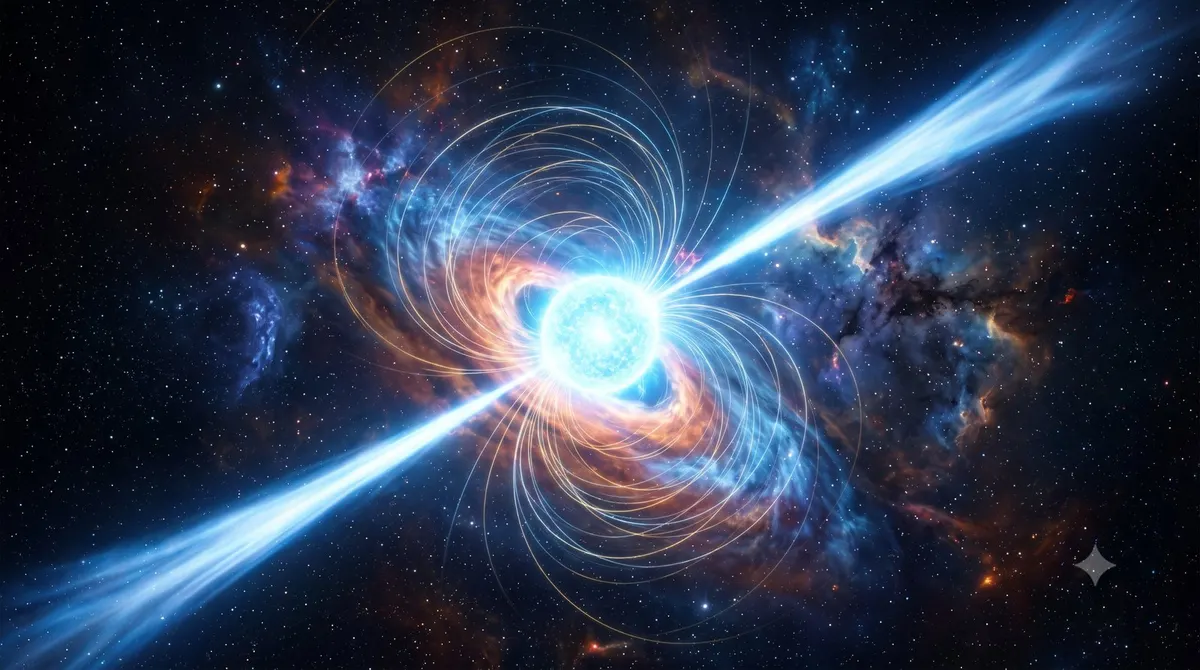
Somewhere out in the galaxy, the collapsed core of a dead star is spinning hundreds of times a second, packing more mass than the Sun into a ball you could drive across in half an hour. A single teaspoon of its material would weigh about as much as a mountain. Neutron stars are the densest objects in the universe short of black holes, and understanding them means abandoning almost everything ordinary matter has taught you.
Born from catastrophe
A neutron star is what remains when a massive star runs out of fuel and dies. For millions of years such a star holds itself up by the outward push of the energy pouring from its core. When the fuel is spent, that support vanishes and the core collapses in on itself in a fraction of a second. The outer layers crash inward, rebound, and blast away in a supernova bright enough to briefly outshine a whole galaxy. What is left behind is the crushed heart of the star.
Matter squeezed past its limits
The collapse is so violent that it overwhelms the forces that normally keep atoms apart. Ordinary atoms are mostly empty space, with tiny nuclei surrounded by distant electrons. Under this pressure the electrons are forced into the nuclei, combining with protons to make neutrons, until the whole object is essentially one vast collection of neutrons packed shoulder to shoulder. That is why a neutron star is so extraordinarily dense: nature has removed the empty space that makes normal matter so roomy.
Lighthouses in the sky
Because the collapsing core keeps its spin but shrinks enormously, it whirls faster and faster, like a skater pulling in their arms. Many neutron stars rotate dozens or hundreds of times every second. Some fire beams of radiation from their magnetic poles, and if one of those beams happens to sweep across Earth we detect a pulse with each rotation — a cosmic lighthouse ticking with astonishing regularity. These pulsars are among the most precise natural clocks known, so steady that they can be used to test the laws of physics themselves.
The strongest magnets in existence
Neutron stars also carry the most powerful magnetic fields ever measured, trillions of times stronger than Earth’s. The most extreme, known as magnetars, have fields so intense that they would scramble the atoms in your body from thousands of kilometres away. Occasionally a magnetar releases a burst of energy in a heartbeat that rivals what the Sun emits in tens of thousands of years.
Why they matter
Neutron stars are not just curiosities. When two of them spiral together and collide, they forge much of the gold, platinum and other heavy elements scattered through the universe — the atoms in a wedding ring may have been born in such a smash-up. These collisions also ripple space itself with gravitational waves that our instruments can now feel. In studying these impossible objects, we are really studying the limits of matter, gravity and time — and, quite literally, where some of the substance of our world came from.


