 Talking Science Podcast
When Telescopes Outrun Their Hard Drives
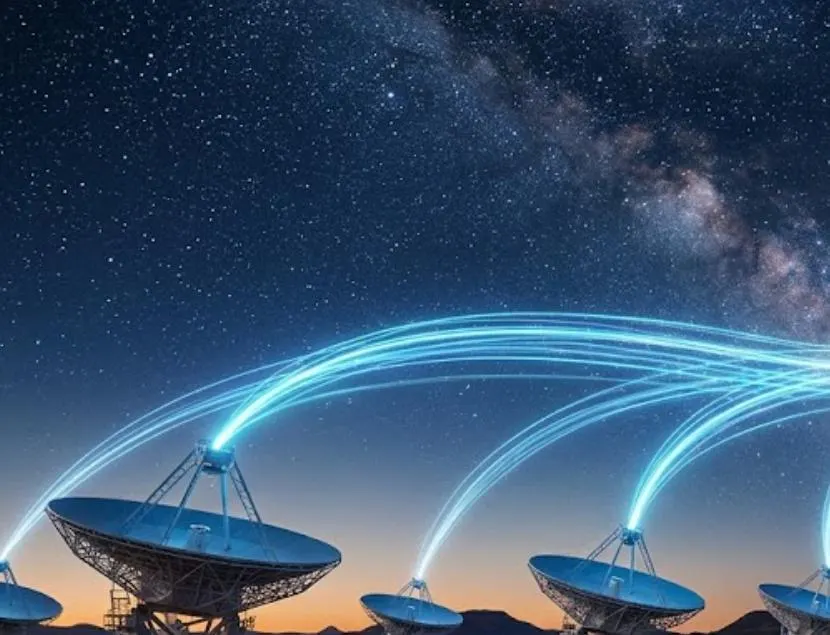
Ask most people what a telescope does and they will talk about light: gathering it, focusing it, magnifying it. That is true, but it misses the quiet crisis of modern astronomy. The great instruments of our age do not merely collect photons — they generate data, in quantities so vast that storing and moving it has become almost as hard as building the telescope in the first place.
A flood measured in terabytes per second
Consider the Square Kilometre Array, the radio observatory now taking shape across remote Western Australia and South Africa. When its low-frequency array in the Murchison region reaches full operation, it is expected to produce raw data at a rate measured in terabytes every second — more information than the entire global internet carried when the project was first dreamed up. No archive on Earth could keep all of that, so the vast majority is processed and thrown away within moments of being recorded, leaving only the fraction that might hold a discovery.
Optical astronomy is drowning too. The Vera C. Rubin Observatory in Chile photographs the whole southern sky every few nights, producing around twenty terabytes each night and firing off millions of automated alerts about anything that has moved or changed in brightness. Over ten years it will build a catalogue of tens of billions of objects.
Why storage is the hard part
Collecting the data turns out to be the easy bit. The genuine engineering challenge is what comes next: getting the information off the mountain or out of the desert, moving it across continents on dedicated fibre, and holding it somewhere it can be trusted for decades. Astronomical data is not disposable. A supernova recorded today may only reveal its secrets when compared with an image taken twenty years from now, so the archive has to outlive the hardware, the software and often the researchers who created it.
That means multiple copies in multiple places, constant checking that files have not silently corrupted, and clear rules about what is kept forever and what is deleted. A single bit flipped by a cosmic ray or a failing disk can quietly poison a measurement, so observatories run continuous verification that every stored copy still matches the original.
The unglamorous discipline behind the science
None of this is unique to astronomy. The same principles — redundant copies, tested restores, a plan for what to retain and what to securely destroy — are exactly what any organisation needs when its records, customer data or research cannot be allowed to vanish. It is the sort of unglamorous rigour that businesses increasingly hand to a specialist managed IT and data-protection provider rather than improvising in-house, precisely because getting it wrong is invisible until the day you desperately need the file that was never really backed up.
Astronomers learned this lesson early and at enormous scale. The lost data cannot be re-observed: the sky has already moved on.
Why it matters for discovery
The upshot is that the next great astronomical breakthroughs may depend less on bigger mirrors and more on smarter data handling. The signal of a distant, fast-fading event, or the faint statistical fingerprint of dark energy, is buried in an ocean of measurements. Finding it means keeping that ocean intact, searchable and trustworthy for years. In modern science, looking after the data is looking after the discovery.


