 Talking Science Podcast
Ageing – Why Do We Get Old?
Look at a photograph of yourself from twenty years ago and something odd becomes clear: you are, in a very real sense, a different collection of atoms. Most of the cells in your body have been replaced many times over. And yet you have aged. Wrinkles appear, joints stiffen, recovery takes longer. If our bodies are constantly rebuilding themselves, why don’t they simply rebuild a younger version each time? The answer sits at the heart of one of biology’s most fascinating puzzles.
Ageing Is Not One Thing
We often talk about ageing as though it were a switch that flips somewhere in middle age. In reality it is a slow, uneven accumulation of small changes happening across every level of the body at once. Some of these changes are in our DNA, some in our cells, some in the tissues and organs those cells build. No single clock ticks down. Instead, many overlapping processes drift gradually away from their youthful settings.
This matters because it explains why ageing looks so different from person to person. Two people of the same age can have very different biological reality underneath, shaped by genetics, environment, and a lifetime of small events. Age in years is only a rough guide to what is happening inside.
The Wear and Tear on Our DNA
Every cell in your body carries a full copy of your DNA, the instruction manual for building and running you. That manual gets read and copied constantly, and copying is never perfect. Small errors, called mutations, creep in over time. Most are harmless, but they accumulate, and a cell working from a slightly garbled instruction set does its job a little less well.
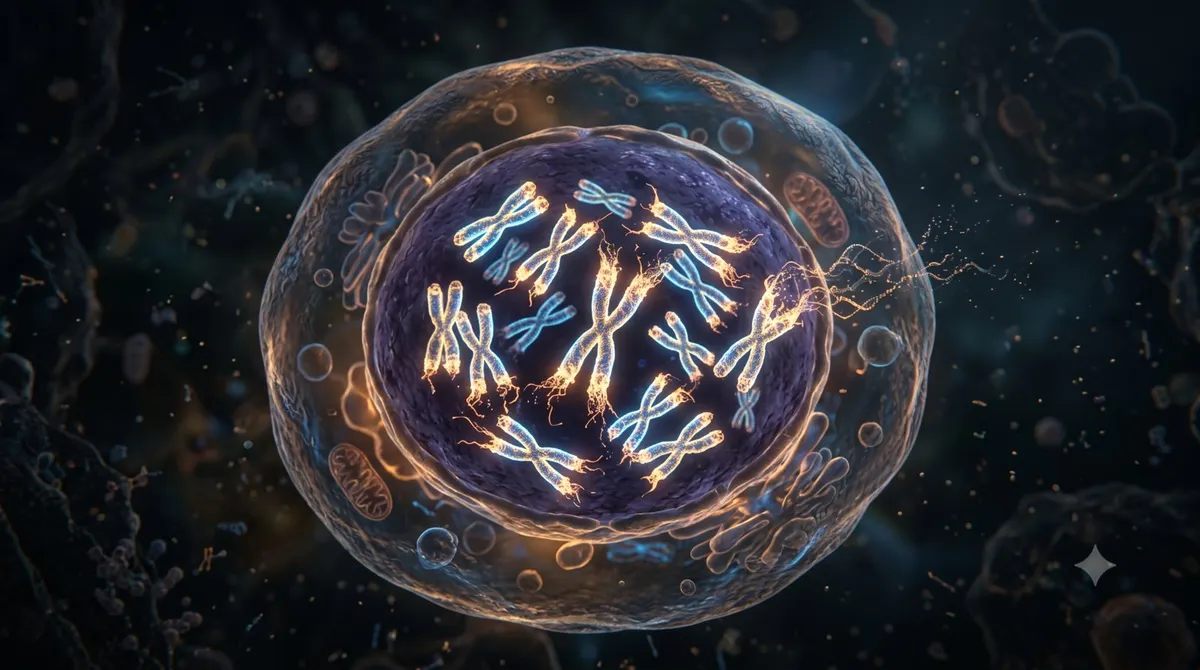
There is also a clever protective feature that becomes a liability. The ends of our chromosomes are capped by stretches called telomeres, a bit like the plastic tips on shoelaces that stop them fraying. Each time a cell divides, these caps get slightly shorter. Eventually they become too short to protect the chromosome, and the cell stops dividing altogether. This limit helps guard against cancer, but it also means our tissues have a finite capacity to renew themselves.
When Cells Stop Playing Along
Some cells, rather than dying when they wear out, enter a strange retirement state called senescence. They stop dividing but refuse to clear out, and worse, they start releasing chemical signals that cause low-level inflammation in the surrounding tissue. Scientists sometimes call these “zombie cells.” A few of them are harmless, but as they pile up over the decades, the constant background inflammation they produce is thought to contribute to many of the aches, slowdowns, and vulnerabilities we associate with old age.
Meanwhile, the tiny power plants inside our cells, called mitochondria, gradually become less efficient. They generate the energy that runs everything you do, and as they falter, cells across the body have less energy to repair and maintain themselves. Waste products that would once have been briskly cleared away start to linger.
Why Hasn’t Evolution Fixed It?
Here is the deep question. If ageing is bad for survival, why hasn’t natural selection weeded it out? The leading idea is surprisingly logical. Evolution cares most about passing on genes, which mostly happens earlier in life. A gene that helps you thrive and reproduce in youth will be favoured, even if that same gene causes problems in old age, because by then reproduction has usually already happened. Natural selection’s grip loosens on the later years of life.
There is also a trade-off at work. The body has limited resources, and it must divide them between growth, reproduction, and repair. A body that poured everything into flawless self-maintenance might never have the energy to reproduce. Ageing, in this view, is partly the price we pay for having invested in living and reproducing in the first place.
Can We Slow It Down?
This is where the science gets genuinely exciting, though it also invites a lot of hype. Researchers have found that in laboratory animals, certain interventions can extend healthy lifespan. Modest calorie restriction, for example, reliably lengthens life in many species, apparently by nudging cells into a more protective, repair-focused mode. Studies of animals that live unusually long for their size, and of the rare human families blessed with exceptional longevity, are helping scientists identify which processes matter most.
For now, the most reliable levers are unglamorous but genuinely effective. Regular physical activity, decent sleep, not smoking, and a sensible diet all measurably influence how well we age. These are not magic, but they act on the very processes described above, keeping cells and tissues functioning closer to their youthful state for longer. None of this is medical advice, but the broad pattern is well established.
Growing Old, Well
It helps to separate two ideas that often get tangled together: lifespan, meaning how long we live, and healthspan, meaning how long we stay healthy and capable. Much of the most promising research is not chasing immortality but trying to compress the frail years, so that more of a long life is spent in good health. That is a subtler and arguably more humane goal.
Ageing, then, is not a disease or a failure but a natural consequence of how living things are built. Our bodies are astonishing self-repairing machines, and the very fact that we last as long as we do is a marvel. Understanding why we grow old will not stop the process, but it is already helping us grow old with more vitality, more comfort, and perhaps a little more wonder at the intricate machinery keeping us going.


