Talking Science Podcast
Blood – The Most Complicated Fluid You Own
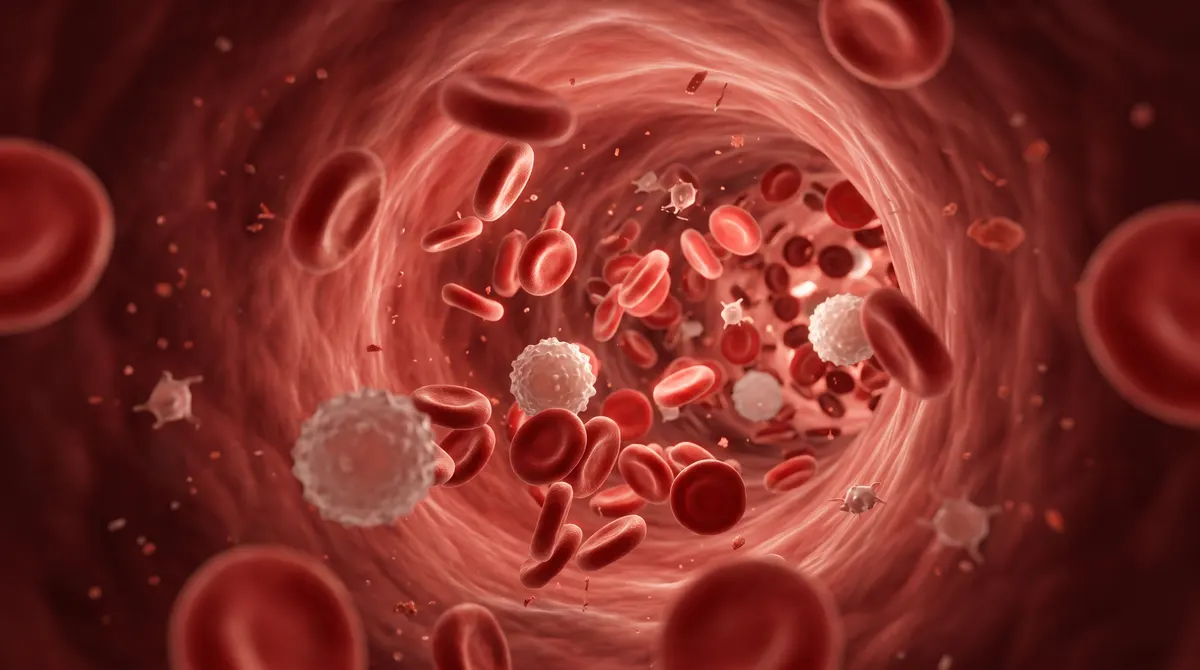
Prick your finger on a rose thorn and a bead of red appears almost instantly. Within minutes it has thickened, darkened and sealed itself, and within days the tiny wound has vanished. That small event involves dozens of molecules and several kinds of cells working in concert, and it is only one of the jobs your blood does without you noticing.
Blood looks like a simple red liquid, but it is better thought of as a tissue, like muscle or bone, that happens to flow. An average adult carries around five litres of it, and within that volume is a delivery service, a defence force, a repair crew and a messaging network, all moving through the body at once.
What's in a Drop
Spin a tube of blood in a centrifuge and it separates. At the top sits a straw-coloured liquid called plasma, which makes up a little over half the volume. At the bottom is a dense layer of red blood cells, usually a bit under half. Between them is a thin, pale band called the buffy coat, which holds the white blood cells and platelets.
Plasma is about 90 per cent water, but the rest is what makes it remarkable. Dissolved in it are salts that keep cells working properly, glucose and fats for energy, hormones carrying chemical messages between organs, and waste products on their way to the kidneys and liver. Much of the carbon dioxide your cells produce travels back to the lungs in plasma, largely as bicarbonate. Plasma is also rich in proteins. Albumin, the most abundant, helps hold water inside the blood vessels. Antibodies patrol for invaders. Clotting factors circulate in an inactive form, ready to spring into action the moment a vessel is damaged.
Red Cells: The Oxygen Couriers
Red blood cells are by far the most numerous cells in the body, and they are built for one main task: carrying oxygen. Each is packed with haemoglobin, an iron-containing protein that picks up oxygen in the lungs and releases it in the tissues. Haemoglobin is also what makes blood red, bright scarlet when loaded with oxygen and a darker red when not. Despite the popular myth, blood in your veins is never blue; veins only look bluish through the skin.
Mature human red cells have given up their nucleus to make room for more haemoglobin. Their shape, a flexible disc dimpled in the middle, gives them a large surface for exchanging gases and lets them fold and squeeze through capillaries narrower than they are. A red cell lasts around 120 days before it is removed, mainly by the spleen and liver, and its iron is recycled.
White Cells and Platelets: Defence and Repair
White blood cells are far fewer but come in several types. Neutrophils, the most common, rush to sites of infection and engulf bacteria. Lymphocytes include B cells, which make antibodies, and T cells, which coordinate the immune response and destroy infected cells. Monocytes leave the blood to become scavenging cells in the tissues, and eosinophils and basophils help fight parasites and drive allergic reactions. For all of them the bloodstream is mostly a highway, as explored in our piece on the immune system.
Platelets aren't full cells at all but tiny fragments pinched off from giant cells in the bone marrow. When a blood vessel is damaged, platelets stick to the exposed wall and to each other, forming a temporary plug. Meanwhile, clotting factors in the plasma set off a chain reaction that ends with a protein called fibrin weaving a mesh through the plug, trapping red cells and sealing the wound. The balance matters: too little clotting and you bleed, too much and clots can block vessels.
The Factory in Your Bones
Because blood cells wear out, they must be replaced constantly. In adults this happens mainly in the red bone marrow inside bones such as the pelvis, breastbone, ribs, skull and vertebrae. There, a small population of blood-forming stem cells divides and gives rise to every type of blood cell. The scale is staggering: an adult makes roughly two million red cells every second.
Production is tightly controlled. When oxygen levels fall, the kidneys release a hormone called erythropoietin, which signals the marrow to make more red cells. This is why people who live at high altitude gradually build up more of them. Bone marrow transplants work because these few stem cells can rebuild an entire blood system.
Why Blood Types Matter
Early attempts at transfusion were dangerously unpredictable. The reason became clear in 1901, when the Austrian scientist Karl Landsteiner discovered that red cells carry different markers on their surface, now called the A and B antigens. People with type A have A markers, type B have B, type AB have both and type O have neither. Crucially, your plasma carries antibodies against whichever of these markers you lack. If incompatible red cells are transfused, those antibodies attack them, which can trigger a severe and potentially fatal reaction.
A second major system, the Rh system, adds the "positive" or "negative" to your blood type, depending on whether your red cells carry a marker called the D antigen. O negative red cells lack the A, B and D markers, so in an emergency they can be given to almost anyone, which is why blood services value O negative donors so highly. Even so, hospitals carefully test and match blood before most transfusions.
Rh matters in pregnancy too. An Rh-negative mother carrying an Rh-positive baby can make antibodies that harm a baby's red cells in a later pregnancy. Injections of anti-D, made from the plasma of donors with high levels of the antibody, prevent this. One of Australia's best-known blood donors, James Harrison, gave plasma more than a thousand times over six decades, and anti-D made from his donations helped protect a very large number of babies.
Anaemia and the Humble Blood Test
Anaemia means having too little healthy haemoglobin, or too few red cells, to carry oxygen effectively. It is a sign of an underlying problem rather than a disease in itself. Common causes include iron deficiency, the most widespread form worldwide, as well as blood loss, a shortage of vitamin B12 or folate, long-term illness, and inherited conditions such as thalassaemia and sickle cell disease. Because the tissues are short of oxygen, people often feel tired, weak or breathless. Working out the cause is the important step, and that is a job for a doctor.
That's where the routine blood test comes in. The most common is a full blood count, which measures the numbers of red cells, white cells and platelets, the amount of haemoglobin, and the average size of the red cells, which can hint at the cause of anaemia. Other tests check things like glucose, cholesterol, iron stores and kidney and liver function. Results are compared with reference ranges drawn from healthy people, so a result slightly outside the range doesn't necessarily mean something is wrong.
A Living River
Each drop of blood holds an oxygen delivery system, an immune patrol, a self-sealing repair kit and a chemical postal service, all kept moving by a pump that never rests, as described in our look at the heart. It is renewed by the millions every second deep inside your bones, and it can be shared with a stranger to save a life. Ordinary as it looks, blood is one of the most complicated and capable things you own.