 Talking Science Podcast
Cancer – What Goes Wrong in a Cell
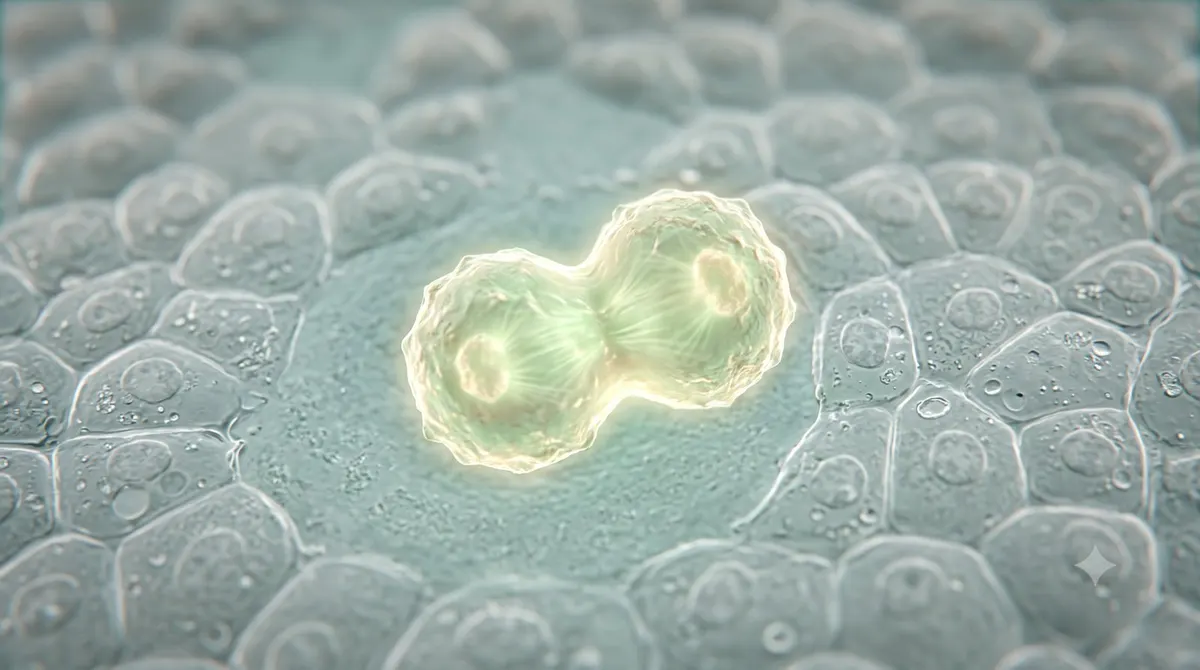
Every one of us is built from trillions of cells, and for the most part they cooperate beautifully. They divide when the body needs them to, stop when the job is done, and step aside gracefully when they are old or damaged. Cancer is what happens when a single cell stops following these rules. It is not an invader from outside but a part of you that has gone rogue, and understanding that simple fact is the key to understanding one of medicine’s hardest problems.
The Rules Cells Live By
A healthy body is a triumph of restraint. Your cells could, in principle, divide endlessly, but they do not. They respond to a constant stream of chemical signals telling them when to grow, when to rest, and when to die. That last instruction matters more than it sounds. Cells have a built-in self-destruct program, a kind of controlled suicide, that they trigger when something goes seriously wrong. This is how the body quietly removes damaged cells before they cause harm.
These rules are written in DNA, the instruction manual inside every cell. Special genes act as accelerators, telling cells to divide, while others act as brakes, telling them to stop. In a healthy cell, accelerators and brakes stay in balance. Cancer is, at its core, a failure of that balance.
When the Instructions Get Corrupted
DNA is copied every time a cell divides, and copying is never perfect. Mistakes, called mutations, creep in. Most are harmless, and cells have clever repair crews that fix many of them. But occasionally a mutation damages one of the genes that control growth, jamming an accelerator on or cutting a brake line.
A single such mutation is rarely enough. Cancer usually requires several to accumulate in the same cell, each one loosening the controls a little more. This is why cancer becomes more common with age: mutations pile up over a lifetime. It is also why some things raise risk. Tobacco smoke, certain chemicals, radiation, and ultraviolet light from the sun all damage DNA, increasing the odds that the wrong genes are hit.
A Cell That Forgets to Stop
Once a cell has broken enough rules, it starts to divide when it should not, ignoring the signals to stop. Its descendants inherit the same broken instructions, and the population grows into a lump called a tumor. Not all tumors are dangerous; a benign tumor stays put and, while it can cause problems by pressing on things, it does not spread.
What makes cancer lethal is a further step. Malignant cells can break away, invade nearby tissue, and travel through the blood or lymph to seed new growths elsewhere in the body. This spreading is called metastasis, and it is what turns a local problem into a whole-body disease. A cancer that has spread widely is far harder to treat than one still confined to its starting point, which is why early detection matters so much.
Why It Is So Hard to Treat
The cruel genius of cancer is that it is made of your own cells. A bacterium or virus is foreign, with features our drugs and immune systems can target. Cancer cells are, disturbingly, almost normal. Treatments that kill them tend to harm healthy cells too, which is why traditional chemotherapy causes such difficult side effects; it targets fast-dividing cells, and some healthy cells, like those in hair and the gut lining, divide quickly as well.
Cancer also evolves. A tumor is not one uniform thing but a shifting population of cells, some of which may happen to resist a given drug. Kill the vulnerable ones and the resistant ones can survive and regrow. This is why cancer sometimes returns after seeming to disappear, and why treating it can feel like a moving target.
Reasons for Real Hope
The story is far from hopeless. Understanding cancer as a disease of genes has transformed treatment. Targeted therapies aim at the specific broken machinery inside a particular tumor, sparing healthy cells more than older methods. Immunotherapy, one of the most exciting advances in recent decades, helps the patient’s own immune system recognize and attack cancer cells it had been overlooking.
Prevention and early detection have quietly saved enormous numbers of lives too. Not smoking, sun protection, vaccines that prevent cancer-causing infections, and screening programs that catch tumors early all shift the odds in our favor. Many cancers caught early can now be treated successfully.
Not One Disease but Many
We speak of cancer as if it were a single illness, but that is a little misleading. Cancer is really a family of hundreds of related diseases, united by the same underlying story of cells that will not stop dividing, yet differing enormously in their details. A cancer that starts in the breast behaves differently from one that starts in the blood, the skin, or the pancreas. Each has its own tendencies, its own pace, and its own response to treatment.
This variety is why there will never be a single cure for cancer in the way there is a single vaccine for a single virus. Even two tumors of the same type, in two different people, can carry different genetic faults and call for different approaches. Modern medicine increasingly treats cancer not as one enemy but as a specific, individual adversary, studying the particular mistakes in a particular tumor and tailoring the attack accordingly.
A Disease of Life Itself
There is a sobering truth at the heart of cancer: it is, in a sense, the price of being a large, long-lived, multicellular creature. Any body made of dividing cells carries the risk that one of them will break the rules. This is not a reason for fear so much as for perspective. Cancer is not a curse or a punishment; it is biology, and biology is something we are steadily learning to understand and outmaneuver.
Every year, researchers map more of the machinery that goes wrong and design cleverer ways to set it right. Cancer remains a formidable adversary, but it is no longer the mystery it once was. It is a puzzle with an increasing number of solved pieces, and each one means more people living longer, fuller lives.


