Talking Science Podcast
Eclipses – The Cosmic Coincidence
Stand under a shady tree on a sunny afternoon and the footpath is dotted with round patches of light. Stand there during a partial solar eclipse and every patch becomes a tiny crescent. Each gap between the leaves works as a pinhole camera, projecting an image of the Sun, so when the Moon takes a bite out of the Sun, hundreds of bitten Suns appear at your feet. An eclipse is the grand version of the same idea: one body blocking light on its way to another.
Two Kinds of Shadow
There are two kinds of eclipse, and the difference is which body does the blocking. In a solar eclipse, the Moon passes directly between the Sun and Earth and casts its shadow onto our planet. From inside that shadow, part or all of the Sun seems to disappear. In a lunar eclipse, it is the other way round: Earth slips between the Sun and the Moon, and our planet's shadow falls across the Moon's face.
A Coincidence of Size and Distance
The Sun is roughly 400 times wider than the Moon. It is also, on average, roughly 400 times further away. Put those two facts together and the result is remarkable: from Earth, the Sun and Moon look almost exactly the same size in the sky. That is why, during a total solar eclipse, the Moon can cover the Sun's bright disc so precisely, no more and no less.
There is no known physical reason for the match; it appears to be simply how our solar system turned out. Nor is it permanent. The Moon is drifting very slowly away from Earth, so in the extremely distant future total eclipses will become a thing of the past.
Because the fit is so close, small changes matter. The Moon's orbit is a slight ellipse, so its distance varies. With the Moon nearer, it looks fractionally bigger than the Sun and blocks it completely: a total eclipse. A little further away, it leaves a blazing ring of sunlight around its edge: an annular eclipse, or ring of fire. Stand off to the side of the shadow's centre and you see a partial eclipse, the kind that makes crescents under the trees.
Why It Doesn't Happen Every Month
The Moon passes between the Sun and Earth once every lunar cycle, at new moon. So why isn't there a solar eclipse every month? The answer is a tilt. Earth orbits the Sun in a flat plane astronomers call the ecliptic, but the Moon's orbit is tipped by about five degrees relative to it. That sounds tiny, yet it is enough that, most months, the new moon passes a little above or below the Sun from our point of view, and its shadow misses Earth entirely.
Only when new moon falls close to one of the two points where the Moon's tilted path crosses the ecliptic, called nodes, do things line up well enough for an eclipse. The same reasoning explains why most full moons pass without a lunar eclipse. Eclipses are not random. They are just geometrically fussy.
Patterns the Ancients Spotted
Because the geometry is so regular, ancient sky-watchers noticed that eclipses repeat in patterns long before anyone understood orbits. The most famous is the saros cycle, a period of about 18 years, 11 days and 8 hours. After one saros, the Sun, Earth and Moon return to almost the same arrangement, so a similar eclipse tends to recur. Those extra eight hours, a third of a day, mean Earth has turned a third of the way round, so the repeat eclipse lands in a different part of the world.
The saros works because three lunar rhythms almost line up: the Moon returning to the same phase, the same node and the same distance from Earth. Babylonian astronomers, and later observers in China, Greece and elsewhere, used cycles like this to make genuinely successful predictions, an early triumph of patient pattern-spotting long before anyone could explain it.
What Happens During Totality
Totality, the short window when the Moon fully covers the Sun, is far more than a dark partial eclipse. Beforehand the light turns strangely flat, the temperature drops and birds often fall silent, as if evening had come early.
Then, for anything from a few seconds to a little over seven minutes, the Sun's bright surface is hidden and the corona appears: the Sun's outer atmosphere, a pale halo of extremely hot, thin plasma stretching millions of kilometres into space. It is around a million times fainter than the Sun's surface and normally lost in the glare.
Eclipse chasers watch for a few fleeting effects too:
- Baily's beads: points of sunlight shining through valleys along the Moon's rugged edge just before and after totality.
- The diamond ring: a glowing ring with one brilliant point left, as the last bead fades or the first returns.
The Eclipse That Tested Einstein
That brief darkness once helped settle a big question in physics. Einstein's general relativity predicted that the Sun's mass bends space and time, deflecting starlight passing close by. Normally the glare hides those stars. During totality, they appear.
In May 1919, British expeditions organised by the astronomer Arthur Eddington travelled to the island of Príncipe off West Africa and to Sobral in Brazil to photograph stars near the eclipsed Sun. Comparing those images with photos of the same stars taken months earlier, the teams found the stars had shifted by close to the amount Einstein predicted. The announcement made headlines worldwide and helped establish relativity as tested physics, all from an event lasting only minutes.
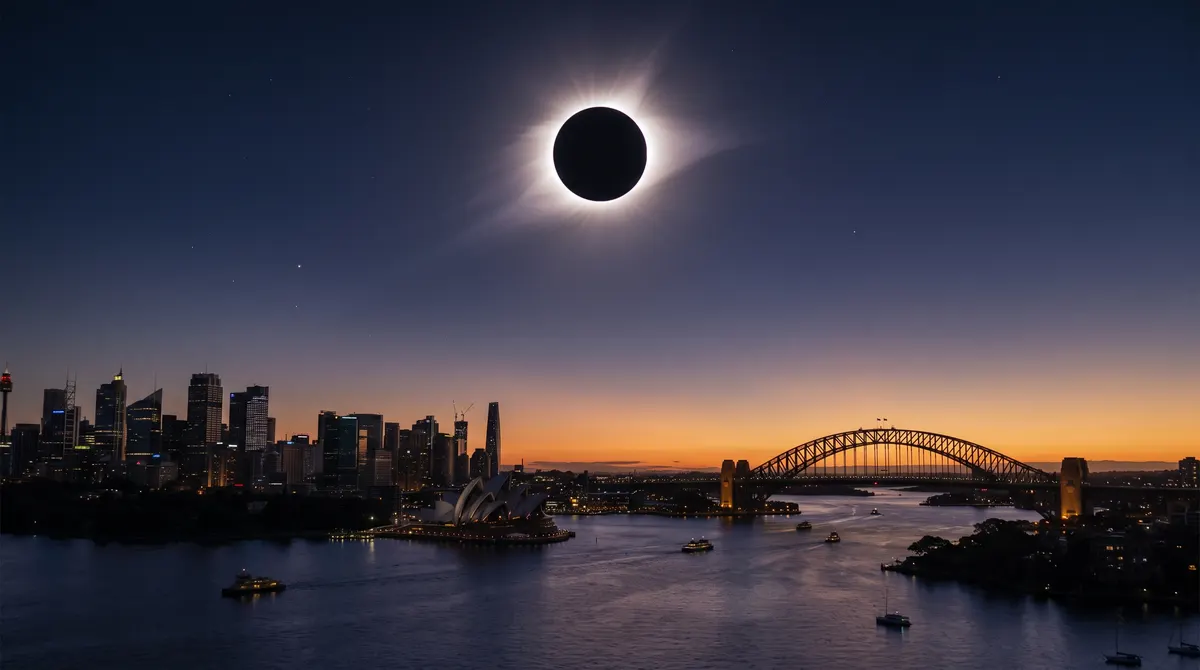
Today, astronomers can calculate eclipses centuries ahead, which is how chasers plan trips years in advance. Australia has had its share recently, with a total eclipse over far north Queensland in 2012 and one seen near Exmouth in Western Australia in 2023. Sydney is due for a total solar eclipse in July 2028.
Red Moons and Safe Eyes
Lunar eclipses look completely different. Earth's shadow does not turn the Moon black, because our atmosphere bends some sunlight into it, scattering away the bluer light on the way, the same process that makes sunsets red. The result is a coppery "blood moon". Earth's shadow is so large that a lunar eclipse is visible from a whole hemisphere and lasts much longer, making it far easier to catch.
Solar eclipses demand care. Looking at the Sun during any partial phase can permanently damage your eyes, and because the retina has no pain receptors, you may feel nothing at the time. Ordinary sunglasses are nowhere near enough. Use certified eclipse glasses or solar viewers meeting the recognised international safety standard, or project the Sun through a pinhole onto card. Only during totality itself, once the Sun is completely covered, is it safe to look with the naked eye, with protection going straight back on as the Sun reappears.
Every Tree Is an Eclipse Camera
Every gap in a tree's canopy is quietly tracing the Sun's true shape onto the ground. Most days that shape is round. On the rare occasions when the Moon lines up just right, the same dappled shade records a cosmic coincidence that has revealed the Sun's hidden atmosphere, helped confirm a great theory of physics, and given countless generations a reason to look up.