Talking Science Podcast
Radio Astronomy – Listening to the Invisible Sky
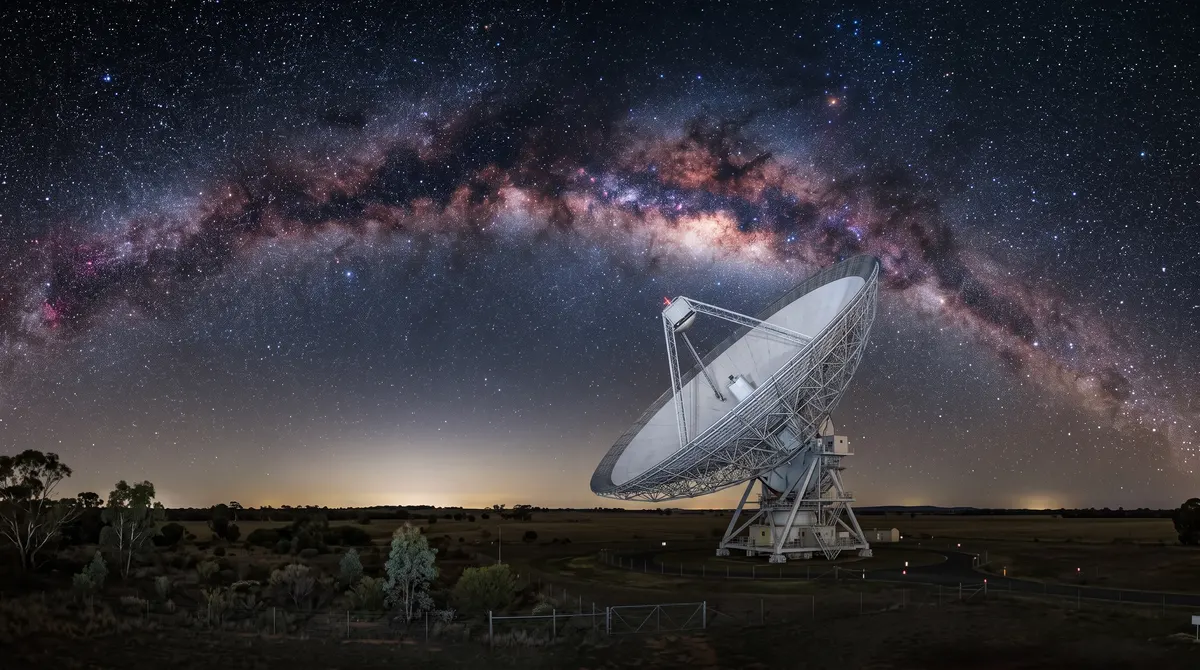
Anyone who has driven through the bush at night, turning an old car radio between stations, knows the soft hiss in the gaps. It sounds like nothing at all. In fact some of it is lightning from a distant storm, some is electrical noise from the car, and buried far below what that little radio could ever pick out is genuine radiation from deep space, some of it older than the stars.
That is the starting point for radio astronomy. The night sky is not only the pinpricks of light our eyes can see. It is also broadcasting constantly in a part of the spectrum we are blind to, and over the last century astronomers have learned to listen. Some of the best listening posts on the planet are in the Australian outback.
Light We Cannot See
Visible light, X-rays, infrared and radio waves are all the same kind of thing, oscillating electric and magnetic fields travelling at the speed of light, differing only in wavelength. Visible light waves are a few hundred nanometres long, smaller than a speck of dust; radio waves stretch from millimetres to metres and beyond. Our eyes evolved for a narrow sliver because that is where the Sun shines brightest and our atmosphere is clear, not because visible light is more important.
Radio reveals different things for two reasons. Long radio waves pass through dust clouds that block ordinary light, much as a long ocean swell rolls past an obstacle that would stop a short, choppy wave, so radio telescopes can see through the thick dust hiding our galaxy's centre. And much cosmic radio comes from a different process, synchrotron radiation, produced when charged particles are whipped around near light speed by strong magnetic fields. It traces violent places, such as the surroundings of black holes and the wreckage of exploded stars.
A Happy Accident on a Telephone Line
In the early 1930s an engineer named Karl Jansky at Bell Telephone Laboratories in the United States was asked to track down static on a new transatlantic radio-telephone service. He built a rotating antenna, nicknamed his merry-go-round because it turned on wheels salvaged from an old car, and catalogued every source of interference.
Thunderstorms were easy to identify, but a faint, steady hiss kept appearing, peaking about every 23 hours and 56 minutes. That is not a solar day but a sidereal day, the time the stars take to return to the same place in the sky. The hiss was tied to the stars, and its strongest point lay towards Sagittarius, roughly the direction of the Milky Way's centre. Jansky had found that the galaxy itself gives off radio waves. Soon after, an amateur astronomer named Grote Reber built the first purpose-made radio telescope in his Illinois backyard, a dish about nine metres across, and made the first radio maps of the Milky Way.
Dishes and Earth-Sized Virtual Telescopes
A radio telescope is a bigger cousin of a satellite TV dish. Its curved surface reflects incoming waves to a focus, where a receiver turns them into an electrical signal. The dishes are huge because of diffraction, the way every wave spreads and blurs slightly as it passes an edge. Sharpness depends on wavelength compared with dish size, so a radio dish tens of metres wide may still see less detail than a modest optical telescope.
The workaround is interferometry: spread many dishes across a landscape and combine their signals with precise timing, giving the sharpness of a single dish as wide as the distance between the outermost antennas. Record signals on different continents against atomic clocks and combine them later, and you get a virtual telescope the size of Earth. That technique produced the first image of a black hole's shadow, and Australian dishes regularly join such global networks.
Mapping Hydrogen, Timing Dead Stars
A hydrogen atom's electron and proton each behave a little like tiny spinning magnets. Occasionally the electron flips and releases a radio wave 21 centimetres long. A single atom does this on average about once in ten million years, but galaxies hold so much hydrogen that the combined signal is steady. Because it comes from cold gas rather than stars, the 21 centimetre line lets astronomers trace the Milky Way's spiral arms from inside, and measuring how fast that gas orbits became a key strand of evidence for dark matter.
In 1967 a postgraduate student in England, Jocelyn Bell, spotted a radio pulse repeating a little more than once a second, so regular it was jokingly labelled LGM-1, for Little Green Men. It was a pulsar, a spinning neutron star sweeping beams of radio around like a lighthouse. The fastest spin hundreds of times a second and keep such steady time that astronomers watch whole sets of them for tiny coordinated shifts caused by gravitational waves. There is more in our article on pulsars.
Flashes Nobody Has Fully Explained
Fast radio bursts were first identified in 2007 in archived data from the Parkes telescope. Each lasts only milliseconds yet releases an enormous amount of energy, and almost all come from far beyond our galaxy. Their cause is genuinely unsettled. In 2020 a burst was traced to a magnetar, a neutron star with an extraordinarily powerful magnetic field, inside the Milky Way, strongly suggesting magnetars produce at least some. Most bursts appear to be one-offs, but a few repeat, hinting there may be more than one kind of source behind the same name.
Australia's Listening Posts
The 64-metre dish at Parkes in central New South Wales, run by CSIRO since 1961, relayed television of the Apollo 11 Moon landing in 1969. It has since been credited with finding around half of all known pulsars. It also solved a charming mystery: signals called perytons that puzzled astronomers for years turned out to come from the staff kitchen microwave being opened before it finished. In 2020 the telescope was given the Wiradjuri name Murriyang, meaning skyworld.
In the Murchison region of Western Australia, on Wajarri Yamaji Country, the low-frequency half of the international Square Kilometre Array is being built: many thousands of simple antennas working as one giant interferometer, at a site named Inyarrimanha Ilgari Bundara, meaning sharing sky and stars. The mid-frequency half is in South Africa's Karoo. Alongside it runs ASKAP, the Australian SKA Pathfinder, whose phased array receivers let each dish see a wide patch of sky at once, ideal for catching fleeting events. The data these instruments produce is staggering, a challenge explored in when telescopes outrun their hard drives.
Cosmic signals can be billions of times weaker than a mobile phone signal, so phones, transmitters and wifi can drown them out the way city lights wash out faint stars. The Murchison observatory sits inside a legislated radio-quiet zone, and its remoteness and tiny population were major reasons it was chosen.
The Other Half of the Sky
Stand somewhere properly dark in the outback and the stars overhead are only half the picture. Laid invisibly over them is another sky, built from the hiss Jansky stumbled on while chasing telephone static, the ticking of collapsed stars, the glow of hidden hydrogen and millisecond flashes nobody has fully explained. Humanity has been tuning in for less than a century, and from Parkes to the Murchison, Australia is still listening.