 Talking Science Podcast
Glaciers and Ice Sheets – Rivers of Ice
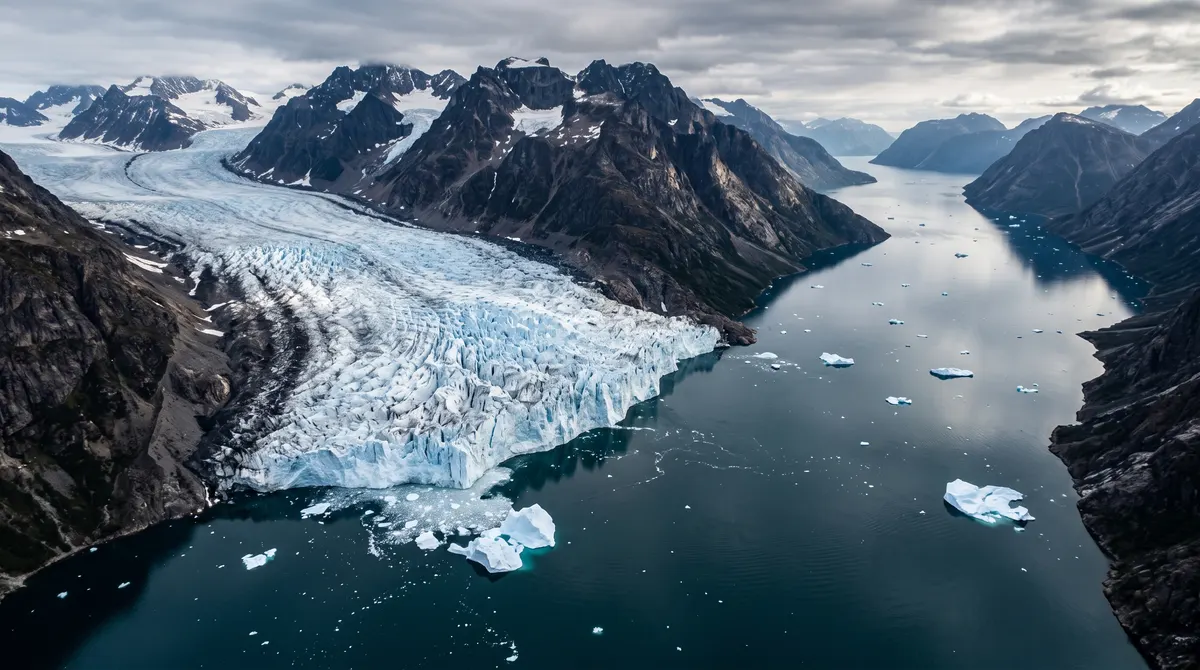
Few things look as still as a glacier. Photographs show vast, silent sheets of white, thick enough in places to bury mountains, apparently frozen in time. Yet every one of them is moving. Under its own enormous weight, the ice is flowing slowly downhill like an impossibly sluggish river, carving rock as it goes.
Glaciers and ice sheets are among Earth's most dynamic systems. They gain and lose mass every year, sculpt landscapes, and store a layered record of the planet's past air.
From Snowflake to Solid Ice
It starts with ordinary snow. Fresh snow is mostly air, a fluffy tangle of delicate crystals with lots of empty space between them, which is why a deep blanket of it holds surprisingly little water. Where more snow falls each year than melts the following summer, layers build up year after year and press down on each other.
The weight squeezes the older layers. Air is forced out and the crystals round off and lock together, producing firn, a grainy, half-compacted material denser than snow but not yet ice. Snow generally has to survive at least a year to count as firn. Over years to decades, more layers squeeze it into dense glacial ice, with only small sealed bubbles of air left inside.
A snowflake landing on the high interior of an ice sheet today might take a human lifetime or more to become solid ice, and could stay locked in the moving ice for thousands of years.
How Solid Ice Flows
Ice feels rigid in an afternoon. But over decades, under hundreds or thousands of metres of ice, deep ice behaves as a plastic solid, slowly and permanently changing shape without cracking. Layers of water molecules in its crystals gradually slide past each other, and the whole glacier creeps from its high accumulation zone towards lower, warmer ground.
Many glaciers also move by basal sliding. At the base, pressure and friction can cause local melting even when the air above is well below freezing, and that thin film of water lubricates the ice over the bedrock. Glaciers with a wet base tend to flow noticeably faster than those frozen to the ground.
Carving Valleys and Fjords
A river cuts a narrow, V-shaped valley, because its water is concentrated along the lowest point and cuts mainly downward. A glacier fills the whole valley floor to great depth and grinds away on every side at once, through two main processes:
- Plucking: meltwater seeps into cracks in the bedrock, refreezes and grips pieces of rock, which are torn away as the ice moves on.
- Abrasion: those rock fragments, now embedded in the base and sides of the glacier, scour the bedrock like grit on sandpaper.
Over time the result is a broad, deep, U-shaped valley. Where a glacier carved down to or below sea level, the ocean floods in once the ice retreats, creating a fjord, like those of Norway, Chile and New Zealand's Fiordland.
Glaciers leave other calling cards. A moraine is a jumbled ridge of debris, from grit to giant boulders, dumped where the ice melted. An erratic is a boulder sitting on completely different rock, dropped wherever its icy ride ended. Australia has traces too: during the last ice age, small glaciers carved features around Mount Kosciuszko, including the bowl holding Blue Lake, and much more extensively in Tasmania's highlands. For more on those times, see The Ice Ages – When the World Froze Over.
The Glacier's Ledger
Whether a glacier grows or shrinks comes down to its mass balance, a yearly ledger of ice gained versus lost. Snowfall adds mass in the upper accumulation zone. Lower down, in the ablation zone, it loses mass by melting and, where it meets the sea, by calving icebergs. The line where gains and losses roughly balance is the equilibrium line.
Gain more than you lose and the glacier advances. Lose more and its front retreats, even though the ice is still flowing forward; it is simply melting faster than new ice arrives. The great majority of monitored glaciers worldwide have had a negative mass balance in recent decades, a well-documented trend.
An Archive Written in Ice
Those tiny bubbles sealed in during the firn-to-ice change are samples of the air from when that snow fell. By drilling out a long cylinder called an ice core, scientists can measure that ancient air directly, including its carbon dioxide, going back hundreds of thousands of years. Why that matters is explored in The Carbon Cycle.
Seasonal changes in snowfall and dust can leave annual bands, countable like tree rings in the upper layers. The ratio of heavier to lighter oxygen isotopes in the ice depends on the temperature when the snow fell, giving a well-calibrated stand-in for past temperatures.
The longest continuous records, from East Antarctica, reach back roughly 800,000 years. Australian scientists have been major contributors, including through cores from Law Dome in East Antarctica, which hold detailed greenhouse gas records over recent centuries and beyond. Greenland's cores do not reach as far back, but its heavy snowfall lets them resolve individual years in fine detail, ideal for studying abrupt climate shifts.
Greenland, Antarctica and Honest Uncertainty
The two great ice sheets, on Greenland and Antarctica, dwarf every other glacier and hold an enormous share of Earth's fresh water. Greenland is losing mass largely at its surface: warmer summers drive widespread melting, and much of that meltwater runs straight into the sea.
Antarctica is more complicated. East Antarctica, mostly on land above sea level, has so far been comparatively stable overall. West Antarctica largely sits on bedrock below sea level, and its edges meet the ocean through floating ice shelves that act like braces holding back the ice. When warmer ocean water melts them from below, the ice behind can flow into the sea faster.
Worse, the bedrock beneath much of West Antarctica slopes downward inland. If the point where the ice begins to float retreats, it moves into deeper water, exposing more ice to the ocean and speeding melting. This feedback is called marine ice sheet instability. The mechanism is well understood. How fast it could unfold at closely watched glaciers such as Thwaites is much less certain, and some headlines run ahead of the science.
Certain Loss, Uncertain Pace
It helps to separate two questions. Are glaciers and ice sheets losing mass? Yes. That rests on several independent lines of evidence: satellite measurements of ice height and gravity, direct field measurements at monitored glaciers, and retreating glacier fronts documented in repeat photographs spanning more than a century.
How fast will future loss unfold? That is genuinely uncertain, because it means modelling ice flow and ocean-ice interactions still being refined. Reputable assessments present that range openly. Uncertainty about pace is not doubt about direction.
Stillness Is an Illusion
Next time you see a photo of a silent white ice sheet, remember what is happening beneath the surface. Ancient snow is compressing into ice, creeping downhill, carving valleys with a patience measured in millennia, and sealing away, bubble by bubble, an honest record of the air our planet breathed long before anyone was there to measure it. It looks frozen in time, and it is exactly the opposite.


