Talking Science Podcast
Pluto and the Kuiper Belt
Mention at a barbecue that Pluto is no longer a planet and someone will almost certainly bristle. For anyone who grew up reciting nine planets, it can feel like a childhood certainty was quietly confiscated, as if a small, distant friend had been struck off a list for no good reason.
The real story is far more interesting than a snub. Pluto's change of label is a fine example of how science works, showing how a discovery can force us to sharpen a word we thought we understood. It also opens a door onto one of the least known and most fascinating regions of the solar system.
The Ninth Planet
Pluto was discovered in 1930 by a young American astronomer named Clyde Tombaugh, working at Lowell Observatory in Arizona. His method was painstaking: he compared photographs of the same patch of sky taken on different nights, looking for a faint dot that shifted against the fixed background of stars. When he found one, it was hailed as the ninth planet, sitting out beyond Neptune at the cold edge of the known solar system. The name was suggested by Venetia Burney, an eleven-year-old schoolgirl in England, after the Roman god of the underworld.
For the rest of the twentieth century, that was what every student learned. But from the start Pluto was an oddball. It turned out to be much smaller than first thought, smaller even than our own Moon. Its orbit was strange too, tilted compared with the flat paths of the other planets and so stretched that for part of each lap it swings closer to the Sun than Neptune does. Pluto never quite fitted in with the club it had joined.
Not Alone After All
The turning point had nothing to do with Pluto misbehaving. As telescopes and cameras improved, astronomers began finding other objects in the same distant region. It turned out Pluto belongs to a vast, doughnut-shaped ring of icy bodies stretching far beyond Neptune, now called the Kuiper Belt.
A good way to picture it is as a second asteroid belt, but much bigger, much further out, and made largely of ice and frozen gases rather than rock. These are leftovers from the birth of the solar system, deep-frozen and barely changed for about four and a half billion years. Some of the comets that occasionally swing into the inner solar system are thought to begin their journeys here, which links this frozen zone to the visitors described in Comets and Asteroids – Visitors from the Deep Past. Pluto, it emerged, is simply one of the larger members of this icy crowd.
The Problem Called Eris
In the early 2000s astronomers began finding other Kuiper Belt objects that were not far off Pluto's size. The clincher came with a world later named Eris, found in 2005 and so similar to Pluto that at first it seemed to be bigger. Careful measurements later showed Eris is very slightly smaller across, but it is actually more massive.
That left astronomers with a genuine dilemma. If Pluto was a planet, then Eris surely had to be one too. And what about the next one found, and the one after that? There might be dozens of Pluto-sized ice worlds still waiting to be discovered. Were schoolchildren going to learn fifty planets? A hundred? The word was in danger of losing its meaning.
Writing Down What a Planet Is
In 2006 the International Astronomical Union, the professional body that officially names things in the sky, did something it had never properly done before. It wrote a formal definition of a planet, with three tests:
- it must orbit the Sun
- it must be massive enough for its own gravity to pull it into a round shape
- it must have cleared its neighbourhood, meaning it is gravitationally dominant enough to have swept up or flung away most other material near its orbit
Pluto passes the first two easily. It orbits the Sun and it is round. But it fails the third, because it travels among the swarm of the Kuiper Belt and shares its orbital zone with countless other icy bodies. So it was placed in a new category: dwarf planet, round and orbiting the Sun, but not dominant enough to have tidied up its own patch.
The decision was contentious and still has critics among serious scientists. Some argue that "clearing the neighbourhood" is a fuzzy rule, and that Pluto is far too geologically interesting to be lumped in with rubble. That disagreement is real and healthy. Deciding where to draw a line is often more about usefulness than deep truth. But the reason behind the change is sound. Pluto was not reclassified because it shrank or did anything wrong. It was reclassified because we discovered it had company, and it made more sense to see it as a leading member of the Kuiper Belt than as the runt of the planets.
New Horizons Finally Takes a Look
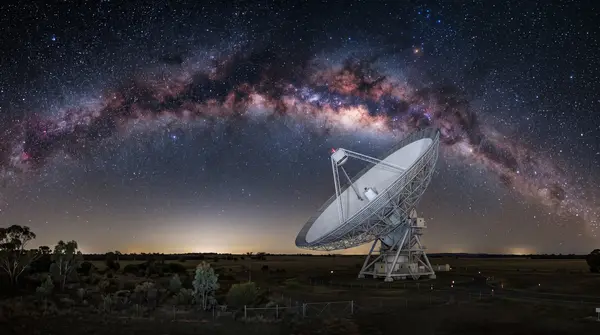
Just as the argument was heating up, humanity went to look. NASA's New Horizons spacecraft launched in January 2006 and, after a journey of about nine and a half years, flew past Pluto in July 2015. Until then, even the best telescopes had shown Pluto as a fuzzy blob only a few pixels across. The faint signals from the spacecraft were collected by NASA's Deep Space Network, which includes the big dishes at Tidbinbilla near Canberra.
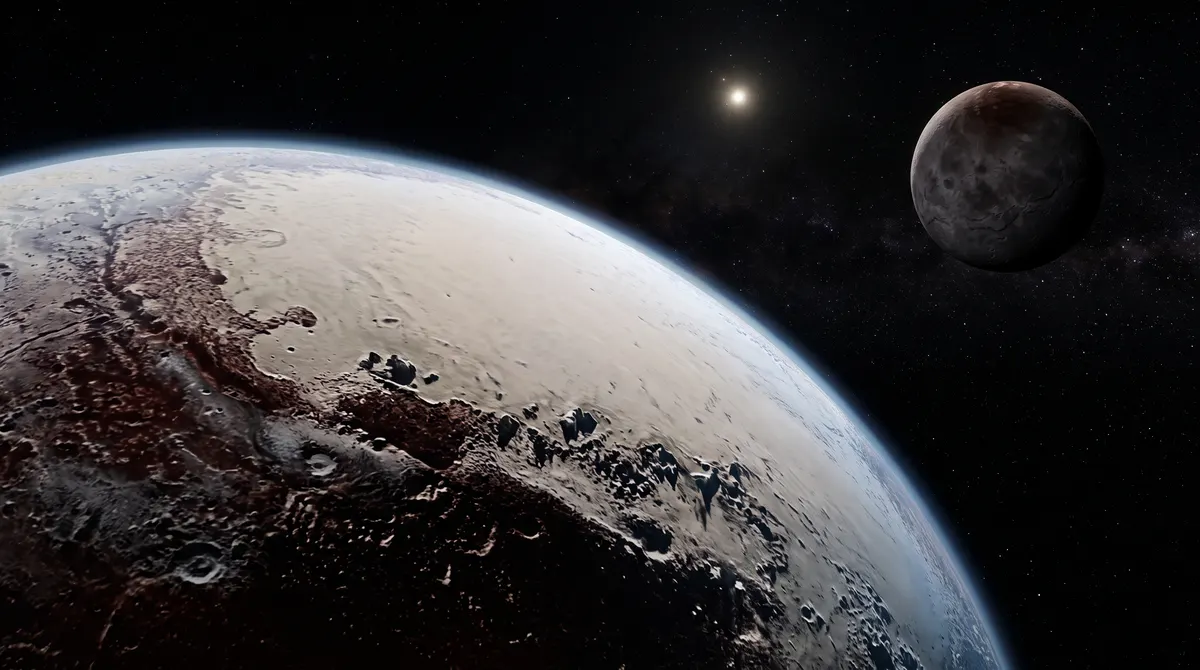
What New Horizons revealed astonished everyone. Instead of a dead, cratered lump, Pluto turned out to be complex and active:
- towering mountains made of water ice, which at those temperatures is as hard as rock
- a vast, smooth, heart-shaped plain of frozen nitrogen that appears to be slowly churning and renewing its surface
- a thin, hazy atmosphere arranged in delicate layers
- a large moon, Charon, with a surprising landscape of its own
A world billions of kilometres from the Sun, which many expected to be frozen and unchanging, was geologically alive in ways nobody had predicted. New Horizons then kept going deeper into the Kuiper Belt, and on 1 January 2019 it flew past a small, snowman-shaped object now named Arrokoth, the most distant world ever visited up close.
A Kingdom, Not a Demotion
So the next time someone complains that Pluto is not a planet anymore, there is a better story to offer. Pluto is the remarkable, geologically active gateway to the Kuiper Belt, a frozen frontier barely known a generation ago that holds the deep-frozen leftovers from the dawn of the solar system. Its change of label was not a loss but a sign of discovery, proof that our solar system is bigger, busier and stranger than the tidy nine-planet picture allowed. Pluto did not get smaller. Our understanding of the solar system got much, much larger.