 Talking Science Podcast
States of Matter – Solid, Liquid, Gas and Beyond
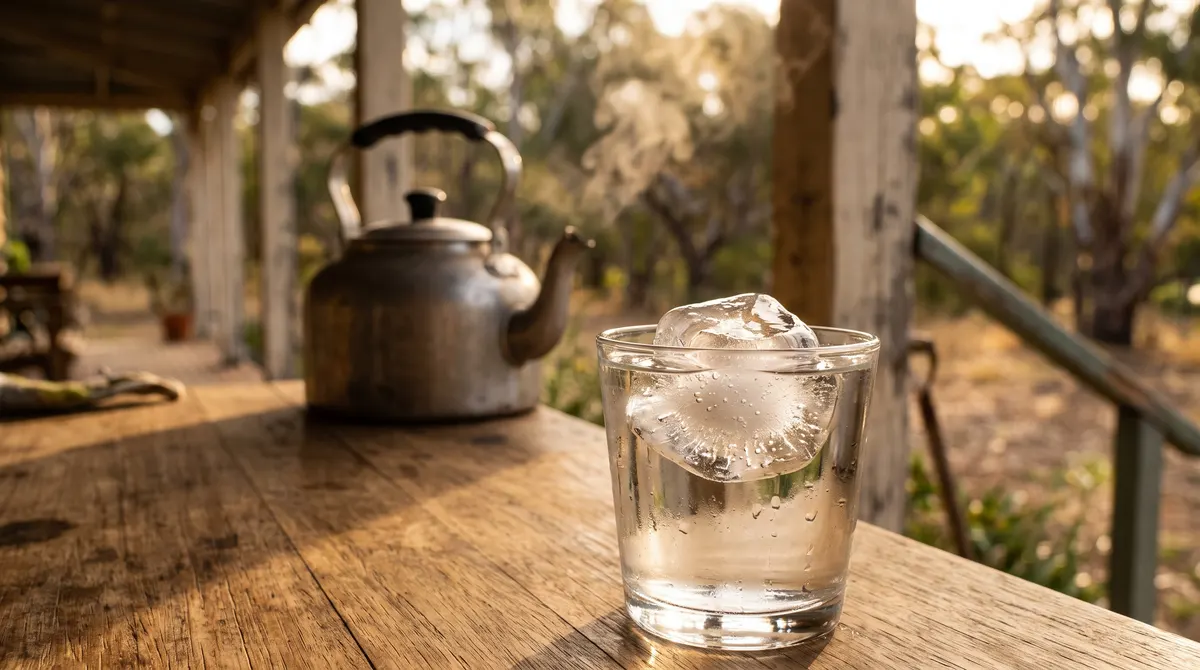
Drop an ice cube into a glass of water on a hot afternoon and watch it for a few minutes. The edges soften, the cube shrinks, and eventually it vanishes into the liquid around it. Later the same water might go into the kettle and leave as steam. You have just watched one substance take three completely different forms without ever becoming something else. It is water throughout, two hydrogen atoms joined to one oxygen atom, simply arranged and behaving in three very different ways.
Those forms are the states of matter. Solid, liquid and gas are the ones we learn at school, but they are only the start of a story that takes in hidden heat, boiling points that move, the blazing material of the Sun, and a cloud of atoms so cold they stop behaving as individuals at all.
A Tug of War Between Energy and Attraction
To see what separates one state from another, picture the particles a substance is made of. They are never perfectly still. They vibrate, jostle and move, and the more energy they have, the more vigorously they do it. Which state you see comes down to two things pulling against each other: energy, which pushes particles to move about and spread apart, and attraction, which pulls them together and tries to hold them in place.
- In a solid, attraction wins. Particles are locked in fixed positions, often in a neat repeating pattern called a crystal lattice. They still vibrate, but cannot swap places, so a solid keeps its shape and volume.
- In a liquid, particles can slide past one another but stay close together. A litre of milk is still a litre in a tall glass or a wide bowl, but it takes the shape of its container.
- In a gas, particles escape one another almost entirely and fly about independently, so a gas spreads to fill whatever space it is given.
The Hidden Heat in Every Change
Temperature, in this picture, is a measure of how much energy of motion the particles have on average. Heat a solid and its particles vibrate harder until they break free of their positions: it melts. Keep heating and enough of the liquid's particles escape altogether: it boils. Cooling runs the same steps backwards, through condensation and freezing.
Here is the surprise. While a substance is changing state, its temperature stops rising even though you keep adding heat. A pot at a rolling boil at sea level sits at 100 degrees Celsius until the water is gone, however high you turn the stove. The extra energy is not speeding molecules up. It is going into breaking the attractions that hold the liquid together.
That energy is called latent heat, from a Latin word meaning hidden, and there is a lot of it. Turning a kilogram of boiling water into steam takes more than five times the energy needed to heat that kilogram from freezing to boiling. That is a big part of why a steam burn is worse than a splash of water at the same temperature: the steam releases all its hidden heat into your skin as it condenses.
Why Boiling Point Is Not Fixed
Water boils at 100 degrees only at roughly sea-level pressure. Boiling happens when molecules have enough energy to form vapour bubbles that can push back against the air pressing on the surface. Lower that pressure and less energy is needed.
On the summit of Mount Everest, where the air is thin, water boils at only around 70 degrees. Cooking rice or eggs becomes frustratingly slow, and climbers often find their tea tastes weak, because cooler water draws less flavour from the leaves. The same rule works in reverse in a pressure cooker: sealing the pot lets pressure build, lifting the boiling point above 100 degrees so tough meat and dried beans cook in hotter liquid than an open pot could reach. For more on how squeezing changes matter, see Pressure – From the Deep Sea to Diamond Anvils.
When Liquid and Gas Stop Being Different
Push temperature and pressure high enough together and every substance reaches a critical point, beyond which the line between liquid and gas disappears. There is no surface separating them, just a single phase called a supercritical fluid, which dissolves things rather like a liquid yet seeps through materials rather like a gas.
Carbon dioxide becomes supercritical at just over 31 degrees and around 74 times normal atmospheric pressure, conditions industry can manage easily. Supercritical carbon dioxide is used to pull caffeine out of raw coffee beans while leaving much of the flavour behind. Release the pressure and it simply turns back into ordinary gas, leaving essentially no residue.
Plasma, the Universe's Usual State
Heat a gas far enough and collisions become violent enough to knock electrons off their atoms. What remains is a churning mix of free electrons and positively charged ions. This electrically charged gas is plasma, and it conducts electricity and responds strongly to magnetic fields in ways ordinary gas does not.
You have seen plasma glowing inside neon signs and flashing across the sky as lightning. But its real home is among the stars. The Sun is an enormous ball of plasma, as is nearly every other star, and the thin gas between stars and galaxies is largely ionised too. Plasma makes up the overwhelming majority of ordinary matter in the universe. It is the solids and liquids of our cool little planet that are unusual. Holding plasma in place is also the central challenge of nuclear fusion.
A Cloud of Atoms That Acts as One
Now go to the opposite extreme, a whisker above absolute zero. In 1995, physicists in the United States used lasers and magnetic fields to slow a cloud of atoms until they had almost no energy of motion left. Quantum physics then took over. The atoms lost their separate identities and merged into a single collective state, behaving as one.
This is a Bose–Einstein condensate, predicted in the 1920s by Albert Einstein, building on work by the Indian physicist Satyendra Nath Bose. The scientists who finally made one shared the 2001 Nobel Prize in Physics. Condensates exist only briefly in specialised laboratories and are not known to occur naturally, but they give physicists a controllable window into quantum behaviour.
Stranger states exist too. Superfluids lose essentially all internal friction at very low temperatures and can creep up and over the walls of their container. And particle colliders have briefly recreated a quark-gluon plasma, in which even the pieces of protons and neutrons roam free, thought to resemble the universe in its first instants.
The Bigger Picture in a Glass of Water
Solid, liquid and gas are best seen as the states that suit creatures like us, living at mild temperatures and pressures on a rocky planet. Across the universe, matter is far richer than that. Yet one simple balance, energy against attraction, runs through all of it.
So the ice cube melting in your drink is quietly demonstrating a great deal: molecules shaking loose, hidden heat soaking in without a change in temperature, and the same physics that sets the boiling point on a mountain, decaffeinates coffee, fills the heart of the Sun and, at the edge of the laboratory, persuades a cloud of atoms to forget they were ever separate.


