 Talking Science Podcast
The Anthropocene – Humanity as a Geological Force
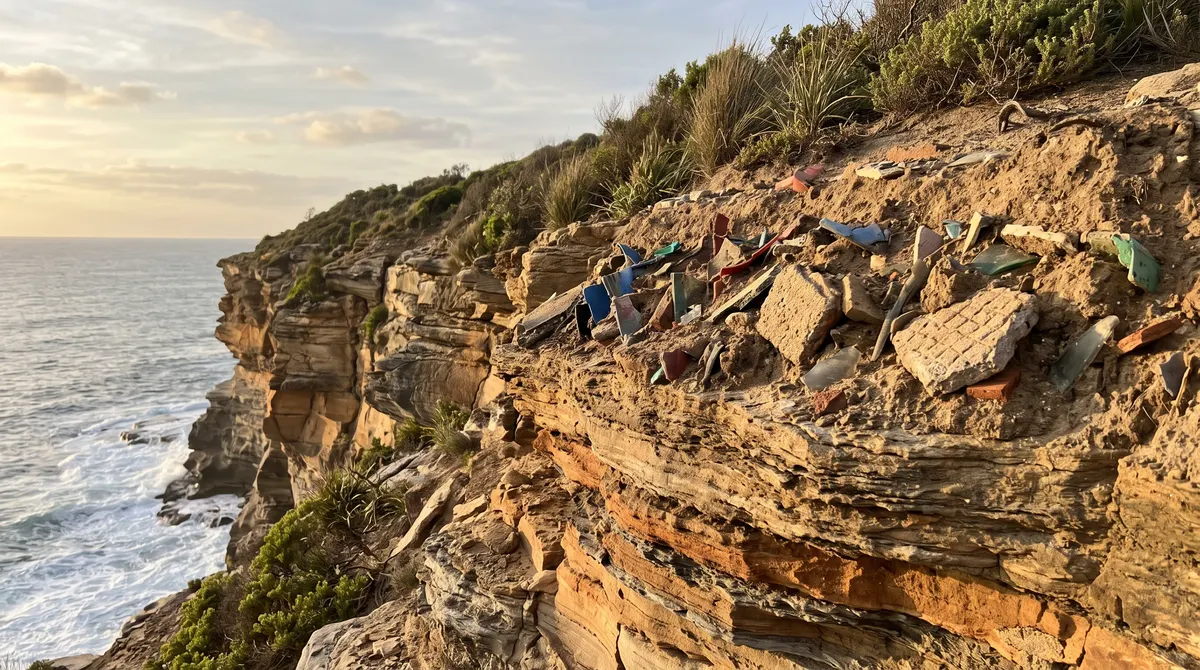
Walk along almost any beach and look closely at the line of debris left by the tide. Among the shells, seaweed and sand there are flecks of coloured plastic, a bottle cap, perhaps a fragment of fishing line. Now imagine that tideline buried, compressed and turned to rock over millions of years. A geologist from the far future cutting through it would find a layer unlike anything laid down before.
That thought sits behind one of the most talked-about words in modern science: the Anthropocene, from the Greek for human and new. The claim is that our species has become a geological force, changing the planet so deeply that the mark will still be readable in the rocks long after we are gone. It is a powerful idea, and also a contested one, so it deserves both awe and care.
How Geologists Carve Up Time
Earth is about four and a half billion years old, and geologists divide that span into a nested hierarchy of named intervals: eons, eras, periods, epochs and ages, a calendar for deep time. The boundaries are not arbitrary. Each marks a genuine, planet-wide change recorded in rock, such as a mass extinction, the rise of new forms of life or a dramatic shift in climate or atmosphere.
To make a boundary official, geologists pick a single reference point in the rock where the change is clearest, nicknamed a golden spike. Australia hosts one of the most famous: the start of the Ediacaran Period, the time of some of the earliest complex life, is marked in the Flinders Ranges of South Australia. The story of how we learned to read these layers is told in Deep Time – How We Learned the Earth's Age.
Officially, we live in the Holocene epoch, which began about 11,700 years ago as the last ice age ended. It has been a warm, unusually stable stretch, and all of human civilisation has grown up inside it.
The Signals We Are Leaving
The Anthropocene proposal says human activity has pushed Earth out of the Holocene into a new chapter defined by us. The evidence is about permanence: what today's sediments, tomorrow's rocks, will still show in the far future.
- Plastics, now spread from mountaintops to the deep sea floor, form a material that never existed before.
- Concrete, poured in such quantities that it is one of the most abundant human-made materials on the planet.
- Radioactive fallout from nuclear weapons testing in the mid-twentieth century, scattered around the globe within a few years to leave a sharp, worldwide marker of a single moment.
- Changed chemistry of air and oceans from burning fossil fuels, recorded in ice, sediments and shells.
- A strange fossil record, dominated by the bones of billions of domestic animals such as chickens.
- Fertilisers, which have greatly increased the flow of nitrogen and phosphorus through the environment.
Taken together, supporters argue, these are exactly the kind of clear, global, lasting signals geologists use to mark the boundaries of deep time. The difference is that this time the cause is a single species.
Where the Name Came From
The word was popularised around 2000 by the Dutch atmospheric chemist Paul Crutzen, a Nobel laureate for his work on the ozone layer, together with the biologist Eugene Stoermer. It caught on quickly well beyond science, appearing in art, philosophy and everyday conversation. Geologists then took the idea seriously enough to set up a working group to test whether it met the strict standards for a formal epoch.
That group eventually proposed that the Anthropocene began in the early 1950s, when the fallout signal and the surge in industrial activity, sometimes called the Great Acceleration, appear together in the record. For its golden spike, it nominated layered sediments at the bottom of Crawford Lake in Canada, where each year's deposits are neatly preserved.
Why It Is Not Official
Here scientific honesty matters. In 2024 the specialist committee that rules on this part of the geological time scale voted against adopting the Anthropocene as an official epoch, and the decision was upheld by the international body above it. As things stand, the Anthropocene is not a formally recognised division of geological time, and it would be wrong to suggest otherwise.
The objections were largely technical. Some geologists felt a start date in the 1950s was far too recent and narrow for an epoch, when human influence on the land stretches back thousands of years through farming, forest clearing and extinctions of large animals. Others argued that the human transformation of Earth is better described as an ongoing event, spreading unevenly through time and place, than as a crisp boundary with a single date. Debate continues about whether and how the idea might be revisited.
The Reality Beneath the Label
Crucially, the rejection was not a verdict that humans are not changing the planet. Almost nobody disputes that our impact is enormous and measurable. The vote was about definitions, boundaries and evidence thresholds, not about whether the changes are real. Many scientists who voted against the formal epoch still use "Anthropocene" freely as a name for the age of human influence, just not as an official line on the chart.
So two things are true at once. The human imprint on Earth is profound and widely accepted. Whether it earns a formal place on the time scale, and where its boundary should sit, is where reasonable experts disagree. Holding both of those ideas together is what taking the science seriously looks like.
A Species Among the Great Forces
For nearly all of Earth's history, the forces that shaped the planet were beyond any creature's control: drifting continents, advancing and retreating ice, the slow churn of the carbon cycle and the occasional asteroid. What is new is that one species has joined them. By some estimates we now move more rock and soil each year than all the world's rivers. We have altered the make-up of the atmosphere, and we are reshaping the web of life at a pace that some scientists compare with the great mass extinctions of the past, explored in Extinction – The Five Great Dyings.
On the scale of deep time, our species arrived only a moment ago, which makes that power all the more striking. It also brings responsibility. Understanding how the climate, oceans and living systems work is what lets us see our own effects clearly, weigh them honestly and choose more wisely.
A Record Still Being Written
Whether or not the Anthropocene ever earns a formal line in the geology textbooks, the idea works like a mirror. The layers settling on lake beds, sea floors and riverbanks right now are a record of what one species did with a brief moment of enormous influence. Unlike almost every other chapter in the rocks, this one is still being written, and what it ends up saying remains up to us.


