Talking Science Podcast
The Arid Zone – How Life Works in the Australian Outback
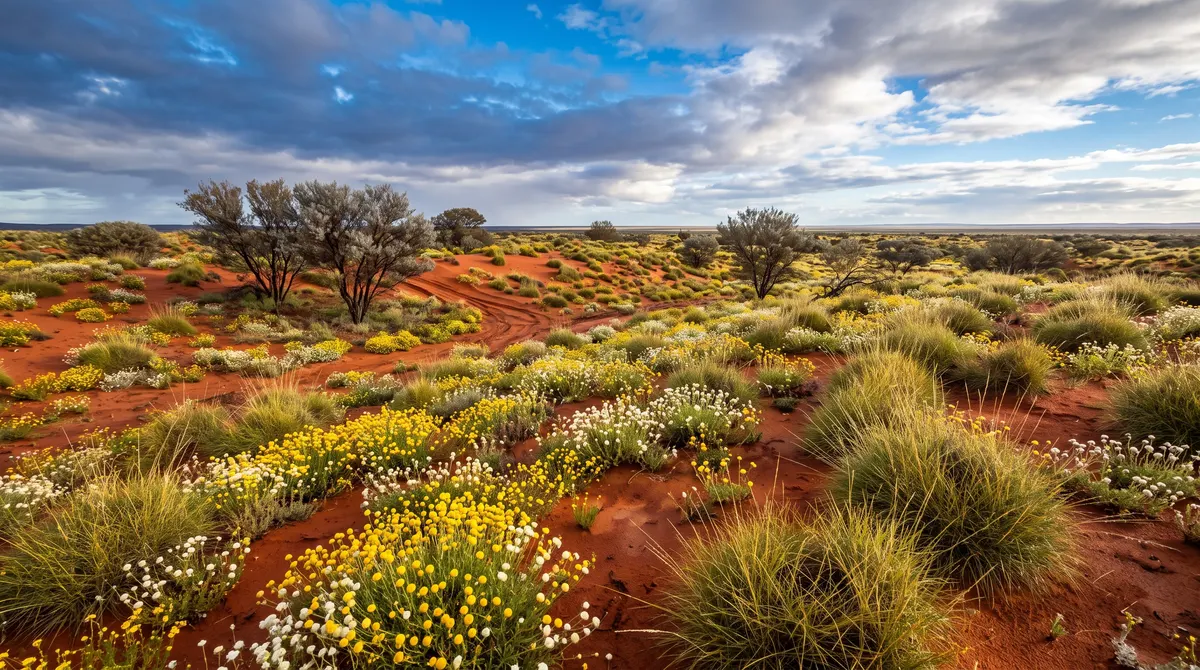
Drive inland from almost any Australian capital for long enough and the green gives way to red. The soil changes colour, the trees thin out and take on new shapes, and to an unfamiliar eye the country starts to look empty.
It is anything but. The arid and semi-arid zone covers roughly seventy per cent of the continent, and it is one of the most quietly sophisticated ecosystems on Earth. Everything living there has been shaped by one harsh constraint: a small, unreliable supply of water.
Why the Middle Is So Dry
Much of Australia sits under a belt of high pressure that circles the globe at these latitudes, the same pattern behind the Sahara and the Kalahari. In high-pressure systems air sinks and warms, and warm air can hold more moisture without letting it fall as rain. Geography makes things worse. Australia is flat, with no towering ranges to force moist air upward and wring rain from it the way the Andes do, and much of the interior lies a thousand kilometres or more from the coast.
Then there is deep time. The continent has been geologically stable and largely free of glaciers for an extraordinarily long period, missing the soil renewal that volcanoes and ice sheets bring elsewhere. Over many millions of years nutrients have been leached away, leaving some of the oldest, poorest soils on the planet, particularly low in phosphorus and nitrogen. There is more on that thin, precious layer in our article on soil.
Boom and Bust
Outback rain is not just scarce but wildly unpredictable, arriving in occasional pulses rather than a reliable season, so the whole ecosystem runs on what ecologists call boom and bust. During the bust, which can last months or years, the landscape looks quiet, with most activity paused. Then a big rain arrives and the response is astonishingly fast. Seeds that have lain in the soil for years, in some species decades, germinate together, and within weeks red country turns green and then bright with wildflowers. Insects multiply on the new growth. Nomadic birds such as budgerigars, which roam the continent following rain, can appear at a freshly filled claypan within days to breed rapidly and repeatedly, before retreating when the water dries up. Population counts for many outback species look less like a smooth trend than a rollercoaster.
Hidden Water and Lifeboat Waterholes
Beneath much of this dry country lies the Great Artesian Basin, one of the largest groundwater systems on Earth, stretching under large parts of Queensland, New South Wales, South Australia and the Northern Territory. Where its water reaches the surface at mound springs, it has supplied reliable water for an immensely long time, supporting isolated plants and animals found nowhere else, and the springs remain places of deep cultural significance for Aboriginal peoples.
Above ground, ephemeral rivers such as Cooper Creek carry rain that may have fallen far upstream weeks earlier, topping up deeper waterholes. These refuges keep fish, waterbirds and many other species alive through the driest stretches, like lifeboats scattered across the landscape.
Plants That Ration Every Drop
- Spinifex, the spiky hummock grass covering vast areas of the interior, has narrow, tightly rolled leaves that expose less surface to drying wind and sun, reducing water lost through the tiny pores called stomata.
- Mulga, a long-lived acacia, has narrow, upright leaf-like structures called phyllodes that catch gentle morning and afternoon light while turning their edges to the harsh midday sun. Its shape also channels rain down towards its own base.
- Seed banks let many plants wait out the bust entirely. Their seeds respond not to the calendar but to the physical and chemical cues of genuine heavy rain, so the plant only gambles on growth when conditions have proven worth it.
Animals That Dodge the Heat
Many outback animals avoid the worst conditions rather than fighting them. Being active at night is extremely common, because cooler, often more humid nights mean far less water lost to evaporation. Some small mammals enter torpor, a controlled drop in body temperature and metabolism lasting hours or days. Some native rodents produce extraordinarily concentrated urine, thanks to kidneys with unusually long structures for reclaiming water. Certain frogs bury themselves and stay dormant underground, sometimes for years, waiting like the seeds above them for rain heavy enough to bring them up to breed.
The red kangaroo builds unpredictability into its reproduction through embryonic diapause. A female can mate again soon after giving birth, but the new embryo can be held paused in her uterus for months, resuming development when conditions and the needs of the joey already in her pouch allow. One female may be carrying a paused embryo, nursing a pouch joey and minding an older young-at-foot at once, letting the species breed again almost as soon as a drought breaks.
The word desert suggests barrenness, yet Australia's deserts host the most diverse reptile communities of any desert region on Earth, with dozens of species of geckos, skinks, dragons and snakes sometimes sharing a small patch of country. The great age and stability of Australian aridity has likely given evolution a long run to produce species that specialise in subtle differences, such as particular soil textures. Many exist nowhere else, which leaves little margin before a whole species is at risk.
Fire, Ferals and a Changing Climate
Aboriginal and Torres Strait Islander peoples have managed fire deliberately for tens of thousands of years. Carefully timed, mostly small, cool burns, often called cultural burning, encourage food plants, support important animals and create breaks that limit later, more dangerous fires. After colonisation these practices were widely disrupted or suppressed, and together with grazing and invasive flammable grasses in some regions, that has contributed to larger, hotter fires in many areas. Cultural burning led by Traditional Owners and Indigenous rangers has been reviving in recent decades and is increasingly recognised for its ecological as well as cultural value.
Introduced animals add newer pressures. Foxes and especially feral cats prey on native species that never evolved alongside such hunters, and cats have been implicated in the decline and extinction of many small and medium-sized native mammals. Rabbits and camels strip fragile vegetation and damage precious waterholes. Climate change brings rising temperatures and, in many arid regions, projections of even more variable rainfall, which could push an already extreme boom-and-bust cycle further for species living close to their limits.
Waiting for Rain
A glance out a car window at red dirt and scattered spinifex can make the arid zone look empty, but it runs on its own patient, opportunistic logic. When news comes that rain has finally reached the outback, picture what is happening out there: seeds breaking dormancy after years of waiting, frogs stirring underground, nomadic birds converging from hundreds of kilometres away, and an ancient, finely tuned ecosystem bursting briefly and brilliantly back into life.