Talking Science Podcast
From One Cell to a Body – The Science of Development
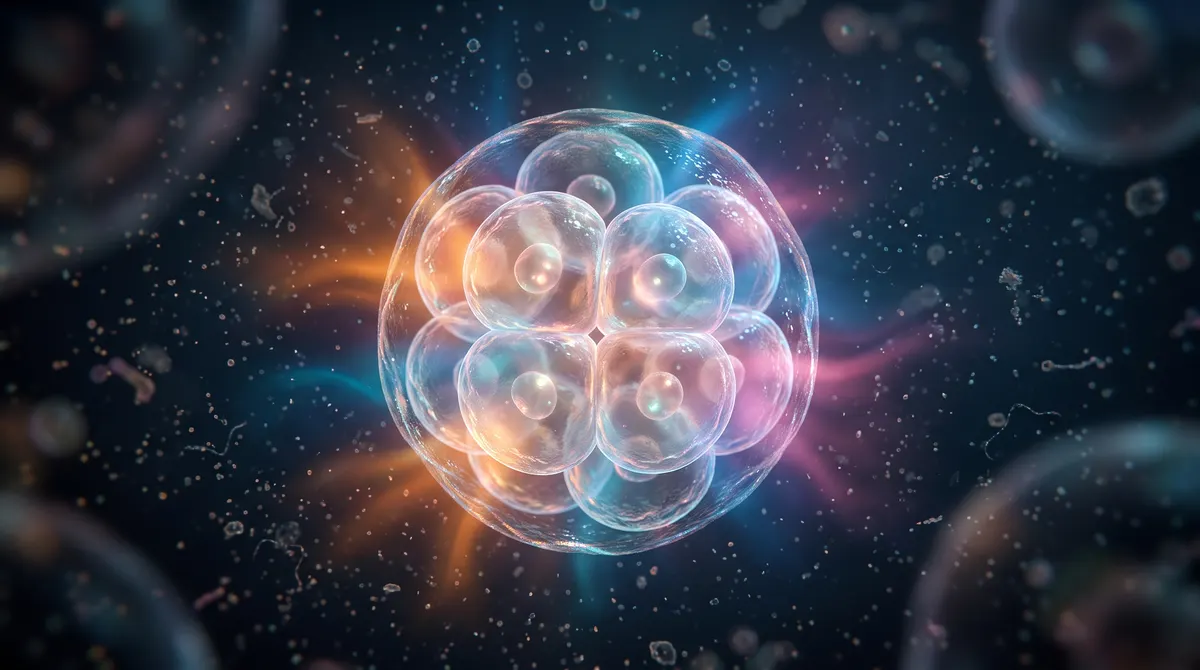
Look at your hand and count your fingers. Five, almost certainly, each in its proper place, with nails on the right side and joints that bend the right way. Not so long ago, all of that was a single cell about the size of a full stop. Nobody drew a plan, no builder followed one and no supervisor checked the work, yet it came out right, along with a beating heart and a brain capable of reading these words.
The process that turns one fertilised cell into a whole working body is called development. Versions of it run in every animal on Earth. Understanding it means answering a deceptively simple question: how does one cell know how to become everything?
A Recipe Book, Not a Blueprint
It starts when a sperm and an egg fuse into a single cell called a zygote, carrying a full set of genetic instructions in its DNA, half from each parent. DNA is often called a blueprint, but that picture misleads. A blueprint is a fixed diagram read once. DNA is more like a vast recipe book, with instructions called genes for building thousands of different proteins, the molecular machines that do most of the work in a cell.
The crucial point is that no cell uses every recipe. Which genes are switched on, in which cells and at which moments, is called gene expression, and development is essentially the story of gene expression changing in an exquisitely coordinated pattern. The molecule itself is covered in DNA – The Instruction Manual for Life.
Divide, Then Diverge
The first thing a zygote does is almost absurdly simple: it splits in two. Then four, eight, sixteen, doubling again and again. Each new cell receives a complete copy of the original DNA, and for the first few rounds the cells are much alike, simply building up raw material.
A ball of identical cells cannot become a body, though. At some point cells have to become different: skin, muscle, nerve, gut lining. This is differentiation. A nerve cell and a skin cell look and behave nothing alike, yet with rare exceptions they carry the same DNA. What separates them is which pages of the shared recipe book each one reads. A nerve cell switches on genes for long branching connections and electrical signalling and keeps unrelated genes, such as those for tooth enamel, firmly off. Differentiation is a gradual narrowing of active genes until each cell commits to an identity.
Reading Position From a Fading Signal
How does a cell know which genes to switch on? Much of the answer lies in chemical signals called morphogens. A small group of cells releases a signalling molecule that spreads into the tissue around it, strongest near the source and weaker with distance, like a drop of dye spreading through still water.
Cells can sense how much morphogen surrounds them, almost like reading a dial, and different levels switch on different sets of genes. Cells close to the source take one path, cells a little further away another, and cells barely touched by the signal a third. One molecule fading with distance can carve a uniform sheet of cells into a neat sequence of zones. In a developing limb, for example, a signal from one edge helps tell the future thumb side from the little-finger side.
Gradients are only part of the picture. Neighbouring cells also talk directly to each other, sharpening fuzzy zones into crisp boundaries, and genes act in cascades, one switching on several others, which switch on more. The overall effect is that a cell's position becomes its identity. It becomes what it becomes largely because of where it sits and what signals reach it there.
Some of the earliest signalling sets up the body's basic directions: head to tail, back to belly, and eventually left and right. These axes act like a coordinate system that every later decision refers to. Errors here would ripple through everything built later, so these steps are tightly controlled.
Shrinking Possibilities
How flexible is a cell's fate? Biologists call this potency. The zygote and the cells from its first few divisions are totipotent: each could in principle produce a whole individual, placenta included. Identical twins show this in action, arising when an early embryo splits into two groups that each develop fully. Non-identical twins come from two separate eggs and are no more alike genetically than other siblings.
A little later, cells become pluripotent, able to form any cell type in the body but not the supporting tissues. After that, options keep narrowing until each cell settles into one role, like a river dividing into smaller and smaller channels. Some of that potential survives into adulthood in reserves of stem cells that keep renewing skin, blood and gut lining throughout life, a story told in Stem Cells – The Body's Master Cells.
Folding, Moving and Sculpting
Development is physical as well as chemical. Sheets of cells fold inward to form tubes that become the gut and the nervous system. Groups of cells detach and travel surprisingly far to settle somewhere new. Chemical instruction and physical movement shape each other, turning a roughly round mass of cells into a three-dimensional body with organs correctly nested inside it.
Robust, but Not Unbreakable
With so many steps across so many cells, you might expect development to be fragile. In fact, one of its most striking features is how robust it usually is. Small fluctuations in a signal, slight differences in timing or the loss of a few cells can often be absorbed, with the embryo correcting course. That resilience comes from redundancy and feedback built into gene networks over evolutionary time.
It does have limits. A gene involved in early patterning can be faulty, a signal can be disrupted at a crucial moment, or migrating cells can fail to arrive. Much of what scientists know about normal development has come from studying those rarer cases.
Timing matters enormously. Each structure has a critical window when it is being built and is most easily disturbed. Substances that interfere with development, called teratogens, tend to do harm when exposure overlaps that window. The most notorious case was thalidomide, given to pregnant women for morning sickness in the late 1950s and early 1960s, which caused severe limb abnormalities. The Sydney obstetrician William McBride was among the first to raise the alarm in 1961. Medical guidance during pregnancy rests on this understanding of when and how the body's structures are built.
An Unfinished Science
Development is still very much a live field. Scientists do not yet fully understand how a single cell weighs all the signals reaching it to make one clean decision, or how much of the process is hard-wired instruction versus cells organising themselves; the evidence suggests both matter. Some of the most exciting recent work grows structures from stem cells in the laboratory that mimic aspects of the early embryo, a carefully regulated way to study steps once almost impossible to watch.
What is remarkable is that none of the individual steps is magic. A cell divides. A signal fades with distance. Genes switch other genes on and off. Cells move, fold and settle. Repeated with breathtaking coordination, those ordinary processes build a complete body from one cell that had no idea what it would become, and became you.