 Talking Science Podcast
The Human Brain – Three Pounds of Mystery
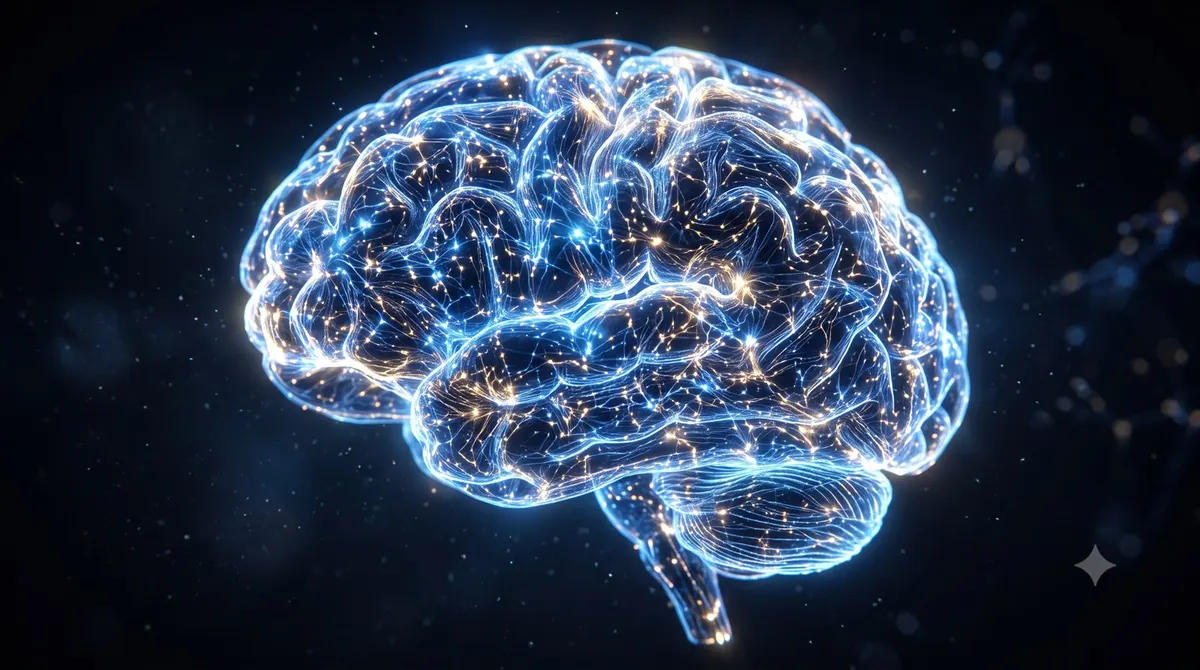
Somewhere behind your eyes, roughly three pounds of soft, wrinkled tissue is doing something no machine has ever matched. It is reading these words, deciding whether you agree, remembering what you had for breakfast, and quietly keeping your heart beating and your lungs filling, all at the same time. The human brain is the most complicated object we know of in the universe, and the strangest part is that you are carrying one around right now, using it to wonder about itself.
A Universe of Cells
The brain is built from special cells called neurons, and there are somewhere on the order of tens of billions of them. Each neuron is a tiny messenger. It gathers signals from its neighbors, and if the incoming signal is strong enough, it fires a brief electrical pulse down a long fiber and passes the message along. What makes this powerful is not any single neuron but the connections between them. A single neuron can link to thousands of others, and the total number of connections runs into the trillions.
Alongside neurons are cells called glia, which for a long time were thought to be mere packing material. We now know they feed neurons, clean up waste, insulate the wiring, and help tune how signals travel. The brain, in other words, is less a single organ and more a bustling city of cooperating cells.
Electricity and Chemistry
When a neuron fires, the electrical pulse eventually reaches a gap between it and the next cell. That gap is called a synapse, and the signal crosses it not as electricity but as chemistry. The sending neuron releases small molecules called neurotransmitters, which drift across the gap and either encourage or discourage the next neuron from firing. Names you may have heard, such as dopamine and serotonin, are members of this chemical family.
This mix of electricity and chemistry is why the brain is so sensitive to substances. Caffeine, alcohol, and medicines all work by nudging these chemical conversations. It is also why mood, focus, and even personality can shift when the chemistry is disturbed. Thought is not a metaphor for electricity and chemistry; it genuinely is electricity and chemistry, organized in mind-bending patterns.
A Map With Districts
Different regions of the brain tend to specialize. The wrinkled outer layer, the cortex, handles much of what we think of as higher thought: language, planning, and reasoning. Tucked underneath are older structures that manage emotion, hunger, fear, and the formation of new memories. At the base sits the brainstem, which quietly runs the machinery of staying alive, including breathing and heartbeat.
Yet the districts are not isolated. Almost anything you do lights up a web of regions working together. Reading a sentence engages vision, language, memory, and attention in a coordinated flash. The old idea that we use only ten percent of our brains is a myth; over a day, virtually all of it earns its keep.
A Brain That Rewires Itself
One of the most hopeful discoveries of modern neuroscience is that the brain is not fixed. It reshapes itself in response to experience, a property called plasticity. Every time you practice a skill, from a language to a golf swing, the relevant connections strengthen. Learn something new and your brain physically changes. This is how a violinist develops enlarged regions for finger control, and how people recovering from strokes can sometimes coax healthy areas to take over lost functions.
Plasticity is greatest in childhood, when the brain is wildly overbuilding connections and then pruning the ones it does not use. But it never fully switches off. The adult brain remains capable of learning throughout life, which is one reason curiosity is such good company as we age.
The Hungry Organ
For all its sophistication, the brain is a demanding houseguest. Though it makes up only about two percent of body weight, it consumes roughly a fifth of the body’s energy. It has no way to store fuel, so it depends on a steady supply of oxygen and glucose delivered by the blood. Interrupt that supply for even a few minutes and cells begin to die, which is what makes strokes so dangerous.
This appetite shapes how we care for our brains. Sleep, movement, good food, and social connection are not luxuries for the brain but maintenance. During sleep, the brain appears to clear away waste products and consolidate the day’s learning, which is part of why a tired mind struggles to think clearly.
The Two Halves and Their Bridge
The brain is famously divided into two halves, or hemispheres, joined by a thick bundle of fibers that lets them talk to each other constantly. Popular culture loves the idea of a logical left brain and a creative right brain, with people neatly sorted into one camp or the other. The truth is more interesting and less tidy. There are genuine differences in what each side tends to handle, and language, for instance, leans heavily on one side in most people. But almost everything you do draws on both halves working together, chattering back and forth across that bridge.
Curiously, the wiring is crossed: the left hemisphere largely controls the right side of the body and the right hemisphere the left. This is why damage to one side of the brain, as in some strokes, shows up as weakness on the opposite side of the body. It is one of many reminders that the brain’s organization, though logical once you learn it, is nothing like what our intuitions would predict.
The Mystery That Remains
We can map the brain’s regions, watch it light up in scanners, and trace the paths of individual signals, and yet the deepest question stays open: how does all this activity become experience? How does a pattern of firing cells become the taste of coffee, the ache of grief, or the simple sense of being someone looking out at the world? This puzzle, sometimes called the hard problem of consciousness, remains genuinely unsolved.
That is what makes the brain so endlessly fascinating. It is the one object in nature that studies itself, the organ using its own three pounds to ask what it is. We have learned an enormous amount, and there is every reason to be humble about how much remains. For now, the best response may simply be wonder that the whole marvelous business is happening inside your skull, right now, as you finish this sentence.


