Talking Science Podcast
The Interstellar Medium – The Stuff Between the Stars
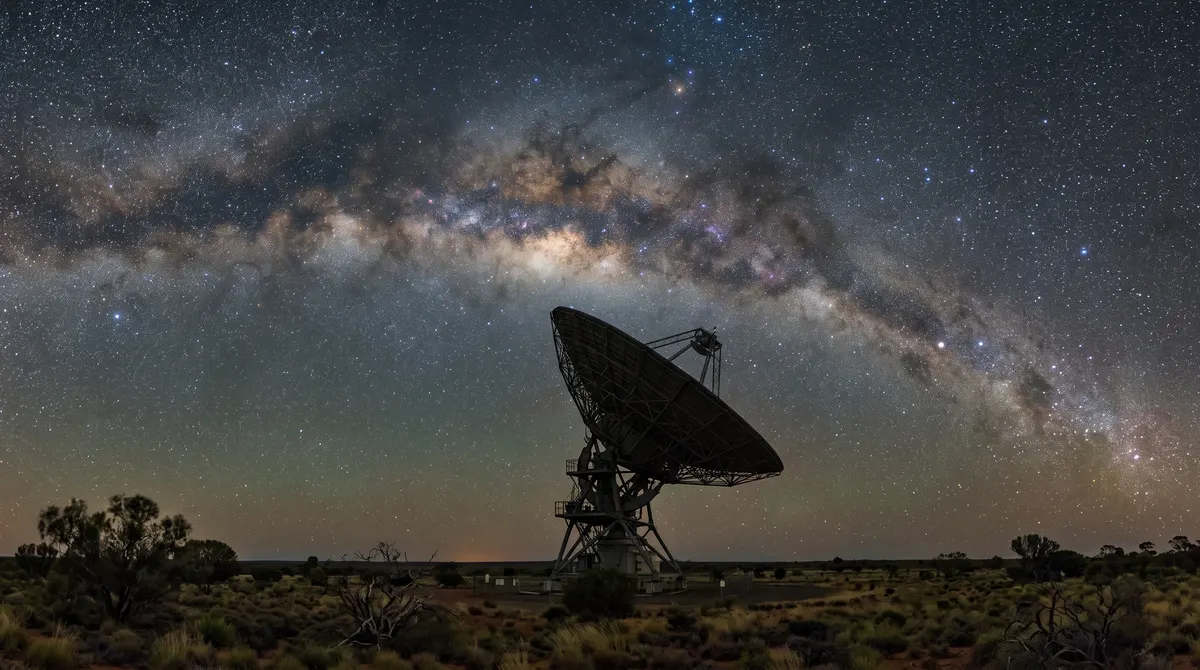
On a clear night far from the city, the Milky Way spills across the sky in a glowing band, and in among the stars are inky gaps where it seems nothing at all is happening. Most of us picture the space between stars as exactly that: empty, black and dull.
That picture is almost completely wrong. The space between the stars is filled with a thin, sprawling mix of gas and dust called the interstellar medium. It is the raw material new stars are built from, the place dying stars return their ashes to, and the reason starlight does not always arrive the colour it should.
Almost Nothing, Spread Across Almost Everything
The interstellar medium is extraordinarily thin. Every cubic metre of the air around you holds something like 25 million billion billion molecules. A typical patch of interstellar space holds roughly one atom per cubic centimetre, and some regions far less. That is emptier than the best vacuum chambers on Earth can manage.
The trick is scale. Spread such a thin gas across trillions of kilometres in every direction and it adds up to an enormous amount of material, a significant fraction of all the ordinary matter in a galaxy. Thinness multiplied by vastness gives you substance.
Gas, Dust and a Lot of Hydrogen
Most of the medium is gas, and most of that gas is hydrogen, the same element that makes up the bulk of the Sun. There is a good share of helium and small but important traces of heavier elements. Scattered through it is dust, though not the kind that drifts through a sunbeam at home. Interstellar dust grains are tiny solid specks of carbon and silicate minerals, chemically a bit like soot and rock, each smaller than a particle of smoke. They make up only a small part of the mass but have a large effect on light.
In places this material gathers into nebulae beautiful enough to have been photographed by every major telescope. An emission nebula glows because hot young stars nearby strip electrons from its hydrogen, and the gas shines as the electrons are recaptured. The Orion Nebula, visible to the naked eye, is one, and it is also a busy stellar nursery. A dark nebula is a dense knot of dust with no light of its own, seen only as a silhouette. The Coalsack beside the Southern Cross is a nearby example, and Aboriginal astronomy has long read these dark dust lanes as figures in their own right, with the Coalsack forming the head of the Emu in the Sky.
Hot Bubbles and Cold Clouds
The medium is not an even fog. It is patchy and turbulent, more like a weather system than a still pond. Some regions are extremely hot and thin, heated by exploding stars to a million degrees or more. Temperature measures how fast particles move, not how many there are, so a gas can be scorching yet almost weightless. Other regions are cooler and denser. In the coldest, densest pockets, hydrogen atoms pair up into molecules and the gas becomes a molecular cloud.
Our own Sun happens to be passing through a hot, sparse region called the Local Bubble, hollowed out over millions of years by ancient nearby supernovae. The Sun's own magnetic bubble, the heliosphere, holds much of the surrounding material at bay.
Where Stars Are Born
Molecular clouds are stellar nurseries. When a cloud becomes cold and dense enough, sometimes squeezed by a shockwave from a nearby dying star or by the galaxy's spiral arms, gravity starts to beat the gas's tendency to spread out. Pockets begin to contract. As they shrink they pull in more material, spin faster and heat up at the centre, the way a figure skater spins faster by pulling in their arms. If a clump gathers enough mass, its core becomes hot and dense enough for hydrogen to fuse into helium, and a star switches on.
A giant molecular cloud can host hundreds or thousands of such clumps, producing a cluster of young stars born together. Every star, our Sun included about four and a half billion years ago, condensed out of the interstellar medium. A galaxy that uses up its gas stops making stars and slowly goes quiet, so the medium is not leftover clutter. It is the fuel tank.
Stardust, Literally
The medium is also where stars send their remains. Inside stars, fusion builds heavier elements from lighter ones: hydrogen into helium, and in bigger stars on to carbon, oxygen and, in the most massive, iron. A star like the Sun ends by gently shedding its outer layers. A much heavier star can explode as a supernova, flinging everything it made out into space at tremendous speed.
That enriched material mixes into interstellar gas, which later cools and clumps into new clouds and new stars. Our Sun and its planets formed from gas already seeded by earlier generations of stars. Saying we are made of stardust is not poetry but a description of a real pathway, one explored in Where the Elements Come From – Cosmic Nucleosynthesis.
Mapping the Invisible
How do astronomers study something that barely glows? One way is to watch what it does to starlight. Light passing through dust is dimmed, an effect called extinction, and it is also reddened, because dust grains block blue light more effectively than red. It is closely related to why sunsets look red, as explained in Why the Sky Is Blue but Sunsets Are Red, only played out over trillions of kilometres.
That nuisance becomes a tool. By measuring how much a star has been dimmed and reddened compared with how it ought to look, astronomers can work out how much dust lies along that line of sight. Repeat the comparison across enough stars and a three-dimensional map of the dust emerges.
Radio telescopes add another view. Cold hydrogen gives off a faint signal at a wavelength of about 21 centimetres, caused by a tiny flip in how each atom's proton and electron are magnetically aligned. Instruments such as the Parkes radio telescope in New South Wales have used it to chart hydrogen across the southern sky. Dense molecular clouds are tracked through carbon monoxide, which is easier to detect than molecular hydrogen itself.
Threaded through it all are a weak magnetic field and cosmic rays, fast charged particles flung out by supernova shockwaves. Seen from far away, the densest gas gathers along a galaxy's spiral arms, so a photograph of a neighbouring spiral is partly a map of where its interstellar medium is thickest.
The Space Where the Story Continues
Plenty remains uncertain. Exactly what triggers a cloud to collapse, how fast stars form, and how dust grains grow and are destroyed all involve turbulence, magnetism and stellar blasts that astronomers are still working to model.
So the dark between two stars is close to a perfect vacuum, and yet it is full: hydrogen drifting in warm and cold reservoirs, dust reddening passing starlight, clouds slowly gathering towards new stars, and the recycled remains of stars that lived and died before the Sun existed. Those gaps are where the ash of old stars becomes the raw material of new ones, in a cycle that has been turning for billions of years and eventually produced us.