 Talking Science Podcast
The Nervous System – The Body’s Wiring
Right now, without any effort, you are performing one of the most complex feats in the known universe. As you read these words, light hits your eyes, becomes electrical signals, races into your brain, is decoded into meaning, and stirs thoughts and feelings, all in a fraction of a second. Meanwhile your heart beats, your lungs breathe, and you sit upright without falling over. Coordinating all of this is a single, breathtaking network of living wiring: your nervous system. It is the fastest communication system your body has, and it is the closest thing you have to a self.
The Cell That Thinks in Electricity
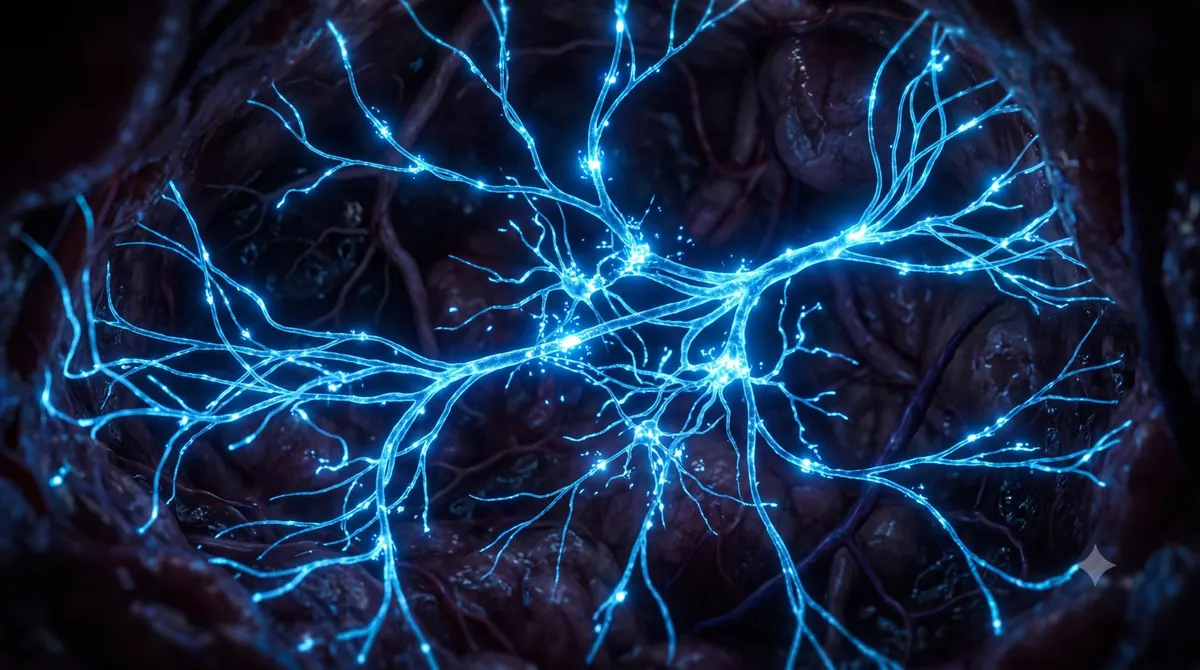
The whole system is built from one extraordinary type of cell: the neuron, or nerve cell. What makes a neuron special is its shape and its trick. Unlike most cells, which are compact blobs, a neuron stretches out long, wiry branches to connect with others, sometimes reaching across surprising distances in the body. And rather than communicating by slow chemistry alone, it carries messages as tiny electrical pulses that zip along its length.
You have a staggering number of these cells, on the order of tens of billions in the brain alone, and each can connect to thousands of others. It is not the individual neuron that is clever, though. Intelligence, sensation, and movement all arise from the connections between them, the vast web they form together. A single neuron is simple; the network is a marvel.
Passing the Message On
If neurons carry electrical signals, how do they hand a message from one cell to the next? Here nature does something elegant. Neurons do not quite touch. Between them lies a microscopic gap called a synapse. When an electrical pulse reaches the end of one neuron, it triggers the release of tiny chemical messengers that drift across the gap and land on the next neuron, either encouraging or discouraging it from firing its own pulse.
So the signal is electrical within each cell and chemical between cells, converting back and forth as it travels. These chemical messengers, called neurotransmitters, are hugely important. They are the molecules through which mood, alertness, and countless brain functions are tuned, and many medicines that affect the mind work by adjusting them. Every thought you have is, in part, a pattern of these tiny chemical handoffs rippling across the network.
The Central Command and Its Cables
The nervous system has two main divisions that work as one. At the centre sit the brain and spinal cord, together called the central nervous system. This is the headquarters, where information is processed, decisions are made, and memories are stored. The brain is the seat of thought and awareness; the spinal cord is the great trunk line running down your back, relaying signals and handling some rapid reactions on its own.
Branching out from this core is the peripheral nervous system, the sprawling network of nerves reaching into every corner of the body. These nerves are like cables carrying two streams of traffic at once: incoming signals from your senses, reporting on the world and your body, and outgoing commands to your muscles, telling them how to move. Sensation flows in, action flows out, endlessly, along the same great network.
The Reflex Shortcut
Not every response can wait for the brain to deliberate. Touch something painfully hot and your hand jerks away before you have consciously registered the pain. This is a reflex, and it reveals a clever piece of design. For urgent protective actions, the signal does not travel all the way to the brain and back. Instead it takes a shortcut through the spinal cord, which fires off the command to move almost instantly, and only afterwards informs the brain of what happened.
This is why you feel yourself pull away first and notice the pain a moment later. The spinal cord acted as a rapid local decision-maker, saving precious time when tissue was at stake. It is a beautiful example of how the nervous system distributes its intelligence, keeping fast jobs local and reserving the slower work of thought for the brain.
The Two Modes of Autopilot
A huge amount of what your nervous system does never reaches your awareness at all. You do not consciously beat your heart, digest your lunch, or adjust your blood vessels. These jobs are handled by the autonomic nervous system, the branch that runs the body on autopilot. It has two complementary modes that balance each other.
One mode, often described as fight-or-flight, revs the body up in the face of challenge or danger, quickening the heart and sharpening the senses. The other, sometimes called rest-and-digest, calms things down, slowing the heart and steering energy toward digestion and repair. Life is a constant, gentle seesaw between these two, adjusting your body to the moment without troubling your conscious mind at all.
The Network That Is You
It is worth pausing at how intimate all this is. Your nervous system does not merely serve you; in a real sense it is you. Every memory, every feeling, every flash of recognition and choice lives in the shifting patterns of signals across this network. The wiring that lets you flinch from a flame is the same fabric from which your inner life is woven. We are only beginning to understand how billions of simple electrical cells give rise to a mind, but the wonder is that they do, quietly and reliably, in every waking and sleeping moment of your life.


