Talking Science Podcast
Acids, Bases and the pH Scale
Bite into a wedge of lemon and your face screws up before you can stop it. That sharp, puckering sourness is one of the most universal tastes there is, recognised by almost anyone from a very young age. What you are tasting is acidity. On the other side of the same coin sits something slippery, soapy and bitter: a base.
Acids and bases turn up in your stomach, your blood, the cleaning cupboard, the rain and the oceans. Behind all of them sits one tiny particle and one cleverly built scale, and between them they explain a surprising amount of biology, medicine and environmental science.
It All Comes Down to One Tiny Particle
A hydrogen atom is one proton with one electron. Remove the electron and what is left is a bare proton, small, positively charged and very reactive. Chemists call it a hydrogen ion, and acidity is simply a measure of how many of them are loose in a solution.
An acid, in the most useful everyday sense, is a substance that releases hydrogen ions when it dissolves in water. Lemons contain citric acid, vinegar contains acetic acid and your stomach makes hydrochloric acid. They are different molecules, but each donates hydrogen ions to the water around it.
A base does the reverse. It soaks hydrogen ions up, or produces hydroxide ions that combine with them and take them out of circulation. Baking soda, many soaps and oven cleaners are bases. Their slippery feel is the base starting to react with the oils and proteins on your skin, which is also why strong bases need careful handling. Pure water sits in the middle, with a tiny, exactly balanced amount of hydrogen and hydroxide ions.
Strong and Weak Are Not About Danger
"Strong" and "weak" have precise meanings here. A strong acid, such as hydrochloric acid, hands over essentially all its hydrogen ions once dissolved. A weak acid, such as the acetic acid in vinegar, lets go of only some of them, with many molecules staying intact in a constant back-and-forth. That is why vinegar can go in a salad dressing while a strong acid at the same concentration would be seriously corrosive. Strength describes how completely an acid releases its hydrogen ions, not how much of it is in the bottle, and the same idea applies to bases.
A Scale That Counts in Tens
The pH scale, introduced by the Danish chemist Søren Sørensen in 1909, compresses hydrogen ion concentration into a manageable number that usually runs from about 0 to 14. The key thing to know is that it is logarithmic, not linear.
On a ruler, each step is the same size. On the pH scale, each whole step is a tenfold change. A solution at pH 4 has ten times the hydrogen ions of one at pH 5, and pH 3 has a hundred times as many. Decibels work in a similar way, where a modest-looking difference hides a huge one underneath.
- Below 7 is acidic. Stomach acid sits far down the scale, much more acidic than black coffee, which is only mildly so.
- 7 is neutral, where pure water sits.
- Above 7 is basic, or alkaline. Heavy-duty oven cleaner sits near the top, far beyond a mild soap.
Why is neutral 7 rather than 0? Because even pure water is never entirely free of hydrogen ions. A tiny fraction of its molecules are always splitting into a hydrogen ion and a hydroxide ion and then rejoining. In pure water the two are exactly matched, and that very low, balanced concentration corresponds to pH 7.
Seeing pH in Your Kitchen
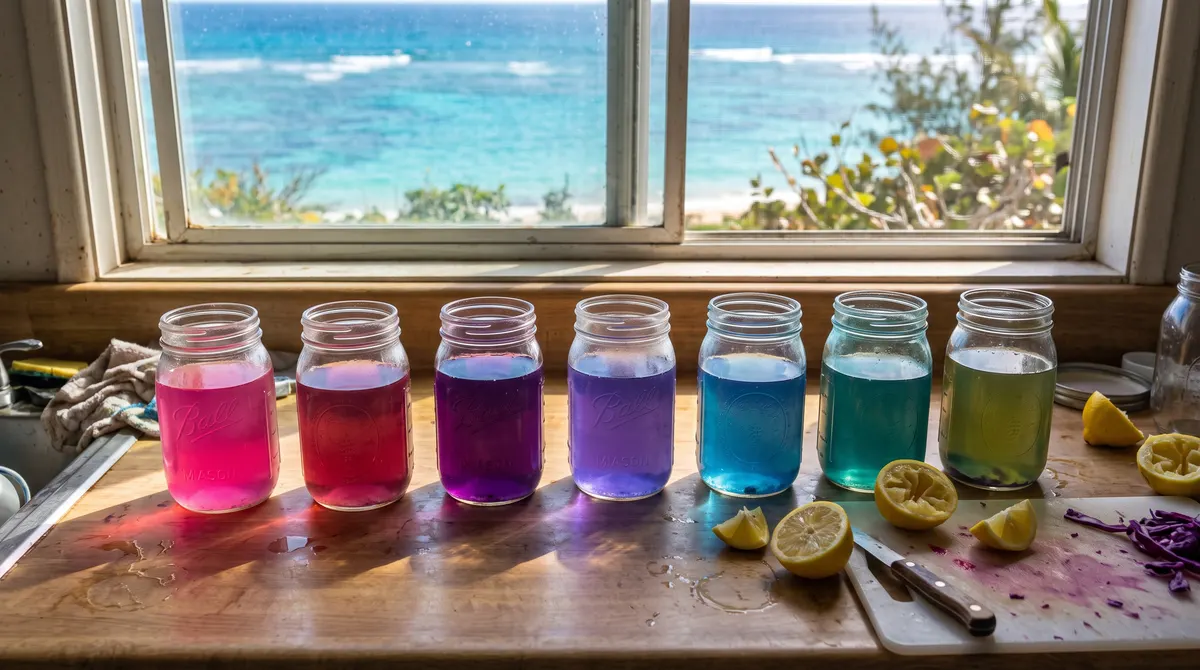
Indicators are substances that change colour with acidity. Litmus paper turns red in acid and blue in base, and universal indicators run through a whole rainbow to give a closer reading. You can make one at home. Boil shredded red cabbage and the purple liquid shifts towards pink with a squeeze of lemon and towards blue or green with a pinch of baking soda.
Two Very Different Jobs Inside You
Your stomach keeps itself fiercely acidic on purpose, typically somewhere around pH 1.5 to 3.5. That acidity helps unravel proteins in food, switches on digestive enzymes that only work in strong acid, and kills many microbes that arrive with a meal. A thick layer of mucus protects the stomach lining from its own contents, and trouble follows when that protection breaks down.
Your blood is the opposite story. Rather than being acidic, it is held in an extremely narrow range just on the basic side of neutral, roughly pH 7.35 to 7.45. The proteins and enzymes that run your body's chemistry are sensitive to pH, and even small shifts outside that range can stop them working properly.
The body holds that number steady using buffers. A buffer contains a pair of substances: one that mops up extra hydrogen ions and one that releases them if too many are removed. Together they act like a shock absorber, resisting change in either direction. Several buffer systems work in your blood at once, while your lungs and kidneys fine-tune the balance continuously. More on that fluid is in Blood – The Most Complicated Fluid You Own.
Acid Rain and an Acidifying Ocean
Ordinary rain is already slightly acidic, around pH 5.6, because carbon dioxide dissolves in raindrops to form a weak acid. Pollution from burning fossil fuels adds sulfur and nitrogen compounds that make rain considerably more acidic. Acid rain can strip nutrients from soil, damage leaves and push lakes and streams beyond what fish can tolerate. Cutting those pollutants has brought real improvement in many regions, though not everywhere.
The ocean faces a related shift. It absorbs a large share of the carbon dioxide people release, and dissolved carbon dioxide forms the same kind of weak acid found in rain. The average pH of the surface ocean has fallen by about 0.1 since before the industrial era. That sounds tiny, but on a logarithmic scale it means roughly 30 per cent more hydrogen ions.
That matters for creatures that build shells and skeletons from calcium carbonate, including corals, oysters and some plankton, because building gets harder in more acidic water. For Australia this is close to home: the Great Barrier Reef is built from the calcium carbonate skeletons of countless generations of coral, and researchers track ocean chemistry alongside ocean temperature as a key pressure on it. The underlying chemistry is well established. Exactly how acidification combines with other stresses, and how far different species can adapt, is still being worked out. The wider picture of reef health is covered in Coral Reefs – Rainforests of the Sea.
The Built-In Undo Button
Mix an acid and a base in the right proportions and they cancel each other out, producing water and a salt and pulling the pH back towards neutral. This is neutralisation. It is the chemistry of an antacid tablet easing an overly acidic stomach, of farmers spreading lime on acidic soil, and of toothpaste, which is mildly basic and helps counter the acid that plaque bacteria make from sugar.
So a sour lemon is a small introduction to something universal. The same hydrogen ion and the same scale describe the acid that digests your dinner, the carefully buffered stability of your blood, the toll of pollution on rain and rivers, and a slow, measurable change in the chemistry of the entire ocean.