 Talking Science Podcast
Caves and Karst – Landscapes Dissolved by Water
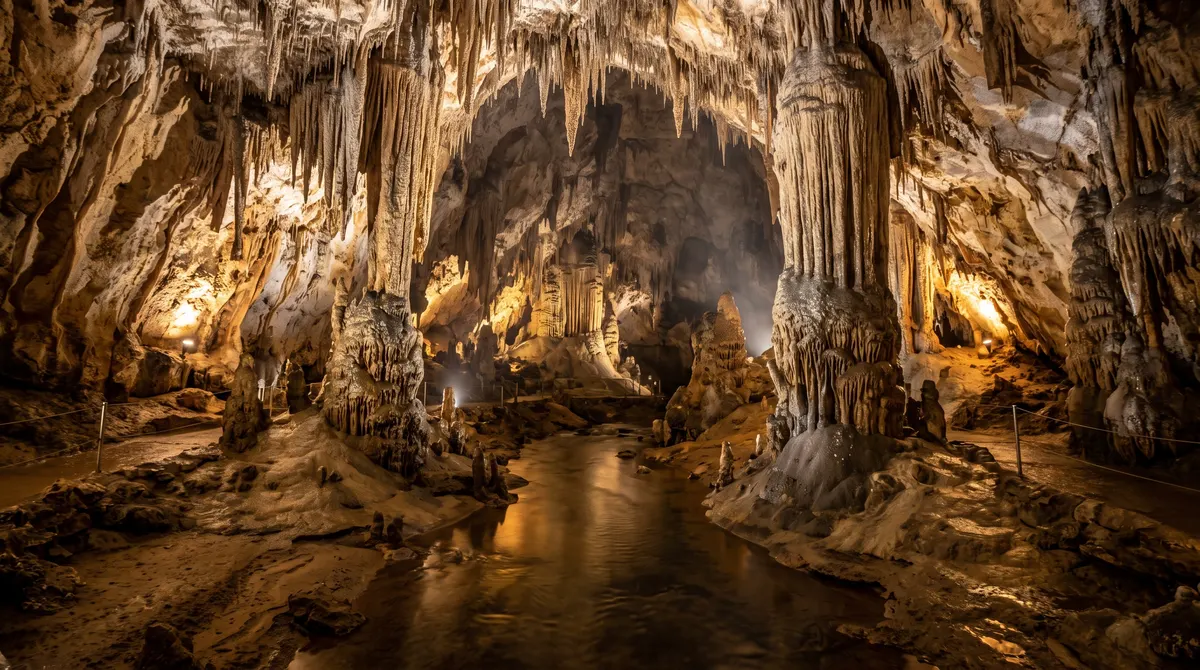
After a heavy shower, rain soaks into the ground and seems to be gone. Most of the time that is the end of it. In some landscapes, though, the water keeps working long after it disappears. It slowly eats away at solid rock, one drop after another, hollowing out tunnels and chambers that nobody walking above would ever guess were there.
Geologists call this kind of country karst, and some of the finest examples in the world are in Australia.
Rain, Soil and a Very Mild Acid
Most karst forms in limestone, a rock made mainly of calcium carbonate. Much of that material started out as the shells and skeletons of sea creatures, which settled on the floors of ancient seas and were slowly pressed into stone over millions of years. Limestone stands up well to wind and grinding water. Its weakness is chemical: calcium carbonate reacts with acid.
Rainwater is a very weak acid. As it falls it picks up a little carbon dioxide from the air, and it picks up far more as it seeps through soil, where roots and rotting plant matter are constantly releasing the gas. Carbon dioxide dissolved in water forms carbonic acid, the same mild acid that gives fizzy drinks their bite. When that slightly acidic water meets limestone, it dissolves the rock and carries it away in solution. Nothing is ground down or broken off.
How a Crack Becomes a Cave
Limestone is full of fine cracks left over from when it formed or from later earth movements. Water follows these weaknesses and widens them slightly as it passes. A wider crack lets more water through, which dissolves the rock faster again. The passages that happen to start a little larger therefore grow faster and faster, while their narrower neighbours lag behind.
Given tens or hundreds of thousands of years, and sometimes much longer, those favoured cracks become passages big enough to walk through, then chambers the size of halls. Nobody could watch this happen in a lifetime. Like mountain building, we understand it from its evidence and chemistry rather than by seeing it unfold.
Passages grow fastest around the water table, the level below which every pore and crack is permanently full. Over long periods, as rivers cut deeper or rainfall and sea levels change, the water table tends to drop, leaving old passages high and dry while new ones form lower down. That is why many big cave systems have several levels stacked like storeys in a building, with the lowest often still carrying an underground stream.
Stalactites, Stalagmites and a Fizzy Drink
Once a chamber is open, a second process begins to decorate it. Water seeping through the ceiling carries dissolved calcium carbonate. When a drop hangs from the roof, some of its carbon dioxide escapes into the cave air, just as gas escapes from a freshly opened soft drink. With less carbon dioxide the water becomes less acidic and can no longer hold all its dissolved mineral, so a tiny trace of solid calcium carbonate is left behind before the drop falls.
Countless drops later, that trace becomes a stalactite hanging from the ceiling. Where drips keep landing on the same spot below, a stalagmite grows upward to meet it, and the two can eventually join into a column.
Climate Records Written in Stone
These cave formations, known collectively as speleothems, are far more than pretty shapes. They grow in layers, a bit like tree rings, and each layer locks in chemical clues about conditions at the time it formed. Researchers drill thin cores from stalagmites and measure trace elements and isotopes, which are versions of the same element with slightly different masses. Some isotope ratios shift in well-understood ways with temperature and rainfall.
The layers can also be dated very precisely using the slow, steady radioactive decay of uranium trapped in the mineral. Together, these tools let scientists reconstruct rainfall and temperature going back tens of thousands of years, sometimes year by year or even season by season. Because they are independent of ice cores and ocean sediments, cave records help cross-check our picture of past climate, including the ice ages.
When the Ground Gives Way
The same dissolving that hollows out caves also shapes the surface above. The most dramatic result is the sinkhole. Some sinkholes form gently, as rock beneath slowly dissolves and the soil above settles into a bowl over years. Others form suddenly, when an underground cavity has grown so large and its roof so thin that it can no longer hold its own weight. The roof collapses, sometimes within hours, swallowing whatever sat above, from a road to a patch of paddock.
Karst also produces disappearing streams. A creek flowing across limestone can reach an opening and simply pour into the ground, continuing its journey through the cave system and sometimes reappearing kilometres away as a spring at the foot of a hill. Because so much water travels underground, karst country often has far fewer permanent creeks and lakes than its rainfall would suggest.
Life Without Light
Deep caves have no sunlight, so there are no plants to start a food chain. Instead, life depends on food brought in from outside: organic matter washed down from the surface, or the droppings of bats, called guano. Bats that roost in caves and feed outside at night carry energy from the sunlit world into the dark, and whole communities of mites, beetles and fungi can depend on a single guano deposit. If the bats are driven away, that food supply goes with them.
Animals that live their whole lives in darkness are called troglobites, and they look remarkably alike wherever they evolved. Many have lost their eyes, since working eyes cost energy and offer nothing in the dark. Many are pale, with long legs or antennae, sharp senses of touch and smell, and slow metabolisms suited to scarce food. Unrelated species arriving at the same solutions is a classic case of convergent evolution.
Australia's Hidden Landscapes
The Jenolan Caves in the Blue Mountains, west of Sydney, are thought to be among the oldest known open cave systems in the world, carved into limestone that is itself hundreds of millions of years old. An underground river still shapes them today.
The Nullarbor Plain, straddling South Australia and Western Australia, takes its name from Latin for "no trees". It is one of the largest single stretches of limestone karst on Earth, flat and dry on top and riddled with caves below, some holding valuable fossils.
In south-eastern South Australia, the Naracoorte Caves are World Heritage listed for their fossils. Over hundreds of thousands of years, openings in the ground acted as natural pitfall traps. Animals that fell in could not climb out, and their bones were preserved in the stable cave conditions. The result is one of the richest records of Ice Age Australian megafauna anywhere, including giant marsupials far larger than their living relatives.
A Landscape Built in Reverse
Most landscapes are built up. Karst is carved away instead, patiently, by water that has vanished from view. Somewhere beneath limestone country right now, this week's rain is widening a crack, adding a thin layer to a stalagmite, or feeding a stream that will surface far from where it sank, all in silence beneath our feet.