Talking Science Podcast
Cosmic Rays – Messengers from Violent Space
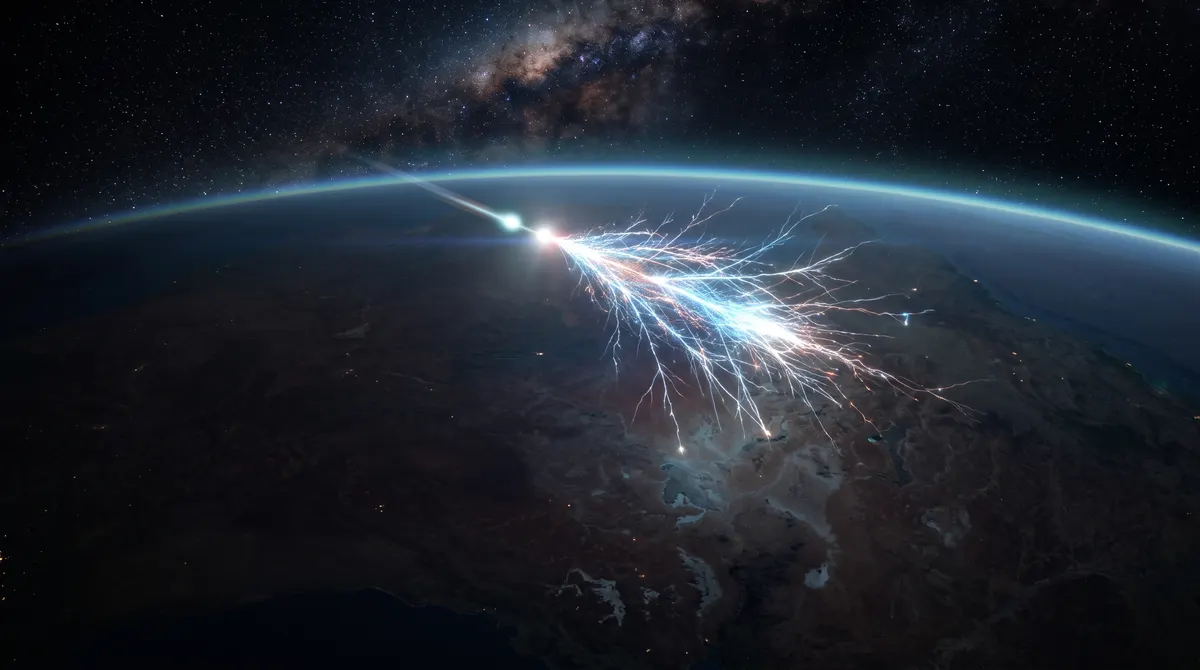
Hold out your hand. Every second or so, something passes straight through it without you feeling a thing. It is not sunlight or a radio signal from your phone. It is a tiny, fast-moving particle called a muon, born a few dozen kilometres above your head when a piece of debris from deep space slammed into the top of the atmosphere at close to the speed of light.
That original piece of debris is a cosmic ray, and despite the name it is not a ray of light at all. It is real matter arriving from the depths of space in a rain that never stops, day or night, and has been falling on Earth for its entire history.
Not Rays at All
The name dates from the early twentieth century, when physicists assumed they were dealing with a kind of radiation like X-rays or gamma rays. It stuck even after that turned out to be wrong. A cosmic ray is, overwhelmingly, a single charged particle. About 90 per cent are protons, the bare nuclei of hydrogen atoms. Most of the rest are helium nuclei, with a small share of heavier nuclei and a sprinkling of electrons.
What unites them is that they carry electric charge and travel extraordinarily fast, many close to the speed of light. That combination lets them smash into atoms in our air and set off spectacular chain reactions.
Discovered by Going Up
In the early 1900s, physicists were puzzled by the electroscope, a simple device for measuring electric charge. Even sealed and shielded, it slowly lost its charge, as if some invisible radiation were sneaking in. The obvious suspect was natural radioactivity in rocks and soil, which predicted that the effect should weaken the higher you went.
The Austrian physicist Victor Hess decided to check. Around 1912 he carried electroscopes up in a balloon again and again, eventually above five kilometres, and even flew during a partial solar eclipse to rule out the Sun as the cause. The result was the opposite of what everyone expected. The effect grew stronger with height. Whatever it was came from above the atmosphere, from space. Hess later received a Nobel Prize, and cosmic rays went on to give physicists free access to particles more energetic than their laboratories could make.
Where They Come From
There is no single answer, and some parts are far better understood than others.
- The Sun sends out lower-energy particles during flares and other outbursts. Their intensity rises and falls with its roughly eleven-year cycle of activity.
- Exploding stars in our own galaxy are the leading explanation for most cosmic rays. A supernova drives a shockwave into the surrounding gas that can last tens of thousands of years. Charged particles bounce back and forth across that shock, gaining energy with every crossing, like a ball struck harder and harder between two approaching paddles. Observations of known supernova remnants support this, though how efficiently it works is still studied.
- The most extreme particles remain a mystery. In 1991 a detector caught one carrying roughly the energy of a well-hit tennis ball, packed into a single subatomic particle. Physicists nicknamed it the Oh-My-God particle.
Candidate sources for those giants include active galactic nuclei, where supermassive black holes devour matter and blast out jets, and gamma-ray bursts, brief and violent explosions linked to collapsing massive stars or colliding stellar remnants. Both are plausible, and there is not yet a confirmed answer. One clue comes from the GZK cutoff: above a certain energy, particles should lose energy by colliding with the faint radiation left over from the Big Bang, so the most energetic ones we catch probably came from relatively nearby, in cosmic terms.
Tracing them is hard because charged particles do not travel in straight lines. Magnetic fields threading the galaxy bend their paths, so most arrive from what looks like every direction at once, and only the most energetic might point back towards a source. Because those are so rare, the Pierre Auger Observatory in Argentina spreads its detectors across about 3,000 square kilometres to catch them.
A Shower From a Single Particle
When a cosmic ray finally hits the atmosphere, it collides with a nitrogen or oxygen nucleus tens of kilometres up. The impact shatters both and sprays out new particles, including short-lived ones called pions. Those decay almost at once into muons and neutrinos, ghostly particles that mostly pass through the entire planet untouched. Other fragments strike more nuclei lower down, which create still more particles, cascading towards the ground. By the time this air shower reaches the surface it can contain millions of particles spread over an area the size of several football fields, all from one arrival.
Muons and Einstein's Clocks
Muons hold a lovely puzzle. They are unstable and decay after a tiny fraction of a second. Even near the speed of light, one made high in the atmosphere should not last long enough to reach the ground. Yet they arrive at sea level in huge numbers, which is why one is passing through your hand right now.
The explanation is special relativity. Because muons are moving so fast, time passes more slowly for them as seen from the ground, an effect called time dilation. From our point of view, its brief life is stretched long enough to complete the journey. Every muon detected at the surface is a small, ongoing confirmation of Einstein, the same physics explored in Time Dilation – Why GPS Satellites Disagree With Your Watch.
Why Pilots, Astronauts and Engineers Care
Cosmic rays have practical consequences. Aircrew on long-haul, high-altitude routes, especially near the poles where Earth's magnetic field shields less, receive noticeably higher doses than people on the ground. In several countries they are monitored as occupational radiation workers, although most doses stay modest, and airlines can estimate exposure route by route. Astronauts face a far bigger version of the problem beyond the atmosphere and much of the protection of the magnetosphere, and it is one of the hardest obstacles for long missions deeper into the solar system.
Electronics are affected too. A particle passing through a chip can leave just enough charge in the wrong spot to flip a stored bit from zero to one, an event called a single event upset. Usually it goes unnoticed, but aircraft systems and satellites need safeguards, because these glitches become far more common at altitude and in space.
A more uncertain question is whether cosmic rays nudge cloud formation. The CLOUD experiment at CERN found that ionisation can help tiny particles form under some conditions, but whether that matters for real cloud cover and climate remains unsettled.
Catching the Invisible Rain
Detecting cosmic rays ranges from the humble to the gigantic. A cloud chamber, a box of supersaturated vapour, can be built for a school project and shows particle tracks as thin streaks. Giant arrays like Auger watch huge areas of ground and night sky. And at the South Pole, the IceCube observatory uses a full cubic kilometre of Antarctic ice as its detector, watching for the faint flashes when a neutrino occasionally hits something.
So the sky above you is not empty. It is crossed constantly by the fast-moving debris of exploded stars and, at the extreme end, by particles from engines so powerful that physicists are still working out what they are. And every second or so, one small piece of that ancient violence slips quietly through the palm of your hand.