 Talking Science Podcast
Fresh Water – The Coming Scarcity
Turn on a tap anywhere in an Australian city and clean, drinkable water pours out, as much as you like, for a fraction of a cent per litre. It is so reliable that most of us never think about where it came from. Yet that water is drawn from one of the scarcest and most contested resources on the planet, and the story of why begins with a paradox.
From space, Earth is the blue planet. Oceans cover around seven-tenths of its surface. And still, fresh water for drinking, farming and running cities is something whole regions struggle to find enough of. To understand how a planet drowning in water can run short, you have to look at where all that water actually is.
A Very Thin Slice
Add up all the water on Earth and roughly 97 per cent of it is salt water in the oceans. That is no use for drinking or for most crops without expensive treatment. Only about 3 per cent is fresh. But even most of that is out of reach, because around two-thirds of the world's fresh water is frozen in the ice sheets of Antarctica and Greenland and in glaciers.
Set the ice aside and the fresh water that is both liquid and accessible, in rivers, lakes and the ground beneath our feet, comes to well under one per cent of all the water on the planet. Every farm, every city and every factory on Earth draws on that sliver. If all the world's water were a large bucket, the usable fresh water would amount to a few spoonfuls.
It is worth stressing that the water itself is not disappearing. The water cycle keeps turning, lifting water from the oceans and dropping it as rain, as explained in The Water Cycle – The Journey of Every Drop. The problem is how much fresh water is available at a given place and time, and how fast we use it.
The Hidden Reservoirs Underground
When we picture fresh water we think of rivers and lakes, but most of the liquid fresh water on Earth is hidden underground. It sits in aquifers, layers of rock, sand and gravel whose tiny pores and cracks are saturated with water, like a giant sponge. Wells and bores tap this groundwater, and it supplies drinking water and irrigation across much of the world, including large parts of rural Australia.
Australia is home to one of the largest underground water systems on Earth, the Great Artesian Basin, which lies beneath a big share of the inland east and has sustained outback towns and stations for well over a century. Some of its water entered the ground an extraordinarily long time ago.
That slowness is the catch. Many aquifers refill only gradually, as rain trickles down over centuries or even longer. Pump water out faster than it is replaced and you are effectively mining it, drawing down a savings account that took ages to build. In several major farming regions around the world, water tables have been falling year after year for exactly this reason.
What Water Stress Means
A region is said to be under water stress when demand for fresh water presses up against, or exceeds, what can be supplied sustainably. Several pressures drive it at once:
- More people, each needing water for drinking, cooking and sanitation.
- Agriculture, which already accounts for the largest share of fresh water taken from rivers and aquifers worldwide, commonly estimated at around 70 per cent.
- Industry and energy production, which take their own substantial share.
- Pollution, which can spoil supplies that would otherwise be usable.
- A changing climate, which is shifting rainfall patterns and can make droughts in dry regions longer and harsher.
The result is that a large and growing number of people live in places where water is genuinely scarce for at least part of the year.
Australia's Great Test Case
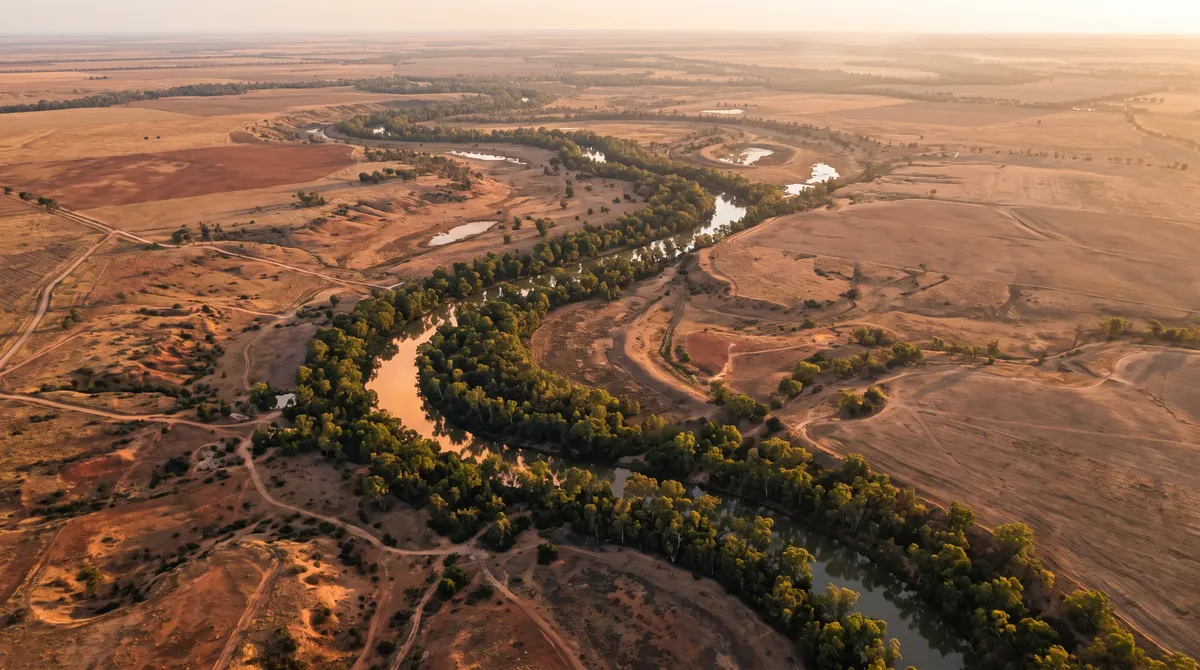
Australia is the driest inhabited continent, and nowhere are the trade-offs sharper than in the Murray–Darling Basin. This vast network of rivers across Queensland, New South Wales, Victoria, South Australia and the ACT is the country's most important farming region, often called its food bowl. It also supplies towns and cities, supports wetlands and native fish, and holds deep cultural significance for the many Aboriginal nations whose Country it flows through.
All of those users draw on the same finite supply, and in a dry year there simply is not enough to satisfy everyone in full. Take too much for irrigation and the rivers suffer: flows drop, water quality declines, wetlands dry out and fish die. Mass fish deaths in the lower Darling in recent years brought that home to the whole country. Leave more water in the rivers for the environment, and farmers and the towns that depend on them feel the squeeze.
Managing the basin has involved decades of negotiation and reform, including the Murray–Darling Basin Plan agreed in 2012, which set limits on how much water can be taken. It remains contested, and it is honest to say there is no arrangement that leaves everyone fully satisfied. Sharing a river is a matter of science, trade-offs and compromise.
The Toolkit
There is no single fix, but there is a well-understood toolkit. The biggest lever is efficiency, particularly on farms: irrigation that delivers water close to plant roots rather than losing it to evaporation, and crops suited to the local climate. Cities can fix leaking pipes, recycle treated wastewater and encourage careful use, as many Australian cities did during the Millennium Drought.
Coastal cities have another option: desalination, which removes salt from seawater. Perth, Sydney, Melbourne, Adelaide and the Gold Coast all have desalination plants, and Perth relies on them for a large part of its supply. Desalination is drought-proof, but it is energy-hungry and expensive, so it tends to work as insurance rather than a cheap cure-all.
Underpinning everything is good management: measuring how much water there is, sharing it fairly and protecting the rivers, wetlands and aquifers that store and clean it. The way water moves through the landscape also depends on healthy ground, a story told in Soil – The Thin Layer That Feeds Us.
Scarcity on a Blue Planet
Fresh water is not about to vanish. But the amount available to us at any time and place is small, unevenly spread and increasingly stretched by rising demand and a shifting climate. The encouraging part is that most water problems can be solved with tools we already have: efficiency, fair sharing and care for the natural systems that supply us. The challenge on a planet made mostly of water is not running out. It is learning to manage the precious few spoonfuls that are actually ours to use.


