 Talking Science Podcast
Hearing and Balance – Physics Inside Your Skull
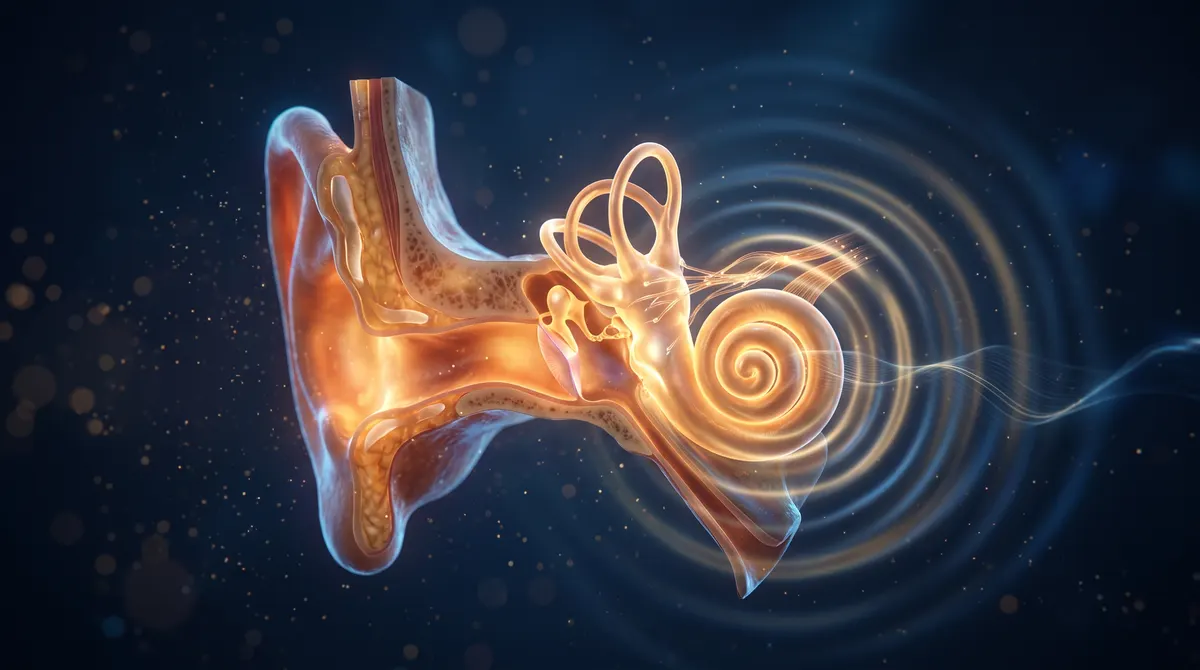
Walk out of a loud concert, or away from a jackhammer you stood too close to, and for an hour or two the world sounds muffled, as if you were underwater. Often there is a thin, high ring sitting behind everything you try to listen to.
That dullness is a warning light. It means an extraordinarily delicate piece of machinery, packed into a space not much bigger than a marble on each side of your skull, has just been pushed harder than it was built for. That machinery turns vibrating air into nerve signals, and right beside it sits a second system with a completely different job: telling your brain which way is down.
From Air to Eardrum
Sound is a travelling pattern of pressure, air molecules bunching and spreading as a wave, a story told in our article on how vibrating air carries meaning. The visible flap of your ear, the pinna, helps funnel those waves down the ear canal to a thin, taut membrane, the eardrum, which vibrates in step with the incoming pressure.
Two ears let you work out where a sound comes from. A sound from your left reaches your left ear a fraction of a millisecond sooner, and arrives slightly quieter at the right because your head casts an acoustic shadow. The brain combines these tiny differences to calculate direction, which is why hearing loss in one ear makes sounds harder to locate, and why turning your head slightly while hunting for a beeping smoke alarm genuinely helps.
Three Tiny Bones Solve a Physics Problem
Behind the eardrum is a chain of three bones, the smallest in the body, named after the objects they resemble: the malleus (hammer), incus (anvil) and stapes (stirrup). The stapes, only a few millimetres long, is the smallest bone you own.
The problem these ossicles solve is called impedance matching. The inner ear is filled with fluid, which is far harder to set moving than air. If airborne sound struck fluid directly, most of its energy would bounce off, which is why a shout barely disturbs a swimming pool. The ossicles concentrate the force collected over the relatively large eardrum onto a much smaller membrane called the oval window, the doorway to the inner ear, and add lever-like advantage from the way they are hinged. Together these boost the pressure roughly twentyfold, enough to drive the sound into the fluid.
A Keyboard Coiled Like a Snail
The vibration now enters the cochlea, a spiral named from the Greek word for snail, coiled into a space about the size of a pea though roughly three centimetres long if unrolled. Along it runs the basilar membrane, narrow and stiff near the entrance and wider and floppier towards the far end. High-pitched sounds make the stiff end vibrate most, low-pitched sounds the floppy end, and every pitch in between has its own spot, an arrangement called tonotopic organisation, effectively a piano keyboard laid along a coiled tube.
Along the membrane sit sensory hair cells, each topped with tiny projections called stereocilia. When the membrane vibrates at a spot, the stereocilia there bend, tugging open microscopic channels that let charged particles in and trigger a signal in the auditory nerve. The full chain runs from air to eardrum, to bones, to fluid, to bending hair cells, to a nerve signal the brain hears as a voice or a song.
Why Noise Damage Lasts
In humans and other mammals, destroyed hair cells generally do not grow back. Birds and fish can regenerate theirs, and understanding why mammals cannot is a major research focus, though not yet a treatment. Loud sound can physically shear or destroy stereocilia, and damage depends on both volume and duration, which is why workplace rules cut permitted exposure roughly in half for every few decibels of extra volume. Headphones are a modern concern because they can deliver concert-level sound straight into the ear for hours without the natural cue of having to shout to be heard.
Hearing also fades with age, usually at high pitches first, since hair cells at the stiff end accumulate a lifetime of wear. Consonants like the hiss of an s carry much of their information at high frequencies, so early loss often shows up as trouble telling similar words apart in a noisy room, easily mistaken for not paying attention.
When loss is severe, a cochlear implant bypasses the hair cells altogether. A microphone and processor turn sound into electrical patterns sent to a thin electrode array threaded into the cochlea, stimulating the auditory nerve at different points to mimic the keyboard layout. The multi-channel implant was pioneered in Melbourne by Graeme Clark and his team, with the first patient receiving one in 1978. It does not match a healthy ear and takes practice to interpret, but for many people it restores useful hearing.
The Balance Organs Next Door
Sharing the same fluid-filled chambers as the cochlea is the vestibular system, which handles balance.
- Three semicircular canals, fluid-filled loops set at roughly right angles like the rings of a gyroscope. When your head turns, the fluid lags behind the canal walls, bending hair cells and telling the brain which way and how fast you are rotating.
- Two otolith organs, the utricle and saccule, which sense straight-line acceleration and gravity. Their hair cells are capped with gel holding tiny calcium carbonate crystals called otoliths, literally ear stones, which lag when you tilt or accelerate. That is how you feel a lift start moving.
The brain cross-checks these signals with vision and body position, and when gravity disappears the system has to adapt, as described in our article on what zero-g does to the body.
Spinning Rooms, Queasy Cars and Phantom Ringing
Vertigo, the feeling the world is spinning while you stand still, often comes from this balance machinery. In a common cause, benign paroxysmal positional vertigo, otolith crystals come loose and drift into a semicircular canal, sending false rotation signals in certain head positions. It is generally harmless, and specific head movements can often guide the crystals back out. The system can also recalibrate, which is why sailors develop sea legs and some then feel wobbly for a while back on land.
Motion sickness is thought to come from a mismatch. Reading in the back seat, your eyes report a still page while your vestibular system correctly reports every turn. A leading explanation, still a hypothesis, is that the brain reads this conflict as a possible sign of poisoning and triggers nausea defensively. Tinnitus, ringing with no outside source, is often linked to hair cell damage; one working idea is that when input at certain pitches goes quiet, the brain turns up its own internal gain and produces a phantom sound. There is no universal cure, though sound therapy and counselling-based approaches help many people.
Small Space, Big Engineering
When your ears ring after a loud night, or the room tips as you stand up too fast, remember what is packed behind your ear canal: a mechanical amplifier solving a physics problem you never knew existed, a coiled analyser sorting sound by pitch, and crystal-topped hair cells in fluid-filled loops keeping you upright. It all works so quietly that it is easy to take for granted, until an hour or two after a concert, when it briefly does not.


