Talking Science Podcast
Nebulae and Star Clusters – Where Stars Are Born
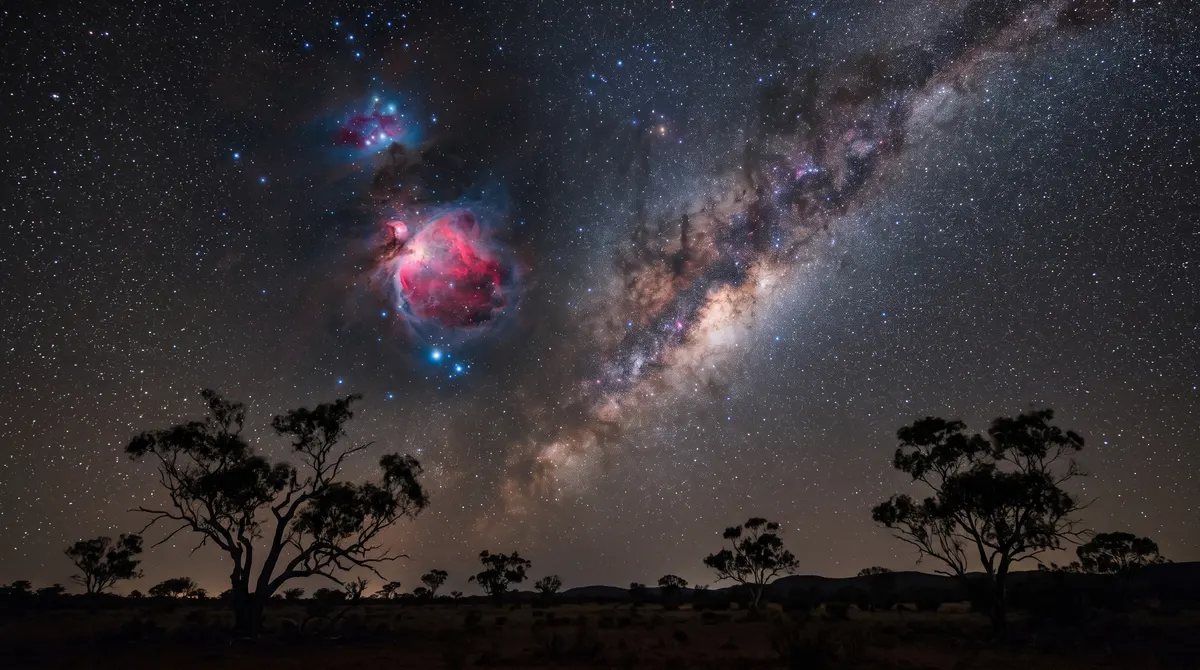
On a clear summer night away from city lights, Australians can find a familiar pattern: the Saucepan. It is the constellation Orion seen upside down from the Southern Hemisphere, the hunter's belt forming the pan and his sword the handle. Look closely at the middle of the handle, especially through binoculars, and one "star" looks wrong. It does not sparkle as a sharp point. It glows as a soft smudge.
That smudge is the Orion Nebula, a vast cloud of gas and dust around 1,300 light years away, and inside it, right now, hundreds of new stars are being born. How that cloud makes stars is how every star in the sky began, including our Sun.
Clouds Between the Stars
"Nebula" comes from the Latin for cloud. It is a cloud of gas and dust between the stars, spread far more thinly than the air in your lungs but spanning dozens or even hundreds of light years, enough material to build thousands of stars. Astronomers sort them by what happens to their light.
Glowing, Reflecting and Blocking Light
An emission nebula, like Orion, shines with its own light. Hot, massive young stars pour out ultraviolet radiation that strips electrons from the cloud's hydrogen, a process called ionisation. When an electron is recaptured, it gives off light of a specific colour, very often a distinctive red called hydrogen-alpha. Countless atoms doing this make the whole cloud glow, powered by its stars like a giant ultraviolet lamp.
A reflection nebula makes no light of its own. Its fine dust scatters light from a nearby star, the way fog makes headlight beams visible. Small particles scatter blue light more readily than red, the same effect that colours our daytime sky, so these nebulae usually look bluish.
A dark nebula is a cloud dense enough to block light completely, appearing as a black shape against brighter stars or gas. The Horsehead Nebula is one. From Australia you can see an example with the naked eye: the Coalsack, a dark patch beside the Southern Cross, a dense cloud in front of the Milky Way's bright starfields that looks like a hole in the sky.
Cold Nurseries and Gravity's Slow Win
The clouds that actually build stars are giant molecular clouds. They are extraordinarily cold, typically only around 10 to 20 degrees above absolute zero, cold enough for hydrogen atoms to pair up into molecules. Their own thick dust shields them from the glare of surrounding stars, keeping them quiet and cold.
Within such a cloud, every particle tugs gravitationally on every other, while gas pressure and churning turbulence push back. Mostly they balance. But in denser pockets, sometimes squeezed by the shockwave of a nearby exploding star or by passage through a galaxy's spiral arm, gravity wins. Once a clump starts collapsing it speeds up, because shrinking makes its gravity stronger.
From Collapsing Clump to Newborn Star
As the clump contracts, it heats up, for the same reason a bicycle pump warms as you compress the air inside. A hot, dense core forms at its centre, called a protostar, an object on its way to becoming a star. Material keeps raining in, often over hundreds of thousands of years, and the core grows hotter and denser.
If enough mass gathers, the centre reaches tens of millions of degrees and nuclear fusion ignites, forcing hydrogen nuclei together into helium and releasing a self-sustaining flood of energy. A star is born. What happens over the rest of its life is the subject of The Life and Death of Stars.
Collapsing clumps usually carry a little spin, and just as tossed pizza dough flattens, a spinning clump flattens into a protoplanetary disc. Leftover dust and gas there gradually clump into planets, moons, asteroids and comets, almost certainly how our own solar system formed.
Why Stars Are Born in Families
A cloud big enough to collapse usually breaks into many clumps at once, each forming a protostar at roughly the same time. So stars are overwhelmingly born in groups, from a handful to many thousands. These families are star clusters, and they come in two kinds with very different fates.
Open clusters are the kind born straight out of clouds like Orion's. They hold anywhere from a few dozen to a few thousand stars, loosely spread out and all about the same age. The Pleiades, the glittering group known in many Aboriginal traditions as the Seven Sisters, is a classic example, its stars formed together roughly a hundred million years ago.
Open clusters are only loosely held by gravity and orbit through the galaxy's busy disc. Encounters with molecular clouds, the pull of the wider galaxy and nudges among their own stars loosen their grip, and typically within a few hundred million years to a billion or so they dissolve. Our Sun, about four and a half billion years old, is thought to have been born in such a cluster, long since scattered so thoroughly that we cannot confidently identify its siblings.
Ancient Swarms That Never Let Go
Globular clusters are altogether different. They pack tens of thousands to several million stars into a roughly spherical region often just tens of light years across, crowded tightly towards the centre. Almost all are extremely old, formed in the early history of our galaxy well over ten billion years ago, some nearly as old as the universe itself.
With so many stars in so small a space, their gravity is enormous, which is why globular clusters have held together for most of the galaxy's history, roaming the sparse halo around its disc. The largest orbiting the Milky Way, Omega Centauri, holds several million stars and is visible to the naked eye from the Southern Hemisphere as a fuzzy patch, a glimpse back towards our galaxy's infancy, a story told in Galaxies – How the Milky Way Was Built.
Pillars, Sculpting and Real Colours
Hot young stars also reshape their nebula. Intense radiation and fast streams of charged particles, called stellar winds, hollow out cavities and evaporate exposed gas. Denser fingers resist longer, which is how the famous Pillars of Creation in the Eagle Nebula formed: columns several light years long, still sheltering star formation in their tips while being whittled away over the next few million years.
So are the colours in those photographs real? Partly. The reds of emission nebulae and the blues of reflection nebulae reflect genuine differences in the light. But many famous Hubble images use the so-called Hubble palette:
- Light from ionised sulphur, hydrogen and oxygen is captured separately through narrow filters.
- Each is assigned to red, green or blue when the image is combined.
- The result reveals structure that would otherwise blur into a reddish haze.
This is not fakery. It is a principled translation of information our eyes could never separate on their own, and reputable observatories say so in their captions.
A Nursery Caught in the Act
Next time you find that soft smudge in the Saucepan's handle, remember what you are seeing: gravity slowly winning over pressure in a cold cloud, the process that built every star in the sky. Somewhere out there, scattered beyond recognition, are the Sun's long-lost siblings, born together in a cluster just like the ones forming tonight.