Talking Science Podcast
The Oort Cloud – The Edge of the Solar System
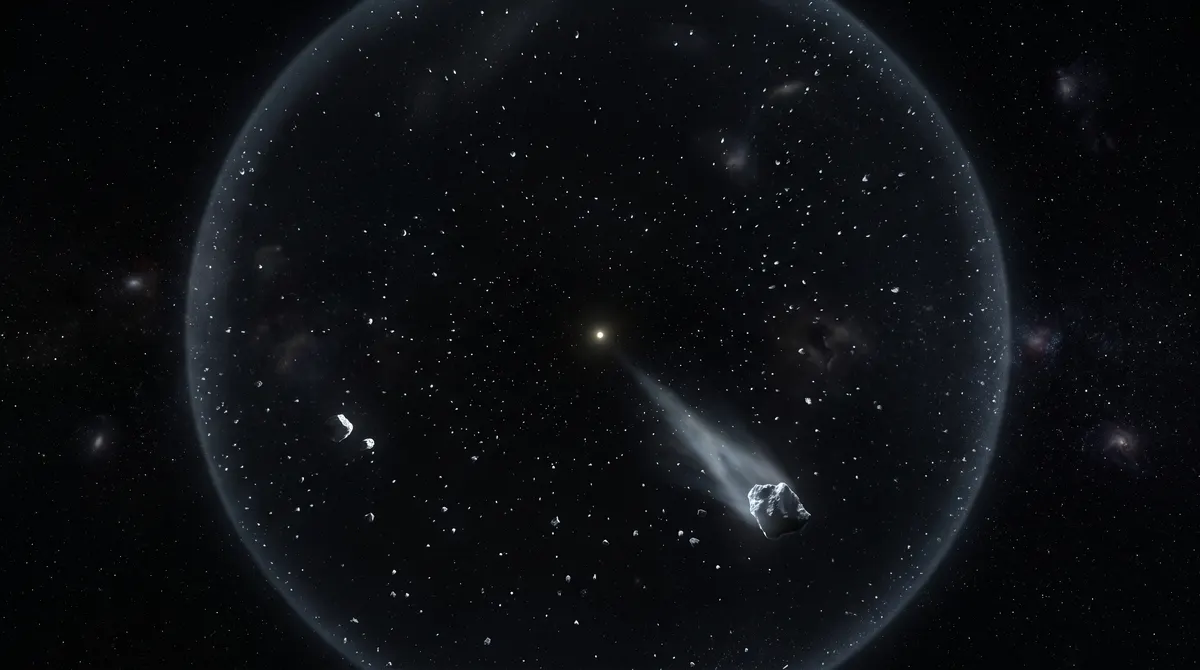
Imagine a relative who visits so rarely that nobody alive has ever met them, yet the family still keeps a chair at the table, because the footprints they leave on each visit are unmistakable. That is roughly our relationship with the Oort Cloud. No telescope has photographed it. No spacecraft has reached it, and none we could build today will in our lifetimes.
Even so, most astronomers are confident it is out there in the frozen dark, because of the trail left by a certain kind of comet that falls in from deep space, loops around the Sun and heads back out on a journey that can take hundreds of thousands of years to repeat. Following those comets leads to the true edge of the solar system, or at least to what most scientists think that edge is.
The Neighbourhood Beyond Neptune
Astronomers measure the outer solar system in astronomical units, or AU, where one AU is the distance from Earth to the Sun. Neptune orbits at about 30 AU. Beyond it lies the Kuiper Belt, a doughnut-shaped band of icy leftovers stretching out to around 50 AU and home to Pluto and many thousands of other icy bodies.
The Kuiper Belt is essentially a flattened disc, an extension of the disc of gas and dust the planets formed from. It supplies most short-period comets, with orbits of a few years to a couple of centuries that stay close to the plane of the planets. Our article on comets and asteroids looks at these wanderers. The Oort Cloud is something else entirely.
A Shell, Not a Disc
The Oort Cloud is thought to be a vast, roughly spherical shell of icy bodies wrapped around the whole solar system, like the skin of an orange but unimaginably thick. Its inner edge may begin somewhere around 2,000 to 5,000 AU from the Sun, and its outer edge may reach 100,000 AU or more, over a light-year and a sizeable fraction of the way to Proxima Centauri, the nearest star.
A scale model helps. If the distance from the Sun to Neptune were shrunk to one centimetre, the outer Oort Cloud would lie something like 30 metres or more away. On that picture, the planets we learn about at school are a tiny cluster at the centre of an enormous, mostly empty sphere.
Detective Work from Comet Orbits
The idea came from long-period comets, those taking more than two hundred years to orbit the Sun. Unlike short-period comets, they arrive from every direction, above, below and every side of the planets' plane, on hugely elongated orbits.
In 1950 the Dutch astronomer Jan Oort, building on earlier suggestions including those of the Estonian astronomer Ernst Öpik, studied the orbits of around twenty long-period comets. Traced backwards, they seemed to come from roughly the same enormous distance whatever direction they arrived from. That pattern is hard to explain without a spherical reservoir of icy material out there, occasionally disturbed into a plunge towards the Sun. Decades of further comets, better calculations and computer models of the young solar system have strengthened the case.
Why Nobody Has Seen It
Oort Cloud objects are thought to be small, mostly a few kilometres across at most, made of frozen water, ammonia and methane mixed with dust and rock. At such distances they reflect only the faintest trace of sunlight, far too little for any current telescope. We only see this material when something nudges a piece inward and sunlight vaporises its ices into a glowing coma and tail.
So the honest description is an extremely well-supported hypothesis, built on consistent and compelling evidence, rather than a directly observed structure like Saturn's rings. The numbers carry wide uncertainty too. Estimates of the population range from many billions to perhaps trillions of objects, and estimates of total mass vary considerably, with some putting it at just a few times the mass of Earth. Spread through such a huge volume, the objects are so sparse that collisions are vanishingly rare.
Nudged In, and Flung Out Long Ago
What dislodges a comet after billions of years? Gravity, working slowly. Every so often, on timescales of millions of years, another star passes relatively close, and even a distant flyby can tug loosely held outer objects, sending some inward and flinging others into interstellar space. The galactic tide, the gentle, constant pull of the rest of the Milky Way, also stirs the outer cloud. Because both effects are gradual and somewhat random, long-period comets arrive one at a time and without warning, and many are seen only once in all of human history.
The leading explanation, backed by simulations, is that these objects did not form way out in the cold. They likely formed much closer in, among the icy building blocks of the giant planets. As those planets grew, their gravity scattered huge amounts of debris, much of it onto vast, looping orbits, which passing stars and the galactic tide later rounded into a shell. Closer in, astronomers have proposed an inner Oort Cloud, sometimes called the Hills cloud, that may slowly resupply the outer shell. A few distant bodies found in recent decades, notably the dwarf planet-sized Sedna, follow orbits in this awkward middle ground and offer rare direct footholds there.
Where Does the Solar System End?
There are two reasonable answers, and mixing them up causes a lot of confusion.
- By the solar wind: the Sun streams out charged particles that inflate a vast bubble called the heliosphere. Where that outflow is overwhelmed by the thin gas between the stars lies the heliopause, around 120 AU away. Voyager 1, launched in 1977, crossed it in 2012, the first spacecraft confirmed to enter interstellar space by this definition.
- By gravity: the Sun's pull has no clean cutoff. It weakens with distance but stays dominant throughout the Oort Cloud, arguably out to where neighbouring stars take over. By this measure the outer Oort Cloud is the true edge.
On the gravitational definition Voyager has barely started. NASA estimates it will take around 300 years to reach the inner edge of the Oort Cloud and perhaps 30,000 years to pass through it, a journey followed in our article on Voyager. In recent years astronomers have also spotted a small handful of genuinely interstellar objects passing through on paths showing they came from other star systems, a separate population from anything bound to the Sun.
Falling Home
The Oort Cloud is science working as it should: reasoning carefully from indirect evidence, staying honest about what is unconfirmed, and leaving room for better data. The next time a bright comet appears in the Australian night sky after a journey longer than recorded history, it may well have come from that unseen shell of frozen leftovers from the solar system's birth, which waited in the dark for billions of years until one small, distant nudge sent it falling towards the Sun.